
In This Article
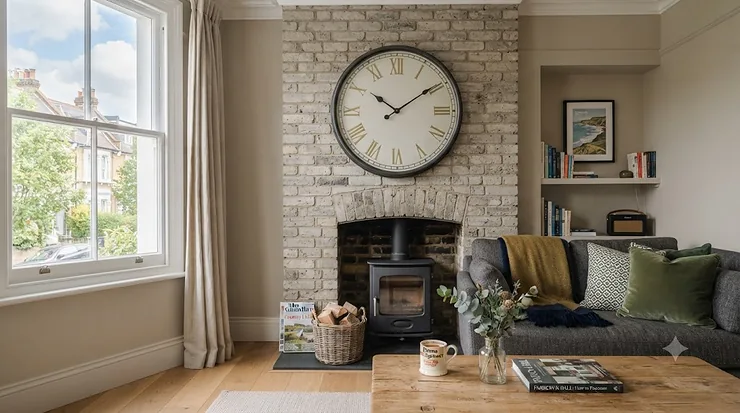
There’s a moment in every home renovation, or every slightly-too-honest look around a bare living room wall, when you realise the space needs an anchor. Not a print. Not another shelf of plants. A clock — but not a fiddly little thing that gets lost above the mantelpiece. Large wall clocks solve a problem that smaller timepieces simply can’t: they read from across the room, they hold their own against a feature wall, and they double as genuine wall art rather than an afterthought. Whether you’re drawn to a stripped-back skeleton design that shows off the mechanism, or a chunky Roman-numeral piece that would look at home in a Victorian railway station, the “big clock” trend has properly landed in UK interiors over the last couple of years.

What is a large wall clock? Broadly, it’s any analogue timepiece with a case diameter of 40cm or more — big enough to function as the focal point of a room rather than a small practical accessory. Anything from 50cm to 60cm and beyond typically falls into “oversized” territory, and it’s this size bracket that dominates search interest and social media styling shots right now.
This guide pulls together real, currently available products sold through amazon.co.uk, weighs up their genuine specs against aggregated customer sentiment, and works through the practical questions that actually matter: how to hang something this heavy without wrecking your plaster, which mechanism type suits a bedroom versus a kitchen, and where the line sits between a design statement and a dust trap. Readers with sight loss in the family may also want to bear size and contrast in mind — the RNIB’s clock range is a useful reference point for what genuinely high-contrast, easy-to-read faces look like, and several of the picks below borrow from that same logic even though they’re not specialist products. Let’s get into it.
Quick Comparison Table
For readers short on time, here’s a snapshot of how the main styles of large wall clock stack up before we go product-by-product.
| Style | Typical Size | Mechanism | Best For |
|---|---|---|---|
| HAITANG Roman Retro Large Wall Clock) | 40–60cm | Quartz, near-silent | Traditional or farmhouse kitchens |
| Wm.Widdop Skeleton Wall Clock) | 45–56cm | Quartz | Industrial, loft-style living rooms |
| Roco Verre Mirror Skeleton Wall Clock) | 45cm | Quartz | Small rooms needing light and depth |
| NEWGATE Mr Clarke Extra Large Wall Clock) | 40cm | Quartz silent-sweep | Studies, home offices, bedrooms |
| Lafocuse Wooden Real Moving Gears Wall Clock) | 58cm | Quartz with cosmetic mechanical gears | Feature walls, conversation pieces |
Looking at the spread above, the split really comes down to noise tolerance and visual weight: silent-sweep and “nearly silent” quartz movements suit bedrooms and studies, while the bolder skeleton and moving-gears styles are built to be looked at rather than ignored, which matters less in a room you’re trying to fall asleep in. Price generally tracks complexity of finish rather than size alone — a plain 60cm metal-faced clock can undercut a smaller, more heavily detailed skeleton design.
💬 Just one click — help others make better buying decisions too!😊
Top 7 Large Wall Clocks: Expert Analysis
Below is the full specification comparison for the seven clocks covered in this guide, followed by individual breakdowns of each
1. NEWGATE Mr Clarke Extra Large Wall Clock — Scandi minimalism from a proper British clockmaker
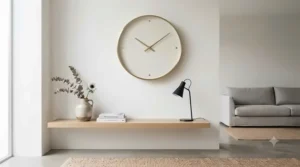
The standout here is the material honesty: a genuine pale plywood case rather than a printed plastic imitation, which changes how the clock ages and how it catches light. Newgate has been designing clocks in Britain for over 35 years, and this model uses a quartz “silent-sweep” movement, meaning the second hand glides continuously rather than stepping with an audible tick — in practice this means no ticking, though a faint whirring can be noticeable in a completely silent bedroom. The 40cm case sits at the smaller end of what counts as “large” but reads bigger than its diameter thanks to the minimalist dial with no crowding of numerals. This is the pick for buyers who want understated Scandinavian styling over an ornate statement piece — home offices, studies and reading nooks are the natural fit, and it works particularly well against pale or neutral walls where a busier skeleton design would feel like too much. Reviewers consistently note that the plywood construction feels considerably more solid than typical mass-market plastic wall clocks at a similar price, and that the silent-sweep mechanism genuinely does eliminate ticking noise, which is the single most common complaint about cheaper analogue clocks. A recurring theme in feedback is that the natural wood grain varies slightly between units — this is a feature of real timber rather than a defect, but it’s worth knowing before you order if you want an exact colour match to existing furniture.
Pros:
- ✅ Genuine plywood case with real timber grain
- ✅ Silent-sweep movement eliminates ticking noise
- ✅ British brand with 35+ years of clockmaking history
Cons:
- ❌ 40cm is the smallest “large” option on this list
- ❌ Wood grain and colour vary slightly unit to unit
Prices for the Mr Clarke sit around £50-£70 at the time of research, and given the material quality on show, this represents solid value for anyone prioritising design pedigree over sheer size — check current price and stock before buying.
2. HAITANG Roman Retro Large Wall Clock 60cm — best value for genuinely oversized scale
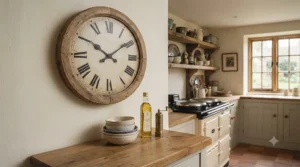
What immediately stands out about this clock is the sheer footprint you get for the outlay: a 60cm metal case with bold gold Roman numerals, sold in multiple sizes (40cm, 47cm and 60cm) so buyers can size up or down depending on wall space. The metal construction gives it more heft and rigidity than the moulded-plastic clocks that dominate the budget end of Amazon’s wall clock category, and the quartz movement is described as “nearly silent” with only a faint tick rather than true silent-sweep. Based on the spec comparison with pricier options on this list, the trade-off here is finish detail rather than durability — you’re not getting the tactile plywood or acrylic gloss of the premium picks, but you are getting genuine scale for under £40. This is the clock for anyone who wants a farmhouse or traditional kitchen focal point without spending on the design-brand premium that names like Newgate or Roco Verre command. Aggregated reviewer sentiment on this range is generally positive regarding size and visual impact, with the gold Roman numerals against a contrasting face praised repeatedly for legibility from across a room; some reviewers note the ticking is more audible than “silent” marketing suggests, so light sleepers should factor that in for a bedroom placement.
Pros:
- ✅ Full 60cm size available at a budget price point
- ✅ Sturdy metal case rather than moulded plastic
- ✅ Bold, high-contrast Roman numerals read well from distance
Cons:
- ❌ “Nearly silent” movement still has an audible tick
- ❌ Fewer finish options than premium competitors
At under £40 for a 60cm clock, this is arguably the best pounds-per-centimetre buy on this list — a strong option for a first statement piece if you’re not yet sure large-format clocks are right for your space.
3. Shoze Vintage Large Black Wall Clock 60cm — skeleton styling at an entry-level price
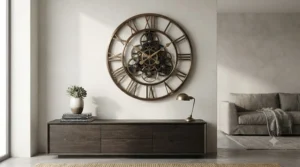
The standout feature here is combining two trends — oversized scale and skeleton openwork — in one sub-£45 product, which is genuinely difficult to find elsewhere in this category. A 60cm round black frame with Roman numerals and an open, silent skeleton dial creates the industrial-loft look that would typically command a much higher price from boutique clockmakers. What most buyers overlook about skeleton-style clocks like this one is that the “openness” of the design means the wall colour behind the clock becomes part of the finished look — a dark clock against a pale wall reads very differently to the same clock against exposed brick or a dark accent wall, so it’s worth picturing your actual wall before ordering. The battery-operated quartz movement is marketed as silent, and aggregated feedback broadly supports that claim for daytime use, though as with most budget skeleton clocks, the thinner frame construction means it benefits from secure wall fixings rather than a single picture hook given its 60cm span and the weight distribution around the rim. This is the clock for hallways, open-plan living spaces or anyone wanting the “statement industrial clock” Pinterest look without the boutique price tag.
Pros:
- ✅ 60cm skeleton design at a genuine budget price
- ✅ Bold silhouette suits industrial and loft-style interiors
- ✅ Quiet movement suitable for most living spaces
Cons:
- ❌ Thinner frame needs secure, load-rated wall fixings
- ❌ Open design means wall colour heavily affects the look
Priced under £45 in most listings, this is the clock to compare directly against the two Roco Verre skeleton options below if budget is the deciding factor rather than brand provenance.
4. Roco Verre Mirror Skeleton Wall Clock (45cm) — the pick for smaller or darker rooms
The standout advantage of this clock is the mirrored acrylic finish, which does something the matt-finish clocks on this list can’t: it bounces light back into the room, making it a genuinely useful design tool in a north-facing hallway or a boxy spare room rather than purely decorative. At 45cm it’s more compact than the 56-60cm entries, which suits smaller wall spaces where a full 60cm piece would overwhelm the proportions of the room. Here’s what to weigh with mirror-finish clocks specifically: they show fingerprints and dust more readily than matt metal or wood, so they need a touch more upkeep to keep that reflective quality looking sharp — this is a genuine trade-off for the light-bouncing benefit, not a flaw to ignore. The skeleton dial design is consistent with the wider trend on this list, but the mirror backing sets it apart visually from the black-frame competitors. Reviewers regularly highlight the “bigger than expected” visual impact the mirror finish creates on a wall, and note that it photographs particularly well for anyone styling a room for social media or a property listing, though a small number mention that the acrylic can show light scratching if cleaned with an abrasive cloth rather than a soft one.
Pros:
- ✅ Mirror finish reflects light into darker rooms
- ✅ More compact 45cm size suits smaller walls
- ✅ Distinctive look versus matt-finish competitors
Cons:
- ❌ Shows fingerprints and dust more than matt finishes
- ❌ Acrylic can scratch if cleaned incorrectly
At around £60-£90, this sits in the mid-range bracket, and the light-reflecting quality genuinely justifies the premium over the budget skeleton picks if your room lacks natural light.
5. Wm.Widdop Skeleton Wall Clock 50cm (Black) — the balanced mid-range statement piece
What stands out on the spec sheet is the combination of a 50cm circular skeleton frame with oversized Roman numerals in a contrasting metallic tone — a deliberate design choice that keeps the clock readable even with the open-frame structure that skeleton clocks are prone to sacrificing legibility for. Wm.Widdop is a long-established British homeware brand, and this model’s slim gold-tone hands are specifically designed to stay visible against the black backdrop rather than disappearing into the open framework, which is a common complaint with cheaper skeleton designs. Based on the spec comparison with the two Roco Verre entries, this sits as the middle ground: bigger than the mirror skeleton clock, more affordable than the acrylic gloss option, and without the light-reflective quirks either brings. The vertical black panel running through the centre of the design, which subtly houses the branding, adds a structural element that most flat-faced clocks lack. This is the pick for buyers who want the industrial skeleton aesthetic as a genuine feature wall centrepiece in a hallway, living room or office reception area, and reviewers of the Wm.Widdop skeleton range consistently note the impressive scale and the “impossible to miss” quality of the finished look once mounted, alongside comments about the straightforward battery-fitting process.
Pros:
- ✅ 50cm size balances scale with proportional readability
- ✅ Contrasting gold hands stay visible against the frame
- ✅ Established British homeware brand backing
Cons:
- ❌ Open design means no glass protection for the face
- ❌ Black finish shows dust more visibly than lighter tones
Expect to pay in the £45-£65 range, making this a genuine middle option between the entry-level skeleton clocks and the two Roco Verre pieces on this list.
6. Lafocuse Wooden Real Moving Gears Wall Clock (23 Inch) — the premium conversation-starter
The defining feature is right there in the name: unlike the cosmetic skeleton dials elsewhere on this list, this 58cm wooden clock incorporates genuinely moving decorative gears as part of the face design, creating a steampunk-adjacent visual effect that none of the other six products attempt. What the spec sheet won’t tell you, but the design implies, is that this is not a clock for minimalists — it’s aimed squarely at buyers who want their wall clock to function as a talking point rather than blend into the background. The wooden construction gives it a warmer visual tone than the metal and acrylic skeleton clocks, which suits rustic, farmhouse or eclectic-maximalist interiors better than the colder industrial look of the black skeleton pieces. As the most expensive product in the Lafocuse large-clock range, priced around £70-£85, it commands a premium that’s justified by the additional moving-parts engineering rather than by size alone, since the HAITANG 60cm clock is actually larger for roughly half the cost. Reviewers consistently single out the moving-gears mechanism as the reason for purchase, describing the visual novelty as the main draw, while a smaller number flag that the intricate face design makes the clock slightly harder to read at a glance compared with a simpler numeral layout — a fair trade for buyers prioritising personality over pure function.
Pros:
- ✅ Genuinely moving decorative gears, not just a static print
- ✅ Warm wooden tone suits farmhouse and eclectic interiors
- ✅ Distinctive design with no close equivalent on this list
Cons:
- ❌ Intricate face is slightly harder to read at a glance
- ❌ Premium price relative to its 58cm size
At around £70-£85, this is priced for design impact rather than raw scale — a strong pick specifically for buyers who want a clock people ask about.
7. Roco Verre Acrylic Gloss Skeleton Roman Wall Clock (56cm, Orange) — the boldest colour statement
The standout advantage here is colour: a high-gloss acrylic skeleton case in a genuinely saturated orange, available across five gloss finishes including white, red, black and silver, which none of the more muted metal or wood clocks on this list can match. At 56cm with Roman numerals set within the open skeleton structure, it delivers scale and drama simultaneously, and the UK-based manufacturing (Roco Verre products are made in Britain) adds a domestic-production angle that some buyers specifically look for over imported alternatives. Here’s what most buyers overlook about high-gloss acrylic: the reflective sheen means the clock changes character throughout the day as light hits it differently, giving it more visual dynamism than a matt-finish equivalent, but also meaning it needs a prominent, unobstructed wall to earn its keep — this isn’t a clock for a shadowy corridor corner. It’s a natural pairing with mid-century modern or maximalist colour-block interiors where the clock is meant to anchor a colour scheme rather than recede into it. Aggregated review sentiment for the Roco Verre acrylic range highlights the vividness of the gloss colours as consistently exceeding photographs, alongside praise for the lightweight acrylic build making installation more manageable than the equivalent-sized metal clocks, with occasional comments about the acrylic warping slightly if hung in direct, sustained sunlight.
Pros:
- ✅ Genuinely vivid gloss colour options, including bold orange
- ✅ UK manufacturing behind the Roco Verre brand
- ✅ Lightweight acrylic build simplifies installation
Cons:
- ❌ Best suited to feature walls, not shaded corners
- ❌ Acrylic can warp with prolonged direct sunlight exposure
Priced around £70-£95, this is the clock for buyers who’ve already committed to a bold colour scheme and want the clock to lead the room rather than support it.
Practical Usage Guide: Installing and Living With a Large Wall Clock
Getting a large wall clock onto the wall safely is the part most product listings skip entirely, yet it’s where most buyer regret actually starts. Before drilling anything, weigh the clock (including its packaging weight as a rough guide) and identify your wall type — plasterboard, masonry or a mix of both around door frames. Anything over roughly 1.5kg, which covers most of the metal and glass clocks on this list, genuinely benefits from a wall anchor or toggle fixing rather than a single picture hook, particularly for the wider 56-60cm pieces where the weight sits further from the centre point and creates more leverage on the fixing. For plasterboard walls, a self-drilling plasterboard anchor rated for at least double the clock’s actual weight gives a sensible safety margin; for masonry, a standard wall plug and screw is usually sufficient given how light most quartz wall clocks are relative to their visual size. Once mounted, set the time and check it against a phone or radio-controlled reference, since basic quartz movements can drift by a few seconds a month and will need occasional resetting rather than being a true “set and forget” purchase.
In the first 30 days, the most common mistake is under-estimating how much a 50-60cm clock changes the visual balance of a room once it’s actually up — many buyers report moving the clock to a different wall entirely after living with the original placement for a week or two, so it’s worth holding a paper template of the clock’s diameter against the wall before committing to drill holes. Skeleton and mirror-finish designs also benefit from a light dusting with a soft, dry cloth every couple of weeks, since their open structure and reflective surfaces show dust more obviously than a solid, matt clock face.
Real-World Scenarios: Which Large Wall Clock Suits You?
Picture a few different buyers browsing this same category. A graduate renting their first flat, working with a small living room and a tight budget, is generally best served by something like the HAITANG Roman Retro Large Wall Clock — it delivers genuine 60cm scale without the outlay of a design-brand piece, and its metal construction survives the inevitable house-move better than a delicate acrylic alternative. A homeowner renovating a north-facing hallway with limited natural light has a different problem entirely: wall space isn’t the constraint, brightness is, which makes the Roco Verre Mirror Skeleton Wall Clock a genuinely functional choice rather than just a stylistic one, since the mirrored finish actively bounces available light back into the space. Meanwhile, someone furnishing a home office who wants a clock that supports focus rather than competing for attention should lean toward the NEWGATE Mr Clarke Extra Large Wall Clock, where the pale plywood and silent-sweep movement stay visually and audibly out of the way during video calls and deep work sessions. Finally, a buyer decorating an open-plan kitchen-diner as the “statement” room of the house — the space guests actually spend time in — is the ideal audience for either the Lafocuse Wooden Real Moving Gears Wall Clock or the Roco Verre Acrylic Gloss Skeleton Roman Wall Clock, both designed to be looked at and talked about rather than quietly ignored above a sideboard.
Problem → Solution: Fixing Common Large Wall Clock Headaches
A handful of issues come up repeatedly with oversized wall clocks, and most have straightforward fixes. Clock looks smaller than expected on the wall: this almost always comes down to skipping the paper-template step before ordering — cut a circle of newspaper to the exact diameter and tape it up first, because a 45cm clock reads very differently on a 4-metre wall than it does in a product photo. Ticking is more noticeable than the listing implied: budget quartz movements marketed as “silent” or “nearly silent” still produce a faint mechanical tick that becomes obtrusive in a genuinely quiet bedroom; a true silent-sweep movement, like the one used in the NEWGATE Mr Clarke clock, is the fix if noise is a dealbreaker rather than a minor annoyance. Clock has started running slow or fast: this is standard quartz drift rather than a fault, and simply resetting the time monthly against a phone resolves it — if drift becomes severe or sudden, it usually signals a battery running low rather than a mechanical fault. Skeleton or mirror clock looks cluttered with dust or fingerprints faster than expected: switch to a soft microfibre cloth used dry, since household glass cleaners can degrade acrylic surfaces over time and leave a hazy finish. Clock feels unstable or has shifted slightly on the wall: this points to an under-rated fixing for the clock’s actual weight, and the fix is a proper wall anchor rated for at least double the clock’s weight rather than a standard picture hook, particularly for anything at 50cm or above.
✨ Ready to Find Your Statement Piece?
🔍 Compare current prices on any of the seven clocks above and check today’s availability before you commit — stock and pricing on statement homeware pieces can shift quickly during peak home-styling months.
How to Choose Large Wall Clocks
Working through a large wall clock purchase methodically avoids most of the buyer’s remorse covered in the section above. Here’s the process, step by step:
- Measure the actual wall space first. Not the room — the specific wall section, accounting for furniture, doorframes and light switches that will constrain how large a clock can realistically sit.
- Decide on movement type before style. If the clock is going in a bedroom or quiet study, prioritise a silent-sweep or genuinely low-tick quartz movement over a design you love that ticks audibly.
- Match the finish to your light levels. Mirror and gloss acrylic finishes actively help darker rooms; matt metal and wood suit bright, naturally lit spaces where reflections would be distracting.
- Check the weight and fixing requirements. Anything over roughly 1.5kg, especially at 50cm-plus, needs a wall anchor rather than a single hook — factor this into your buying decision, not just your installation day.
- Consider maintenance realistically. Skeleton and gloss finishes look striking but need more frequent dusting than a flat, matt clock face — be honest about how often that cleaning will actually happen.
- Read the aggregated review themes, not just the star rating. A 4.3-star average tells you less than repeated comments about a specific mechanism issue or sizing surprise.
- Compare price per centimetre against design premium. As shown in the comparison table above, a budget 60cm clock and a premium 45cm clock can cost roughly the same — know which you’re actually paying for.
Oversized Wall Clocks 60cm Reviews: What the Data Actually Shows
The 60cm bracket is where “large wall clock” search interest concentrates most heavily, and it’s worth being specific about what buyers are actually reporting at this size. Both 60cm entries on this list — the HAITANG Roman Retro Large Wall Clock and the Shoze Vintage Large Black Wall Clock — sit at genuinely budget price points, which tells you something important about this size bracket: at 60cm, manufacturing cost scales more with material choice (metal versus acrylic versus wood) than with diameter alone, since the movement itself, hands and battery compartment cost roughly the same regardless of how large the face is. Reviewers consistently note that clocks at this size dramatically outperform smaller 30-40cm alternatives in terms of “focal point” impact, particularly in open-plan living spaces or above a fireplace, but the aggregated feedback also flags a genuine pattern worth knowing before you buy: several buyers across both 60cm products report needing a helper to hold the clock steady while marking fixing points, simply due to the physical size of the item rather than any design flaw. What the spec sheets won’t tell you outright, but review patterns confirm, is that 60cm clocks read clearly from considerably further away than smaller pieces — useful in open-plan kitchen-diners where the clock might be viewed from 4-5 metres rather than up close, which is precisely the scenario where a 30cm clock’s numerals become illegible.
Skeleton Wall Clocks UK: A Style Deep-Dive
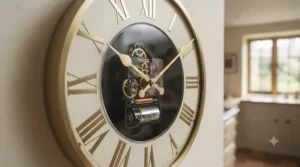
Skeleton wall clocks — designs that expose an open frame rather than a solid backing behind the numerals and hands — have become one of the fastest-growing sub-categories within large wall clocks on the UK market, and three of the seven products in this guide fall into that bracket: the Shoze Vintage Large Black Wall Clock, the Roco Verre Mirror Skeleton Wall Clock and the Wm.Widdop Skeleton Wall Clock. What ties them together, and what genuinely matters when comparing skeleton designs against each other, is how well the hands and numerals contrast against whatever’s visible through the open frame — since there’s no solid backing, the wall colour behind the clock effectively becomes part of the design. Based on the spec comparison across these three, the Wm.Widdop model addresses this most deliberately with its vertical black panel providing a consistent visual anchor regardless of wall colour, while the Roco Verre Mirror version sidesteps the issue entirely by reflecting the room back rather than showing the wall through it. Reviewers consistently note that skeleton clocks photograph exceptionally well for interior styling purposes — the open structure catches light and shadow in a way flat-faced clocks don’t — though the trade-off, mentioned consistently across aggregated feedback, is that thinner-framed skeleton designs need more careful, load-rated wall fixing than their solid-backed equivalents given the weight distribution around an open rim.
Statement Clock Styles Compared
Beyond the skeleton trend, “statement” large wall clocks broadly split into three visual camps worth understanding before you buy: bold-colour acrylic gloss (the Roco Verre Acrylic Gloss Skeleton Roman Wall Clock in orange), warm novelty mechanisms (the Lafocuse Wooden Real Moving Gears Wall Clock), and understated material-led minimalism (the NEWGATE Mr Clarke Extra Large Wall Clock). Interior styling commentary consistently points to sculptural, personality-driven statement pieces as a defining feature of UK home decor right now, and the 2026 home decor trend coverage from Ideal Home specifically highlights sculptural, retro-inspired statement pieces with elevated detailing as a dominant direction this year — a trend that maps directly onto the moving-gears and gloss-acrylic clocks covered here. The practical distinction for buyers is less about which looks best in isolation and more about role: a gloss acrylic statement clock is designed to lead a room’s colour scheme, a moving-gears piece is designed to be a conversation starter up close, and a minimalist plywood clock is designed to support a calmer overall look rather than dominate it. None of these is objectively “better” — the right choice depends entirely on whether the room already has a strong personality the clock needs to complement, or a blank canvas the clock is meant to define.
Large Clock Mechanisms Explained
Every clock on this list runs on a quartz movement, but “quartz” covers a wider range of real-world behaviour than the single word suggests, and understanding the differences genuinely changes which of the seven products suits a given room. Standard quartz movements, like those used in the HAITANG and Shoze clocks, work by using a battery-powered electrical charge to vibrate a small quartz crystal at a precise, consistent frequency; this vibration drives a stepping motor that advances the second hand roughly once per second, producing the familiar audible tick, as explained in more technical detail on Wikipedia’s overview of quartz clock movements. Silent-sweep quartz movements, used in the NEWGATE Mr Clarke clock, take the same underlying crystal-oscillator technology but drive the second hand continuously rather than in discrete steps, eliminating the tick at the cost of an occasional faint whirring sound in a completely silent room. The “moving gears” mechanism in the Lafocuse clock is a separate, cosmetic layer: a genuine quartz movement still keeps time, but additional decorative gears are engineered to visibly turn as a design feature, adding mechanical complexity without changing the underlying accuracy, which — as with all consumer quartz movements — typically sits within a few seconds of drift per month. What most buyers overlook is that skeleton and moving-gears designs are not “mechanical” clocks in the traditional watchmaking sense, despite the visual impression; they’re quartz movements with an exposed or embellished aesthetic, which means maintenance stays as simple as an occasional battery change rather than the winding and servicing that genuine mechanical movements require.
Oversized Timepieces vs Standard Wall Clocks
The comparison table below sets out where oversized timepieces genuinely outperform standard-sized wall clocks, and where a smaller clock remains the more sensible choice.
| Factor | Oversized (45cm+) | Standard (up to 30cm) |
|---|---|---|
| Room impact | Functions as wall art / focal point | Purely functional, blends into decor |
| Readability from distance | Clear from 4-5 metres | Best within 2-3 metres |
| Installation | Needs load-rated wall fixings | Standard picture hook usually sufficient |
| Price range | £25-£95+ depending on finish | Typically £10-£30 |
| Best For | Statement walls, open-plan spaces, feature areas | Kitchens, bathrooms, small hallways |
The table makes clear that size isn’t simply a scaled-up version of the same purchase decision — an oversized clock changes category entirely, from a purely functional item to a piece of wall art that happens to tell the time. For smaller rooms or purely practical spaces like a utility room or a compact bathroom, a standard-sized clock remains the sensible choice both financially and proportionally; oversized clocks earn their premium specifically in rooms where the wall space and sightlines can support a genuine focal point, such as an open-plan living-dining area or a hallway with a long uninterrupted wall run.
Common Mistakes When Buying Large Wall Clocks
The single most frequent mistake, based on aggregated review patterns across this category, is buying on diameter alone without accounting for how the clock will actually read against the wall’s colour and the room’s existing focal points — a striking product photo doesn’t guarantee the same impact once mounted three metres up on your particular wall. A close second is underestimating installation requirements: treating a 3-4kg skeleton or metal clock like a standard picture-hook job rather than checking its actual weight and choosing an appropriately rated fixing, which is the single most common cause of a clock working loose within the first few months. Buyers also regularly overlook movement noise until after purchase, assuming “silent” marketing claims mean genuinely silent rather than reduced-tick, which becomes a real issue specifically in bedrooms and studies. Finally, a subtler mistake is choosing a finish (particularly gloss acrylic or mirror) based purely on aesthetics without considering the room’s light exposure and cleaning routine — these finishes reward rooms with indirect light and regular light dusting, and can disappoint in direct sun or low-maintenance households.
Long-Term Cost & Maintenance
| Consideration | Budget Clocks (e.g. HAITANG, Shoze) | Premium Clocks (e.g. Lafocuse, Roco Verre Gloss) |
|---|---|---|
| Upfront price | Under £45 | £70-£95 range |
| Battery running cost | 1x AA battery, roughly annual replacement | Same — movement type doesn’t change running cost |
| Maintenance | Occasional dusting | More frequent dusting for gloss/mirror finishes |
| Expected lifespan | Several years with case care | Similar, provided away from direct sun |
| Best value scenario | First large clock, rental homes | Long-term feature wall in a permanent home |
Running costs across this entire category are genuinely low and barely differ by price bracket — every clock here uses a single AA battery replaced roughly once a year, so the real long-term cost difference comes down to durability of finish and how well the clock survives its environment rather than ongoing spend. Budget metal and plywood clocks generally hold up well with minimal care, while gloss acrylic and mirror finishes need a slightly more consistent cleaning routine to keep their visual edge, and should be kept out of direct, prolonged sunlight to avoid the warping some reviewers report. For renters or anyone who moves frequently, the lower upfront cost of the budget picks makes more financial sense than investing in a premium piece that may not suit the next property’s wall space.
Safety, Regulations and Wall-Mounting Compliance
Battery-powered wall clocks fall under standard UK consumer electronics and battery disposal rules rather than any specialist regulation, but a few practical compliance points are worth knowing. All the clocks on this list run on standard AA batteries, which under UK law must never be placed in general household waste; the crossed-out wheelie bin symbol on the packaging indicates they need to go to a proper battery recycling point, and full guidance on this is set out on GOV.UK’s consumer battery recycling page. From a physical safety standpoint, the main consideration is genuinely the wall fixing rather than the clock’s electronics: any product mounted above head height and weighing more than a kilogram or so should use a fixing rated for at least double the item’s actual weight, particularly in households with young children or pets where an insecurely mounted clock poses a real falling hazard. UKCA marking, which replaced CE marking for goods sold in Great Britain, should be present on the packaging of compliant electrical and battery-powered homeware; it’s worth a quick check on the listing or packaging before purchase, particularly with lesser-known sellers, as a basic indicator that the product has met UK safety requirements for its category.
Frequently Asked Questions
❓ How big should a large wall clock be for a living room?
❓ Are skeleton wall clocks harder to read than standard clocks?
❓ Do large wall clocks tick loudly?
❓ What wall fixing do I need for a large wall clock?
❓ How much does a good large wall clock cost in the UK?
Conclusion
Choosing between these seven clocks really comes down to answering three questions honestly: how large is the wall space you’re actually working with, how much noise can the room tolerate, and whether you want the clock to lead the room’s design or support it quietly in the background. Budget-conscious buyers chasing genuine scale should look first at the HAITANG Roman Retro Large Wall Clock or the Shoze Vintage Large Black Wall Clock, both delivering full 60cm impact for under £45. Anyone furnishing a bedroom or study where ticking matters should prioritise the NEWGATE Mr Clarke Extra Large Wall Clock and its silent-sweep movement over the louder budget alternatives. For rooms that need extra light or a genuine talking point, the Roco Verre Mirror Skeleton Wall Clock, the Roco Verre Acrylic Gloss Skeleton Roman Wall Clock and the Lafocuse Wooden Real Moving Gears Wall Clock each bring something the more understated picks can’t. And for a dependable middle ground with British homeware heritage behind it, the Wm.Widdop Skeleton Wall Clock balances scale, price and design confidently. Whichever direction you go, measure the wall properly, check the fixing requirements against the actual weight, and be honest with yourself about how much ticking noise or dusting upkeep you’re genuinely willing to live with — get those three things right and any of the seven clocks above should serve the room well for years.
✨ Don’t Miss These Exclusive Deals!
🔍 Take your living space to the next level with any of the seven large wall clocks covered above. Click through to check current pricing and availability before stock or prices shift, and give your walls the focal point they’ve been missing.
Recommended for You
- Best Arched Mirrors UK 2026: 7 Top Picks Compared
- 7 Affordable Venetian Style Mirrors That Don’t Look Cheap (2026)
- 7 Best Venetian Mirrors UK 2026: Stunning Styles Reviewed
Disclaimer: This article contains affiliate links. As an Amazon Associate, I earn from qualifying purchases. If you purchase products through these links, we may earn a small commission at no additional cost to you.
✨ Found this helpful? Share it with your friends! 💬🤗
