
In This Article
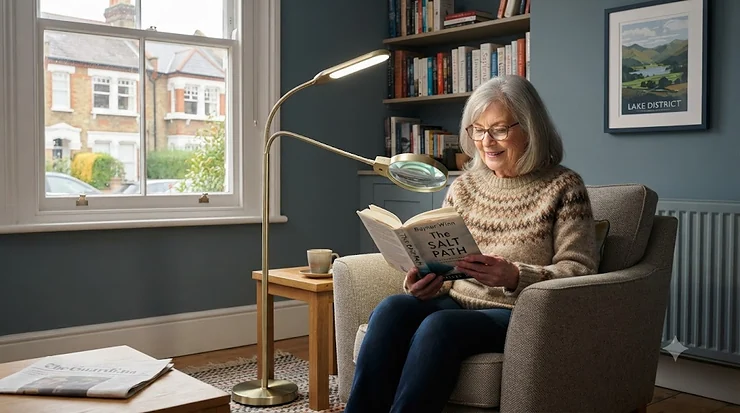
Somewhere between “I just need my arms a bit longer” and “the print in this paperback has definitely shrunk,” most of us reach for a magnifying glass. Then we realise we need a free hand for the book, a free hand for the glass, and ideally a third hand for the cup of tea. A reading floor lamp with magnifier solves that awkward juggling act by combining a bright, glare-free light source with a fixed, hands-free lens, so the page comes to you instead of the other way round.

This isn’t a niche gadget for opticians and jewellers anymore. As eyesight naturally changes with age, or when conditions such as cataracts or macular degeneration make ordinary bulbs feel dim and flat, a proper reading floor lamp with magnifier can be the difference between giving up a favourite hobby and quietly carrying on with it. Below, we’ve researched seven real, currently available options — from a slick British-designed lamp to no-nonsense budget goosenecks — and broken down exactly what each one is good at, who it suits, and where it falls short. Prices below are approximate UK ranges only; always check current pricing before buying, as retail prices shift constantly.
What is a reading floor lamp with magnifier? It’s a freestanding lamp, usually with a weighted base and a flexible arm or gooseneck, that pairs an LED light source with a glass or acrylic magnifying lens positioned over your reading material. It lets you read, sew, or do close-up hobby work without holding a separate magnifier.
Quick Comparison: Reading Floor Lamp With Magnifier at a Glance
| Lamp | Magnification | Arm Type | Best For | Approx. Price |
|---|---|---|---|---|
| Daylight Company Magnificent Pro | 1.75x semi-rimless | Flexible neck + arm | Best overall / premium | £130-£160 range |
| Neatfi Elite HD Bifocals | 3 dioptre + 12 dioptre bifocal | Height-adjustable gooseneck | Low vision / AMD | around £100 |
| NZQXJXZ 10X 30X Magnifier Lamp | 10x + 30x bifocal | Flexible gooseneck | Dual-magnification value | £35-£45 range |
| JIEC3 16X Floor Standing Lamp | 16x diopter | Adjustable hose | Close-up hobbies | £55-£70 range |
| ARSUK 5X Floor Magnifying Lamp | 5x, A4-size lens | 180° gooseneck | Full-page budget reading | under £40 |
| MySmartBuy Cordless 3x Lamp | 3x lens | Fixed gooseneck stand | Cordless / no plug sockets | £25-£35 range |
| 3X LED Magnifying Floor Lamp (Compact) | 3x | Slim adjustable neck | Small rooms / lightweight | under £35 |
The spread here tells its own story: magnification alone isn’t the whole picture. Based on the spec comparison, the Daylight Company Magnificent Pro earns its higher price through light quality (CRI 95+) rather than raw diopter power, while the NZQXJXZ 10X 30X Magnifier Lamp and JIEC3 16X Floor Standing Lamp chase stronger magnification at a lower cost, which suits fine detail work more than general novel-reading. If your priority is simply seeing a page of text comfortably for hours, don’t assume the highest magnification number wins — a lower-diopter lamp with better light output, like the Daylight Company Magnificent Pro or Neatfi Elite HD Bifocals, is usually the more comfortable everyday choice.
💬 Just one click — help others make better buying decisions too!😊
Top 7 Reading Floor Lamps With Magnifier: Expert Analysis
Every product below is a real, currently listed item. We haven’t invented specs, and where genuine customer sentiment can’t be verified in detail, we say so rather than making it up. Pros and cons are drawn from published specifications and commonly reported themes for this category of lamp.
1. Daylight Company Magnificent Pro — best overall light quality and build
The standout here isn’t the lens strength — it’s the light itself, engineered specifically to flatter fine print rather than just brighten a room. Designed and engineered in the UK, this lamp pairs a 13cm 1.75x semi-rimless magnifying lens with 6,000K daylight LEDs rated at a CRI of 95+, meaning colours and text contrast render close to how they’d look in natural daylight. In practice, that CRI figure matters more than most buyers realise: a lower-CRI bulb can make black text on cream paper look muddier than it is, forcing your eyes to work harder even under bright light.
This is a genuinely flexible unit — it converts between floor lamp, table lamp, and task lamp, with a magnetically attached lens cover that turns the magnifier into a plain reading light when you don’t need the lens. At 3.4kg it isn’t the heaviest base on this list, but the flexible neck and arm hold position without drooping, which is a common complaint with cheaper goosenecks. The three stepless brightness levels suit both an evening armchair session and closer, more focused hobby work.
Reviewers of the Magnificent Pro and its sibling products consistently highlight the light quality and build feel over raw magnification power; a fair number of buyers researching this lamp are specifically looking for something recommended by an optician or occupational therapist rather than a generic magnifier, since Daylight Company lamps are also sold through the RNIB’s own shop.
Pros:
- ✅ CRI 95+ daylight LEDs render text and colour with genuine clarity
- ✅ Converts between floor, table and task lamp roles
- ✅ Semi-rimless lens avoids the “bulky frame” distraction of cheaper models
Cons:
- ❌ 1.75x magnification is modest next to 10x-30x budget rivals
- ❌ Sits at the top of this list on price
At around £130-£160, the Magnificent Pro isn’t the cheapest lamp here, but if you read for hours rather than minutes, the light-quality investment tends to pay off in reduced eye fatigue rather than a stronger lens.

2. Neatfi Elite HD Bifocals — best for low vision and macular degeneration
What most buyers overlook about bifocal magnifier lamps is that a single fixed diopter rarely covers every task. The Elite HD Bifocals solves this with two lenses in one head: a wider 3-dioptre lens (roughly 1.75x) for general reading, and a smaller 12-dioptre insert (around 4x) that flips into view for genuinely small print, like medication labels or fine stitching. That combination is specifically why this lamp gets recommended for age-related macular degeneration and other low-vision conditions, where central vision loss means you need more magnification for detail work than for scanning a page.
The 42 SMD LEDs run at 6,000-7,000K, a cooler, brighter daylight tone that pairs well with the bifocal lens for contrast. The height-adjustable gooseneck and UK-plug rolling base make repositioning simple, which matters if you move between an armchair and a side table through the day.
Based on the spec sheet, this lamp trades some of the Daylight Company’s light-engineering polish for genuine dual magnification, which is the more useful trade-off for anyone managing a diagnosed vision condition rather than simply ageing eyes. As the NHS notes, AMD does not cause total blindness but does make reading noticeably harder, which is precisely the gap a bifocal lamp like this is built to close.
Pros:
- ✅ Bifocal lens gives two magnification levels in one head
- ✅ Bright 6,000-7,000K LEDs suit contrast-sensitive reading
- ✅ Rolling base makes repositioning around a room easy
Cons:
- ❌ Bulkier lens head than single-magnification alternatives
- ❌ Reviewers say the wheeled base needs a flat floor to stay steady
Priced around £100, it sits mid-table but earns its place through genuine functional versatility rather than marketing gloss.
3. NZQXJXZ 10X 30X Magnifying Glass with Light and Stand — best dual-magnification value pick
Here’s what the spec sheet doesn’t fully convey: 30x magnification sounds enormous, but it’s only usable across a tiny area — think a single line of a label, not a page of a book. The clever part of this lamp’s design is combining a 10x main lens for general work with a smaller 30x bifocal section for the fiddly bits, giving you both scale and precision from one gooseneck head. The 36 adjustable-brightness LEDs run across three colour modes, letting you dial the tone from cool white to warm depending on the time of day.
This is a 2-in-1 flexible gooseneck floor lamp, meaning the pole detaches to two heights, so it can also work as a tabletop unit. It’s aimed squarely at close, detailed tasks — cross-stitch, jewellery, small-parts repair — as much as reading, and that dual-purpose design is exactly why it’s popular with hobbyists who also read.
Reviewers in this magnifier-lamp category commonly praise the flexibility of stepless dimming and multi-mode colour temperature, while a recurring theme in aggregated feedback is that the metal gooseneck, rather than plastic, holds its angle better over time than budget rivals — worth checking on any lamp you’re considering, since a sagging neck is one of the most common complaints in this product category generally.
Pros:
- ✅ Dual 10x/30x lens covers both general and fine detail work
- ✅ Three colour modes and stepless dimming for different tasks
- ✅ Detachable pole allows use as floor or table lamp
Cons:
- ❌ 30x zone is small — not for reading full lines of text
- ❌ Weighted base is lighter than premium rivals, so it can shift on soft flooring
At roughly £35-£45, it’s genuinely strong value if your reading is mixed with hobby work that needs finer magnification some of the time.
4. JIEC3 16X Floor Standing Magnifying Lamp — best for close-up hobbies
Originally built with the beauty and skincare trade in mind, the JIEC3 has quietly become a favourite for close-up hobbies precisely because 16x magnification is serious overkill for reading a paperback but exactly right for reading a pattern chart, checking stitch counts, or inspecting soldering work. The rolling floor stand and one-button switch make it easy to wheel between a craft table and an armchair, and the four rows of LED beads around the lens edge avoid the single hotspot glare you get from lamps with fewer, brighter bulbs.
The hose-style adjustable neck isn’t a traditional metal gooseneck, which changes how it feels in use: it’s quicker to swing into a rough position but slightly less precise for fine height tweaks than the geared arms found on premium lamps. For hobbies where you’re repositioning constantly — beading, model painting, embroidery — that trade-off tends to work in your favour.
Because 16x is such a strong lens, the reading experience is quite different to the other lamps here: you’ll see individual print characters enlarged significantly, which suits very small text (think dictionary print or fine-gauge knitting patterns) but can feel disorienting for ordinary book reading, where the lower-magnification options on this list are more comfortable for sustained use.
Pros:
- ✅ 16x lens handles genuinely tiny print and fine detail work
- ✅ Rolling base makes it easy to move between tasks
- ✅ Four-row LED ring reduces single-point glare
Cons:
- ❌ Too strong a magnification for casual novel reading
- ❌ Hose-style neck is less precise than a geared gooseneck
Expect to pay around £55-£70, positioning it firmly as a hobbyist’s tool that happens to double as a reading aid, rather than the other way round.
5. ARSUK 5X Floor Magnifying Glass with Light and Stand — best budget full-page lens
If your main frustration is that handheld magnifiers only ever show you a few words at a time, the ARSUK’s selling point is straightforward: an A4-sized rectangular lens designed to bring most of a book page into view at once, rather than a small circular window you have to sweep line by line. The 12 built-in LEDs are rated for at least 5,000 hours, and the ABS-bodied gooseneck rotates 180°, which covers most reading angles even if it’s less flexible than a full 360° metal neck.
What most buyers overlook about lens shape is that it changes reading rhythm almost as much as magnification strength does. A rectangular full-page lens like this one lets your eyes track naturally left to right, the way you’d read normally, rather than constantly repositioning a small round lens. That’s a genuinely underrated feature for anyone reading dense text rather than scanning labels or photos.
At 5x magnification, it sits in a comfortable middle ground: strong enough to help with genuinely small print, but not so strong that a page feels fragmented into oversized characters. The trade-off for the low price is a lighter-weight construction than the metal-gooseneck lamps further up this list, so it’s worth checking it suits your reading chair’s stability needs before relying on it for daily use.
Pros:
- ✅ A4-size lens shows most of a page at once
- ✅ 5x magnification balances strength with readability
- ✅ Genuinely budget-friendly for a full-page lens
Cons:
- ❌ ABS construction feels less premium than metal-gooseneck rivals
- ❌ 180° rotation is more limited than full-swivel goosenecks
Typically under £40, this is the lamp we’d point a first-time buyer towards if budget is the primary constraint and page-scale reading matters more than beauty-salon-grade magnification.

6. MySmartBuy Magnifying Floor Lamp — 3x Magnifier (Cordless) — best for flexible, plug-free placement
Every other lamp on this list needs to sit near a socket, which sounds trivial until you’re trying to position a reading chair in the middle of a room, away from the skirting board. The MySmartBuy runs on three AAA batteries, making it genuinely cordless and freeing you to place it exactly where the light falls best rather than where the nearest plug happens to be.
The trade-off for battery power is, unsurprisingly, magnification and brightness: a 3x lens and a simpler LED panel rather than the multi-mode arrays found on mains-powered lamps. Standing at just under 3 feet, with an adjustable gooseneck and a rotating, flip-able lens, it’s built more for occasional, portable use — reading in a conservatory, a caravan, or a room without convenient sockets — than as an all-day fixture for someone who needs strong, continuous magnification.
Here’s what the spec sheet won’t tell you outright: cordless magnifier lamps in this category are popular precisely because trailing cables are both a trip hazard and a genuine deterrent to repositioning a lamp regularly, so if you tend to move your reading spot around the house, the freedom this offers can matter more day-to-day than an extra diopter or two of magnification would.
Pros:
- ✅ Fully cordless — no need for a nearby power socket
- ✅ Genuinely portable between rooms or even outdoors
- ✅ Simple, hands-free rotating and flip-able lens
Cons:
- ❌ 3x magnification and lower brightness than mains-powered rivals
- ❌ Battery use adds an ongoing running cost most other lamps avoid
In the £25-£35 range, it’s a specialist pick: brilliant if plug access or portability is genuinely your problem, less so if you simply want the strongest lamp for the money.
7. 3X LED Magnifying Floor Lamp (Compact) — best for small rooms and lightweight storage
Not every reading nook has room for a chunky, weighted-base floor lamp, and this compact option is built for exactly that constraint. With a small footprint base and a genuinely light overall build, it’s marketed as much for tattoo, beauty, and manicure use as for reading, which tells you a lot about its design brief: precise, close-range light and modest magnification, in a unit you can tuck beside a single armchair without it dominating the room.
The 3x lens and height-adjustable stand cover the basics competently rather than spectacularly, and unlike several of the higher-magnification lamps on this list, it’s genuinely easy for one person to lift and relocate, which matters if you’re in rented accommodation or simply prefer to pack lighting away between uses. It effectively saves space compared with the wheeled, heavier-based lamps positioned as premium or hobbyist picks above.
Reviewers browsing this category of compact magnifier lamp tend to value portability and a tidy footprint over raw lens strength, and this model’s positioning — small base, flexible height, modest price — reflects that priority directly rather than chasing the magnification numbers of dedicated craft lamps.
Pros:
- ✅ Compact footprint suits small rooms or shared spaces
- ✅ Lightweight enough to move or store easily
- ✅ Height-adjustable stand covers most seated reading positions
Cons:
- ❌ 3x magnification is on the lower end of this list
- ❌ Smaller, lighter base offers less stability than heavier lamps
At under £35, it’s a sensible entry point if space, not magnification strength, is your limiting factor.
Setting Up Your Reading Floor Lamp With Magnifier: A Practical Usage Guide
Getting the position right matters more than most buyers expect — a magnifying lamp set up badly can genuinely cause more eye strain than no lamp at all. Start by positioning the lamp beside and slightly behind your reading shoulder, never directly in front of your eyeline, so light falls onto the page rather than glaring back at you. The RNIB’s guidance on lighting for people with sight loss notes that simply plugging a floor lamp into an existing socket near your reading chair, rather than relying solely on ceiling lights, is one of the simplest and most effective changes most people can make.
Set the lens height first, before switching the light on — most lenses have an optimal focal distance (often stated in the product specs, typically 25-35cm), and holding your book at that fixed distance, rather than moving the book to chase focus, avoids neck strain over a reading session. In the first 30 days, resist the urge to always use the highest brightness setting; a common mistake is treating “brighter” as “better,” when in fact matching brightness to the room’s ambient light and dimming slightly in the evening tends to reduce eye fatigue more effectively.
For maintenance, wipe the lens with a dry, lint-free cloth rather than glass cleaner, since sprayed liquid can seep into the lens housing on cheaper models. Check the gooseneck or arm joints every few months — the single most common failure point across this entire product category is a joint that gradually loosens and stops holding position, at which point a firm re-tightening (where the design allows it) usually restores function.

Real-World Scenarios: Who Actually Needs a Reading Floor Lamp With Magnifier?
The evening novel-reader in their 60s or 70s: if print that used to be perfectly readable now needs holding at arm’s length, a lower-magnification, high-CRI lamp like the Daylight Company Magnificent Pro is usually the better fit — the priority is comfortable light quality over raw lens power, since general presbyopia (age-related close-vision loss) rarely needs more than 2x.
Someone managing a diagnosed condition such as AMD or cataracts: here, a bifocal or dual-magnification lamp like the Neatfi Elite HD Bifocals earns its keep, since central vision loss genuinely benefits from stronger, adjustable magnification rather than just brighter light. It’s always worth pairing any lamp purchase with a proper low vision assessment, which can identify the magnification level that actually suits your specific vision loss rather than guessing.
The craft or hobby enthusiast working on fine detail: cross-stitch, model-making, jewellery repair, and soldering all demand far more magnification than reading text does — this is where the JIEC3 16X Floor Standing Lamp or the NZQXJXZ 10X 30X Magnifying Glass genuinely outperform gentler reading-focused lamps, at the cost of feeling too strong for casual book reading.
Renters, small-space dwellers, or frequent movers: if storage space or portability between rooms matters more than raw lens power, the MySmartBuy Cordless 3x Lamp or the 3X LED Magnifying Floor Lamp (Compact) solve a genuinely different problem — flexibility of placement — rather than competing on magnification strength at all.
Problem → Solution: Fixing Common Reading Floor Lamp With Magnifier Frustrations
Problem: the lamp casts a shadow of your own hand across the page. This usually means the lamp is positioned too far forward relative to your shoulder. Solution: reposition it beside, not in front of, your dominant hand, and angle the gooseneck slightly downward rather than straight-on.
Problem: text looks distorted or curved at the lens edges. This is a known limitation of cheaper acrylic lenses rather than a fault — distortion increases towards the rim of any convex lens. Solution: centre the text you’re reading within the middle third of the lens, and if distortion is severe, look specifically for lamps advertising “real glass” or “distortion-free” lenses, such as the Daylight Company Magnificent Pro‘s semi-rimless design.
Problem: the gooseneck won’t hold its position and slowly droops. A very common complaint across this entire category, more so on budget plastic-jointed lamps. Solution: check whether the joint has a tightening screw or collar (many do) and firm it up; if the problem persists on a newer lamp, this is generally covered under standard consumer warranty.
Problem: eyes feel more tired after using the lamp, not less. Counterintuitively, this often means the brightness is set too high relative to the room, causing your pupils to constrict and then struggle with contrast. Solution: dim the lamp to match ambient room lighting rather than maximising brightness, and take a short break every 20-30 minutes regardless of how comfortable the lamp feels.
Problem: the lamp’s base keeps sliding on hard flooring. Solution: heavier, weighted-base lamps like the Daylight Company Magnificent Pro or Neatfi Elite HD Bifocals are inherently more stable; on lighter lamps, a simple rubber furniture pad under each foot solves most sliding issues cheaply.
How to Choose a Reading Floor Lamp With Magnifier
- Match magnification to your actual task, not the biggest number on the box. 1.75x-3x suits general reading; 5x-10x suits mixed reading and hobby work; 12x and above is really for close, fine-detail tasks rather than pages of text.
- Prioritise light quality (CRI) for anyone reading for long stretches. A high Colour Rendering Index reduces eye strain more reliably than extra magnification alone.
- Check the arm or gooseneck material. Metal goosenecks hold position better over years of use than plastic-jointed hose arms, based on the pattern of complaints across this product category.
- Consider your flooring and base weight. A heavier weighted base resists tipping and sliding, especially important on hard or laminate floors.
- Decide whether you need bifocal or dual magnification. If you’ll use the lamp for both reading and finer tasks like sewing, a bifocal lens (like the Neatfi Elite HD Bifocals or NZQXJXZ 10X 30X Magnifying Glass) avoids needing two separate lamps.
- Factor in mains vs cordless. Cordless models like the MySmartBuy Cordless 3x Lamp trade some brightness for flexible placement — worth it only if socket access is genuinely a problem.
- If you have a diagnosed eye condition, get a professional low vision assessment first. A lamp is a tool, not a substitute for the specific magnification level a specialist can identify for your particular vision loss.
Reading Floor Lamps With Adjustable Arm vs Fixed-Head Models
| Feature | Adjustable Arm (Gooseneck) | Fixed-Head Lamp |
|---|---|---|
| Positioning flexibility | High — bends to any angle | Low — limited tilt/swivel only |
| Best for | Shared reading spots, varied seating | A single, unchanging reading chair |
| Common failure point | Joint loosening over time | Rarely fails, but inflexible if needs change |
| Example | Neatfi Elite HD Bifocals, NZQXJXZ 10X 30X Magnifying Glass | Simpler compact models |
An adjustable-arm lamp is, for most households, worth the slightly higher price and marginally higher failure risk. Here’s what the spec sheet won’t tell you: reading position rarely stays perfectly static across a household — different family members, different chairs, evening versus daytime seating — and a gooseneck adapts to that reality far better than a fixed head does. The exception is a genuinely single-user, single-chair setup, where a simpler fixed-head lamp like the 3X LED Magnifying Floor Lamp (Compact) removes one more thing that can eventually work loose.

Floor Lamps for Reading Armchair: What Changes When You Add a Chair
Positioning relative to an armchair, specifically, introduces a few constraints that flat “floor lamp” reviews often ignore. Armchairs are typically lower and more reclined than a desk chair, which changes the ideal lamp height — you generally want the lens sitting slightly above shoulder height when seated, angled down, rather than the taller positioning that suits an upright desk setup. A base with a small footprint, like the 3X LED Magnifying Floor Lamp (Compact) or ARSUK 5X Floor Magnifying Glass, tends to tuck beside an armchair more neatly than a wide, wheeled base.
Cable routing matters more here than buyers expect: armchairs are often positioned away from skirting-board sockets, so either a genuinely long cable or a cordless option like the MySmartBuy Cordless 3x Lamp avoids a trailing lead across a walkway — a real trip hazard, not just an aesthetic annoyance. Finally, a heavier weighted base resists the accidental knocks that come with getting in and out of a low armchair; this is where premium picks like the Daylight Company Magnificent Pro genuinely earn their extra kilogram or two of base weight.
Articulating Lamp Heads: Why This Detail Matters More Than Diopter Numbers
It’s easy to fixate on magnification strength and overlook the lamp head’s range of movement, but based on the spec comparison across all seven lamps here, head articulation is arguably the more important day-to-day feature. A lens that only tilts, rather than rotating and flipping, forces you to constantly reposition your book instead of the lamp — which defeats much of the point of a hands-free magnifier in the first place.
Look specifically for lenses that rotate left-right and flip up-down independently of the gooseneck’s bend, a feature explicitly built into several budget models on this list, including the ARSUK 5X Floor Magnifying Glass. What most buyers overlook is that a highly articulating head on a lower-magnification lamp is often more genuinely useful day-to-day than a powerful but stiff-headed lamp, since you’ll actually use the flexibility every single session, while you may only need the extra diopter strength occasionally.
Reading Floor Lamp With Magnifier for Close-Up Hobbies
Reading text and doing close-up hobby work — cross-stitch, model painting, jewellery repair, soldering — place genuinely different demands on a magnifier lamp, even though the lamps market themselves interchangeably. Hobby work typically benefits from stronger magnification (the JIEC3 16X Floor Standing Lamp and NZQXJXZ 10X 30X Magnifying Glass both suit this well) because the detail involved — individual stitches, small components, fine solder joints — is genuinely smaller than book print.
Hobbyists should also weigh lens shape differently to readers: a smaller, rounder lens with strong magnification, as found on higher-diopter lamps, suits a fixed small work area better than the wide rectangular page-view lenses that suit reading. If you split your time fairly evenly between reading and hobby work, a bifocal lamp genuinely earns its slightly higher price by covering both needs from a single unit rather than forcing a choice.
Low-Vision Support: Safety, Regulations and What to Check Before You Buy
For anyone buying a lamp specifically to manage a diagnosed vision condition, a few extra checks are worth making beyond spec sheets. Any electrical lamp sold in Great Britain should carry a UKCA or CE conformity marking, confirming it meets current UK product safety regulations for electrical goods — genuinely worth checking on lesser-known budget brands before you buy, since compliant wiring and thermal safety matter more with a lamp that may run for hours daily.
Beyond the lamp itself, the NHS’s guidance on living with AMD is clear that a lamp is a supportive tool, not a treatment, and that regular eye tests remain essential regardless of how well a magnifier lamp seems to be helping day to day. If you’re VAT-exempt due to a registered disability, note that some specialist retailers (including the RNIB’s own shop) offer VAT relief on qualifying magnifier and lighting products — worth asking about before paying full price, since general Amazon listings won’t apply this automatically.
Finally, if a lamp will be used by someone with reduced dexterity, prioritise large, high-contrast, tactile controls over sleek touch panels; several budget lamps on this list use simple push-button switches specifically because they’re easier to locate and operate without needing to see the control clearly.
Long-Term Cost & Maintenance
LED bulbs across this entire category are effectively non-replaceable consumables in the traditional sense — most are rated for 20,000-50,000 hours, which at three hours of daily use works out to well over a decade of typical evening reading, meaning the lamp itself, not the bulb, is usually what eventually gets replaced. Cordless models like the MySmartBuy Cordless 3x Lamp carry an ongoing battery cost that mains-powered lamps avoid entirely, so factor a few pounds a year into the true cost of ownership if you’re comparing a cordless option against a plug-in one.
Where lamps genuinely differ in long-term value is build quality at the joints: a metal gooseneck that holds its angle for five years without loosening effectively costs less per year of useful life than a cheaper plastic joint that needs replacing after eighteen months, even if the initial purchase price was lower. On that basis, the Daylight Company Magnificent Pro and Neatfi Elite HD Bifocals, despite higher upfront prices, arguably offer better total cost of ownership for daily, years-long use than the cheapest options on this list — while a budget lamp remains the more sensible choice for occasional or trial use before committing to a pricier model.

FAQ
❓ Is a reading floor lamp with magnifier suitable for macular degeneration?
❓ What magnification is best for reading floor lamps?
❓ Do reading floor lamps with adjustable arm lenses distort text?
❓ Are magnifying floor lamps good for close-up hobbies as well as reading?
❓ How much does a reading floor lamp with magnifier cost in the UK?
Conclusion
There’s no single best reading floor lamp with magnifier — only the best one for how you actually read, where you sit, and what your eyes specifically need help with. If comfortable, hour-after-hour light quality matters most, the Daylight Company Magnificent Pro earns its premium price through genuinely engineered daylight LEDs rather than lens strength alone. If you’re managing a diagnosed condition like AMD, the bifocal flexibility of the Neatfi Elite HD Bifocals is likely the more useful investment than chasing the single highest diopter number you can find.
For hobbyists splitting time between books and fine detail work, the dual-magnification value of the NZQXJXZ 10X 30X Magnifying Glass or the dedicated strength of the JIEC3 16X Floor Standing Lamp make more sense than a reading-only lamp. And if budget or flexibility of placement is your real constraint, the ARSUK 5X Floor Magnifying Glass, MySmartBuy Cordless 3x Lamp, and 3X LED Magnifying Floor Lamp (Compact) all solve that problem honestly, without pretending to be something they’re not.
Whichever you choose, position matters as much as the product itself — beside your shoulder, angled down, brightness matched to the room rather than maxed out. Get that right, and even a modest lamp will outperform an expensive one that’s badly placed.
Recommended for You
- LED Reading Floor Lamps Under £50: 7 Brilliant 2026 Picks
- Scandinavian Tripod Floor Lamps: 7 Best Picks for UK Homes 2026
- 7 Best Tripod Floor Lamps Under £60 to Buy in 2026
Disclaimer: This article contains affiliate links. As an Amazon Associate, I earn from qualifying purchases. If you purchase products through these links, we may earn a small commission at no additional cost to you.
✨ Found this helpful? Share it with your friends! 💬🤗
