
In This Article
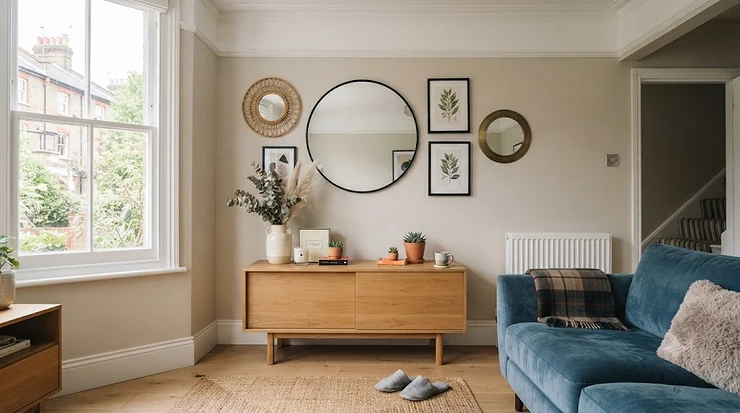
There’s a particular kind of satisfaction in watching a plain, forgettable wall turn into a focal point with nothing more than a circle of glass and a decent frame. That’s the quiet magic of a round mirror: no sharp corners, no visual argument with the rest of the room, just a soft shape that bounces light around and makes a hallway or bathroom feel like someone actually thought about it. A round mirror is a circular reflective panel, typically framed in wood, metal or rubber, used to add light, visual depth and decorative interest to a room without the cost of a bespoke piece. And here’s the genuinely good news for anyone furnishing a flat, refreshing a rental, or just tired of staring at a bare hallway wall: you don’t need to spend big to get one that looks considered rather than cut-price.

This guide rounds up seven real, currently available round mirrors under £100, pulled from UK retailers including Argos, Habitat, IKEA and Umbra, with actual sizes, materials and aggregated review sentiment rather than vague marketing copy. Whether you’re hunting for budget round mirrors to fill a rental-friendly gap, or a slightly more considered circular piece for a living room feature wall, the goal here is the same: honest analysis of what each mirror actually delivers, who it suits, and where the compromises sit. We’ll compare specs side by side, walk through common buying mistakes, and cover the practical stuff nobody tells you until you’re already up a ladder with a spirit level in one hand. Round mirrors have become one of the most searched shapes in UK home decor over the past few years, and interior designers consistently recommend placing an oversized mirror strategically as one of the simplest ways to make a room feel larger, which partly explains why the format refuses to go out of fashion. Let’s get into the seven contenders.
Quick Comparison Table
| Mirror | Diameter | Frame | Price Range | Best For |
|---|---|---|---|---|
| Argos Home Frameless Wavy Edge Round Mirror | 60cm | Frameless glass | around £25 | Budget statement piece |
| IKEA NISSEDAL Round Mirror | 65cm | Black metal | around £22 | Cheapest all-rounder |
| Habitat Black Round Wall Mirror | 80cm | Black wood | £30-£40 range | Large format on a budget |
| Habitat Mango Wood Round Wall Mirror | 50cm | Mango wood | £30-£45 range | Natural, organic look |
| Habitat Patsy Gold Brushed Round Wall Mirror | 82cm | Brushed gold metal | £70-£90 range | Premium statement wall piece |
| IKEA LINDBYN Round Mirror | 50cm | Gold-colour frame | around £80 | Boutique aesthetic on a budget |
| Umbra Hub Round Wall Mirror | 46-94cm (sizes vary) | Rubber bumper frame | £40-£99 range | High-traffic, modern industrial spaces |
Looking at the spread above, the cheapest genuinely usable option sits around £22, while the most expensive still lands comfortably under the £100 ceiling even at its largest sizes. What stands out is that price doesn’t map neatly onto size here: the Habitat Black Round Wall Mirror delivers an 80cm diameter for less than half the cost of the smaller IKEA LINDBYN, because frame material and finish, not glass area, are what actually drive the price. If your priority is simply filling wall space affordably, size-per-pound favours the wood and frameless options; if you want a piece that reads as considered rather than cheap, the metal-framed and gold-finish mirrors punch above their price bracket.
💬 Just one click — help others make better buying decisions too!😊
Top 7 Round Mirrors Under £100: Expert Analysis
Coverage here spans genuinely budget picks, solid mid-range options, and a couple of mirrors that stretch closer to the £100 ceiling but still justify themselves. Each one is a real, currently listed product, not a composite or an invented placeholder.
1. Argos Home Frameless Wavy Edge Round Mirror — best budget statement piece
The wavy, undulating edge is what separates this from a plain circle of glass, and it’s the standout feature worth knowing about before anything else: it turns a purely functional mirror into something that reads as intentional wall art. This is a 60cm diameter frameless mirror, which means there’s no bulky surround eating into your wall space or adding weight — a genuine practical advantage in rental properties where every kilogram on a picture hook matters. Because it’s frameless, it also reflects fractionally more light than a chunky-framed equivalent of the same diameter, since there’s no border interrupting the reflective surface.
Who is this for? Renters and first-flat furnishers who want a mirror that looks deliberately chosen rather than default-issue, without committing to a heavier framed piece. Aggregated customer review sentiment on the Argos listing is strongly positive, with reviewers rating it a full five stars, though the sample size is currently small, so treat that as an early positive signal rather than exhaustive proof.
Pros:
- ✅ Wavy edge adds personality without extra cost
- ✅ Frameless design keeps it lightweight for hanging
- ✅ Reflects slightly more light than framed equivalents
Cons:
- ❌ Frameless glass edges can chip if knocked
- ❌ Limited review volume so far to judge long-term durability
At around £25, the Argos Home Frameless Wavy Edge Round Mirror is one of the cheapest ways to get a mirror that doesn’t look like the cheapest option in the room.
2. IKEA NISSEDAL Round Mirror — cheapest genuinely reliable all-rounder
The standout here isn’t styling flair, it’s sheer track record: this is one of IKEA’s most-reviewed round mirrors, with well over a thousand ratings sitting at a strong average. That volume of aggregated review data matters more than most marketing copy, because it means the black metal frame and 65cm glass panel have been tested by thousands of actual UK and European households, not a handful of early adopters. The metal frame is slim, which keeps the whole piece visually light on the wall despite the generous diameter.
Based on the spec comparison with the rest of this list, the IKEA NISSEDAL Round Mirror offers the best diameter-to-price ratio of any entry here — 65cm for around £22 undercuts almost everything else while still delivering a properly sized reflection, not a token decorative circle. It suits students, first-time renters and anyone furnishing a home office or hallway who wants function first and styling second, though the black frame does read as slightly more utilitarian than the gold or wood options further down this list.
Pros:
- ✅ Very large review sample supports its reliability
- ✅ Excellent size-to-price ratio at 65cm diameter
- ✅ Slim metal frame keeps the look uncluttered
Cons:
- ❌ Plainer aesthetic than framed wood or gold options
- ❌ Not marketed as bathroom-safe against humidity
Reviewers consistently note it as a dependable, no-fuss choice, and at around £22 it remains the benchmark against which every other budget round mirror on this list gets measured.
3. Habitat Black Round Wall Mirror — best large format for the money
An 80cm diameter for under £40 is the headline here, and it’s worth dwelling on: most large-format mirrors of this size from boutique retailers start closer to £75, so this represents genuine scale-for-spend. The standout feature is straightforward — this is simply a lot of reflective glass and solid wooden frame for very little outlay, and the frame’s understated black finish means it won’t clash with existing decor the way a bold gold or copper frame might.
What most buyers overlook about this mirror is that its size does real functional work beyond decoration: an 80cm mirror positioned opposite a window reflects a meaningfully larger amount of natural light back into a room than a 50cm equivalent, which matters in north-facing hallways and box rooms that never quite feel bright enough. Aggregated review sentiment on the Argos listing is notably strong, with reviewers rating it close to a perfect score and repeatedly describing it as looking more expensive than its price suggests.
Pros:
- ✅ Large 80cm diameter at a genuinely low price point
- ✅ Solid wood frame feels more substantial than the cost implies
- ✅ Strong, high-volume review rating
Cons:
- ❌ Not recommended for bathrooms due to humidity
- ❌ At this size, wall strength and stud location matter more
The Habitat Black Round Wall Mirror is the pick if your priority is maximum visual and light-reflecting impact per pound spent, rather than a specific decorative finish.
4. Habitat Mango Wood Round Wall Mirror — best natural, organic look
Mango wood framing is the standout feature, and it’s a genuine point of difference on this list: everything else here is metal, frameless glass or rubber, so this is the one option that brings warmth and grain texture into a scheme that might otherwise lean cold or clinical. The 50cm diameter keeps it proportionate for smaller walls, and the frame has real heft to it — around 3.45kg — which reviewers repeatedly describe as feeling more expensive than its price bracket suggests.
Here’s what the spec sheet won’t tell you outright: mango wood is a fast-growing, relatively sustainable hardwood, and Habitat has confirmed the piece uses FSC-certified sourcing, which matters if you’re trying to furnish thoughtfully rather than just cheaply. It’s best suited to boho, Scandinavian or organic-modern interiors, and less suited to strictly minimalist monochrome schemes where the wood grain would visually compete rather than complement.
Pros:
- ✅ Genuine wood frame adds warmth other materials can’t
- ✅ FSC-certified sourcing for more sustainable furnishing
- ✅ Reviewers say it looks pricier than its actual cost
Cons:
- ❌ Not designed for bathroom use
- ❌ Three keyholes need careful measuring for a level hang
Typically priced in the £30-£45 range depending on stock and promotions, the Habitat Mango Wood Round Wall Mirror earns its place through material honesty rather than flashy branding.
5. Habitat Patsy Gold Brushed Round Wall Mirror — best premium statement piece
At 82cm across with a brushed gold metal frame, this is the largest and most visually dominant mirror on the list, and the standout feature is exactly that scale paired with a genuinely premium-looking finish rather than a thin gold-effect coating. Brushed metal catches light differently to polished chrome or plain gloss paint — it diffuses reflections slightly, which softens the overall look and avoids the slightly garish shine that cheaper gold-effect frames sometimes have.
Based on the spec comparison, this is the heaviest mirror on this list at roughly 11kg, and that weight is doing real work: thicker gauge metal framing typically holds its shape and finish better over years of use than the thin pressed-metal frames found on some budget alternatives. What most buyers overlook is that a mirror this size functions as the room’s focal point rather than a supporting piece, so it works best hung alone rather than grouped with other wall art, and it demands secure fixing into a stud or solid wall rather than a plasterboard-only plug.
Pros:
- ✅ Large 82cm scale reads as a genuine statement piece
- ✅ Brushed finish looks more premium than flat gold paint
- ✅ Substantial metal frame construction
Cons:
- ❌ Heaviest option here, needs robust wall fixing
- ❌ Closest to the £100 ceiling of anything on this list
Typically listed in the £70-£90 range, the Habitat Patsy Gold Brushed Round Wall Mirror is the pick for a living room or dining room that needs one confident, considered piece rather than several smaller decorative touches.
6. IKEA LINDBYN Round Mirror — best boutique aesthetic on a budget
The gold-colour frame is the standout feature here, and it’s specifically designed to mimic the slim, tapered profile found on far more expensive boutique mirrors from independent UK retailers, where equivalent framed pieces regularly start above £150. At 50cm diameter, it’s more compact than the Habitat premium option above, making it a better fit for smaller hallways, cloakrooms or as part of a gallery-style grouping above a console table.
Reviewers consistently note the frame’s slim profile as its main appeal, describing it as understated rather than showy, which suits contemporary and Scandi-adjacent interiors better than a heavier ornate gold frame would. On paper this means you’re paying a premium over the cheapest options on this list largely for finish quality and brand consistency rather than glass size, since the 50cm mirror surface itself is comparable to several sub-£30 alternatives here.
Pros:
- ✅ Slim gold frame mimics pricier boutique styling
- ✅ Compact size suits smaller walls and groupings
- ✅ Consistent, well-reviewed IKEA quality control
Cons:
- ❌ Smaller glass area than the Habitat premium pick
- ❌ Premium finish costs noticeably more than IKEA’s own basic options
At around £80, the IKEA LINDBYN Round Mirror sits closer to the top of this list’s price range, but delivers a finish that genuinely competes with independent boutique retailers charging double.
7. Umbra Hub Round Wall Mirror — best for high-traffic modern spaces
The innovative rubber bumper frame is the single standout feature of this entire list, and it solves a problem none of the other six mirrors address: durability in busy areas. The rubber rim doubles as a literal bumper, absorbing knocks from bags, coats and passing shoulders in a way that wood, metal or frameless glass simply can’t. It’s available across multiple sizes, from smaller 46cm options through to large 94cm statement pieces, with UK retail pricing varying significantly by size and retailer.
What the spec sheet won’t tell you, but the design brief makes clear, is that this mirror is explicitly engineered for entryways, hallways and other transitional spaces where a fragile frame would eventually chip or dent. Reviewers and retailers consistently frame it as the modern, industrial-leaning alternative to traditional framed mirrors, and it’s one of the few entries on this list that photographs distinctly on its own rather than blending into a broader decor style — it has a recognisable design language.
Pros:
- ✅ Rubber frame genuinely protects against knocks
- ✅ Wide size range from compact to statement-scale
- ✅ Distinctive modern design stands out from generic frames
Cons:
- ❌ Price varies considerably between retailers and sizes
- ❌ Industrial look won’t suit every traditional interior
Depending on size and retailer, expect a price somewhere in the £40-£99 range, with the smaller diameters comfortably at the budget end and larger sizes pushing toward the ceiling of this list — making the Umbra Hub Round Wall Mirror the pick specifically for households with kids, pets or a genuinely high-traffic hallway.
Practical Usage Guide: How to Hang and Style Your Round Mirror
Getting a round mirror onto the wall properly is less intuitive than it looks, mostly because a circle gives you no straight edges to eyeball level against. Start by using a spirit level rather than judging by eye — round frames are surprisingly good at making a slightly crooked hang look obviously wrong, more so than rectangular mirrors, because there’s no straight top or bottom line to distract from the tilt. Most of the mirrors on this list use either a keyhole fixing or a D-ring hook, so check which your chosen model has before buying wall fixings, since keyhole mirrors typically need a single screw with a slightly protruding head, while D-rings need a picture hook.
For anything over roughly 5kg — which includes the Habitat Patsy Gold Brushed Round Wall Mirror and the larger Umbra Hub sizes — locate a wall stud where possible rather than relying purely on a plasterboard plug, since heavier framed pieces put concentrated stress on a single fixing point. A common mistake in the first 30 days of ownership is over-tightening screws into wooden-backed mirrors, which can crack the MDF backing board that several budget options use behind the glass. Once hung, a light wipe with a microfibre cloth and a vinegar-water solution keeps the glass streak-free without the ammonia found in some commercial glass cleaners, which can degrade certain frame finishes, particularly gold-effect and brushed metal surfaces, over repeated use.
Real-World Scenarios: Which Round Mirror Suits You?
Picture a first-time renter moving into a small one-bed flat with magnolia walls and a landlord who’s twitchy about wall damage. For that situation, the frameless Argos Home Frameless Wavy Edge Round Mirror or the IKEA NISSEDAL Round Mirror make the most sense: both are light enough for a single, small, easily-patched fixing, and neither represents a significant financial loss if it needs to be left behind at the end of a tenancy.
Now consider a family with two young children and a narrow hallway that doubles as the main route from front door to kitchen. Coats get slung, bags get dropped, and a fragile frame is a genuine liability here. The Umbra Hub Round Wall Mirror, with its rubber bumper edge, is built precisely for this scenario — it’s the one mirror on this list explicitly designed to survive daily knocks without chipping.
Finally, imagine someone furnishing their first proper living room after years of shared houses, wanting one piece that signals the space is finally theirs. The Habitat Patsy Gold Brushed Round Wall Mirror, hung solo above a console table or sideboard, does exactly that job: it’s large enough to anchor the room and finished well enough to not need supporting decor around it to look intentional.
Problem → Solution: Fixing Common Round Mirror Headaches
Problem: the mirror looks crooked no matter how carefully I measure. This is almost always a levelling issue rather than a manufacturing fault — use a spirit level directly against the frame edge rather than trusting a tape measure from the ceiling, since ceilings themselves are rarely perfectly level in older UK housing stock.
Problem: my rental won’t allow wall drilling. Command-style adhesive strips rated for the mirror’s specific weight can work for the lighter frameless and metal-framed options under around 3kg, though none of the mirrors on this list are officially rated for adhesive-only mounting, so treat this as a workaround rather than a manufacturer-endorsed method.
Problem: condensation is clouding the glass in my bathroom. Several mirrors here, including the Habitat wood and gold options, are explicitly not recommended for bathroom use — humidity can degrade the backing and eventually cause black spotting at the edges. If a bathroom mirror is what you actually need, look specifically for models marketed as bathroom-safe or with a sealed back.
Problem: I can’t tell if my wall can take the weight. As a rough guide, a single sheet of standard plasterboard supports around 15kg per square metre when using a correctly rated plasterboard anchor, which is more than enough for every mirror on this list individually — but always fix closer to a stud for anything approaching the 11kg weight of the heaviest option here.
Buyer’s Decision Framework: Choosing Your Round Mirror
If you’re renting and want zero wall damage risk, choose the lightest frameless or slim-metal option and use rated adhesive strips rather than screws. If you have a high-traffic hallway with kids or pets, choose a rubber-framed design like the Umbra Hub Round Wall Mirror because durability matters more than finish. If your priority is maximum light reflection for the lowest cost, choose the largest diameter you can afford in a simple frame, since diameter — not brand — is what actually moves light around a room. If you want a single statement piece for a living or dining room, choose a premium metal-framed option and hang it alone rather than grouped, because scale is the whole point. And if your budget genuinely caps out under £30, don’t compromise on diameter to get a “nicer” frame — a larger plain mirror consistently outperforms a smaller decorative one for actual room-brightening effect.
How to Choose Round Mirrors Under £100
- Measure your wall space first, not the mirror. As a general sizing rule, round mirrors between roughly 60-80cm work well above a mantel or console without overwhelming it, so work out the maximum diameter that suits the wall before browsing.
- Check the frame material against your room’s humidity levels. Wood and MDF-backed mirrors generally aren’t rated for bathrooms; metal and rubber-framed options tend to cope better with occasional steam.
- Confirm the fixing type before ordering wall hardware. Keyhole and D-ring fixings need different screws and hooks, and buying the wrong one means a wasted trip back to the shop.
- Weigh diameter against frame thickness. A slim-framed 65cm mirror often reflects more usable light than a heavily-framed 50cm one, even at a similar price.
- Read aggregated review sentiment, not just the star rating. A 4.8-star rating from three reviews tells you far less than a 4.6-star rating from over a thousand.
- Decide if the mirror needs to be bathroom-safe. If so, narrow your shortlist immediately, since several budget options explicitly aren’t designed for that environment.
- Set a hard price ceiling and stick to it. With genuinely good options starting around £22, there’s rarely a need to stretch close to the £100 mark unless you specifically want a statement metal-framed piece.
Common Mistakes When Buying Cheap Circular Mirrors
The most frequent mistake is buying based on the product photo’s apparent scale rather than the stated diameter — a 40cm mirror photographed close-up in a styled room shot can look far larger than it is in your actual hallway, so always cross-reference the diameter against something you can physically measure. A second common error is ignoring frame weight when planning fixings; buyers regularly under-estimate how much a solid wood or thick metal frame adds versus the glass alone, leading to a fixing that’s technically rated for the mirror but with little safety margin. Buyers shopping purely on price also tend to overlook whether a mirror is bathroom-suitable, only discovering the limitation after black spotting appears at the glass edges months later. Finally, many people buying cheap circular mirrors skip checking the hanging orientation — some models are designed to hang only in a specific position due to off-centre fixings, and mounting them the “wrong” way round can leave the mirror sitting subtly off-level even when perfectly plumb.
Round Mirrors vs Rectangular Mirrors
| Factor | Round Mirrors | Rectangular Mirrors |
|---|---|---|
| Visual softness | Softens sharp room corners | Reinforces strong architectural lines |
| Light reflection spread | Diffuses light in all directions | Directs light more linearly |
| Space perception | Adds openness without dominating | Can extend a wall’s apparent width |
| Styling flexibility | Works well solo as a focal point | Groups more easily in symmetrical arrangements |
| Typical budget-tier pricing | Comparable across both shapes | Comparable across both shapes |
A round mirror generally works better as a singular, standalone feature — hang one Habitat Patsy Gold Brushed Round Wall Mirror above a console table and it does the job alone, without needing supporting decor. A rectangular mirror, by contrast, tends to perform better in symmetrical groupings or when the goal is specifically to extend the visual width of a wall, such as above a long console or dining table. Neither shape is objectively superior; the choice comes down to whether your room already has strong straight lines that need softening, or open space that benefits from a more directional reflection.
What to Expect: Real-World Performance of Budget Round Mirrors
On paper, a budget round mirror and a premium one both do the same basic job: reflect light and show your reflection. In everyday use, the differences show up mostly in the frame’s long-term durability rather than the glass quality itself, since even entry-level UK retailers now use standard float glass mirror panels that perform near-identically at this price point. Where you’ll notice a genuine gap is in how the frame ages — thin pressed-metal or lightweight MDF frames on the cheapest options can show wear at fixing points after a couple of years of use, while the thicker wood and brushed-metal frames on the mid-range and premium picks here tend to hold their finish for considerably longer. Reviewers across the Argos and IKEA listings referenced in this guide repeatedly describe the actual reflective clarity as indistinguishable from pricier alternatives, which tracks with the reality that mirror glass quality has become fairly standardised across UK high-street retailers.
Affordable Round Mirrors for Different Rooms and Buyers
For a rental hallway, affordable round mirrors under £30 like the IKEA NISSEDAL Round Mirror do the job without financial risk if you move on within a year or two. For a family bathroom that occasionally gets steamy, look specifically for models marketed as humidity-tolerant rather than assuming any budget round mirror will cope — most of the wood-framed options on this list explicitly aren’t designed for that environment. For a first home living room, a mid-range or premium pick like the Habitat Patsy Gold Brushed Round Wall Mirror offers a genuine style upgrade without breaking a modest furnishing budget, while students and shared-house tenants are usually best served by the cheapest, lightest options that won’t represent a major loss if left behind. Buyers specifically searching for affordable circular mirrors to complete a gallery wall arrangement should prioritise slim frames over chunky ones, since multiple heavy-framed circles grouped together can visually overwhelm a wall far more quickly than the diameter alone suggests.
Long-Term Cost & Maintenance of Budget Circular Mirrors
| Cost Factor | Budget Tier (£20-£40) | Premium Tier (£70-£99) |
|---|---|---|
| Upfront cost | Lower | Higher |
| Typical frame lifespan | 2-5 years with care | 5-10+ years with care |
| Replacement glass availability | Rarely offered separately | Sometimes offered by specialist retailers |
| Resale/reuse value | Minimal | Moderate, especially named-brand pieces |
Over a five-year period, a £22 mirror replaced once due to frame wear ends up costing roughly the same as a single £80-£90 premium piece bought once — the maths only favours the cheaper route if the frame genuinely lasts the full stretch without visible degradation. Maintenance itself costs next to nothing regardless of tier: a soft cloth and mild glass cleaner is all any of these mirrors need, and none require specialist products. When a mirror does eventually reach the end of its life, note that mirror glass typically can’t go in standard household glass recycling due to its reflective backing coating, so check your local council’s specific guidance on recycling collections before disposal rather than assuming it belongs in the regular glass bin.
Features That Actually Matter (And Those That Don’t)
Frame material and fixing type genuinely matter — they determine both how long the mirror lasts and how easily it goes up on your specific wall. Diameter matters enormously for the light-reflecting, room-brightening effect that’s usually the actual reason someone buys a mirror in the first place. What matters far less, despite how retailers often present it, is the specific brand name attached to a basic design; a plain black-framed 65cm circle performs almost identically whether it comes from a budget retailer or a mid-tier one, provided the glass quality is comparable. Bevelled edges, frequently marketed as a premium touch, add a subtle decorative line around the mirror’s perimeter but have no meaningful impact on reflection quality or durability — they’re a purely aesthetic upgrade worth paying for only if you specifically like the look.
Frequently Asked Questions
❓ What size round mirror should I buy for a small hallway?
❓ Are cheap wall mirrors as good as expensive ones?
❓ Can I hang a round mirror in a bathroom?
❓ How do I know if my wall can hold a heavy round mirror?
❓ What's the best budget round mirror under £30?
Conclusion
Choosing among round mirrors under £100 really comes down to answering three honest questions: how much wall space do you actually have, how much knocking-about will the mirror realistically take, and does the room need one confident statement piece or a lighter, more forgettable touch. Budget options like the IKEA NISSEDAL Round Mirror and Argos Home Frameless Wavy Edge Round Mirror prove that spending under £30 doesn’t mean settling for something that looks it, provided you’re realistic about frame longevity. Mid-range and premium picks, from the warmth of the Habitat Mango Wood Round Wall Mirror to the scale of the Habitat Patsy Gold Brushed Round Wall Mirror, earn their higher price through genuine material and finish upgrades rather than marketing alone. And for anyone dealing with a genuinely high-traffic space, the Umbra Hub Round Wall Mirror solves a durability problem none of the cheaper frames can. Whichever you land on, measure twice, check the fixing type before you buy hardware, and remember that diameter does more for a room’s brightness than brand ever will.
Recommended for You
- Best Round Mirrors UK 2026: 7 Top Picks Compared
- 7 Statement Mirrors Under £150 That Transform a Room in 2026
- Large Wall Mirrors UK: 7 Best Statement Buys for 2026
Disclaimer: This article contains affiliate links. As an Amazon Associate, I earn from qualifying purchases. If you purchase products through these links, we may earn a small commission at no additional cost to you.
✨ Found this helpful? Share it with your friends! 💬🤗
