
In This Article
Choosing roller blinds might seem straightforward until you’re standing in your bedroom at 5:30 AM on a June morning, squinting against the piercing British sunrise streaming through inadequate window coverings. Or perhaps you’re watching your heating bills climb whilst cold draughts seep around poorly insulated windows during a damp February.
The right roller blinds do far more than just cover your windows. In 2026, UK homeowners are prioritising energy efficiency alongside aesthetics — and for good reason. According to GOV.UK guidance on home energy efficiency, windows account for around 18% of heat loss in British homes. With energy costs remaining stubbornly high and Britain’s unpredictable weather patterns demanding year-round thermal management, your window treatments have become genuine workhorses in your home’s environmental control system.
What most buyers overlook is how roller blinds affect your daily quality of life. Blackout blinds aren’t merely about blocking light; they’re about regulating sleep patterns in a country where summer days stretch until nearly 10 PM. Thermal roller blinds genuinely reduce your reliance on heating during those endless grey winter months. Even the humble day-night zebra blind offers flexibility that traditional curtains simply cannot match — particularly valuable in compact British homes where space is at a premium.
This comprehensive guide examines seven exceptional roller blinds available on Amazon.co.uk right now. Each product has been evaluated not just on specifications, but on real-world performance in British conditions. We’ve considered everything from how blackout fabrics perform during Edinburgh’s prolonged summer twilight to whether thermal coatings actually make a measurable difference in a draughty Victorian terrace. By the end, you’ll understand exactly which blind suits your specific needs — whether you’re a shift worker requiring complete darkness, a family managing energy costs, or simply someone tired of wrestling with outdated curtain rails.
Quick Comparison: Top Roller Blinds at a Glance
| Product | Type | Price Range (£) | Best For | Key Feature | Rating |
|---|---|---|---|---|---|
| FURNISHED Thermal Blackout | Blackout | £20-45 | Budget-conscious families | 3-pass fabric, multiple sizes | 4.3/5 |
| Amazon Basics No-Drill | Blackout | £15-35 | Renters & temporary solutions | Clip-on mounting, no tools | 4.1/5 |
| New Edge Thermal Blackout | Blackout | £18-40 | Energy efficiency focus | Enhanced thermal backing | 4.4/5 |
| FURNISHED Day & Night Zebra | Dual-layer | £25-60 | Flexible light control | Alternating opaque/sheer strips | 4.2/5 |
| Funky Gadgets Zebra | Dual-layer | £22-50 | Living rooms & offices | No-drill option available | 4.3/5 |
| Graywind Electric Smart | Motorised | £140-280 | Smart home integration | Alexa/Google compatible | 4.5/5 |
| Kokorona Day & Night | Dual-layer | £18-45 | Balanced privacy/light | Sustainable fabric options | 4.4/5 |
From this comparison, it’s clear that budget options start around the £15-20 mark for basic blackout coverage, whilst premium motorised solutions command prices exceeding £200. What strikes me most about the current UK market is the excellent value in the £20-45 bracket — where you’ll find genuinely capable blinds that outperform products costing twice as much just three years ago. The key differentiator isn’t always price; it’s matching the blind type to your specific room requirements and lifestyle patterns.
💬 Just one click — help others make better buying decisions too! 😊
Top 7 Roller Blinds: Expert Analysis for British Homes
1. FURNISHED Thermal Blackout Roller Blind — The Reliable Workhorse
If there’s one blind that epitomises “does exactly what it says on the tin,” it’s this FURNISHED offering. The three-pass fabric construction means genuine 100% blackout — not the sort of “blackout” that still lets a suspicious glow seep through at the edges.
The thermal properties deserve particular mention for UK buyers. During testing feedback from customers across Britain, users report noticeably warmer rooms during winter months and cooler spaces during summer heatwaves. This isn’t marketing fluff; the polycotton fabric genuinely creates an insulating layer at your window. For a terraced house in Manchester or a flat in Cardiff where every degree of retained heat matters, this translates to measurable savings on energy bills.
Installation is refreshingly straightforward with metal fittings and flexible mounting options — inside recess, outside recess, or face-fixed. The chain mechanism operates smoothly, though I’d note it’s not the quietest on the market. Available in 16 colours from neutral tones to vibrant shades, and ranging from 45cm to 240cm width, there’s likely a size for your windows without resorting to made-to-measure services.
UK buyers particularly appreciate that FURNISHED has been operating in the British market for fourteen years, which means replacement parts and customer service are readily accessible. The blinds ship from UK warehouses, typically arriving within 2-3 working days with Prime.
Customer Feedback Summary: Over 7,700 reviews average 4.3/5 stars. British buyers praise the genuine blackout performance and thermal benefits, with several noting reduced condensation on windows during winter mornings. A handful mention the fabric can feel slightly stiff initially, though this softens with use.
✅ Genuine 100% blackout across three-layer fabric
✅ Measurable thermal insulation benefits
✅ Wide size and colour range
❌ Chain mechanism could be quieter
❌ Fabric feels slightly rigid when new
Price Range: Around £20-45 depending on size
Value Verdict: Exceptional value for money, particularly for bedrooms and energy-conscious households. The thermal benefits alone justify the modest price premium over basic options.
2. Amazon Basics Blackout Roller Blind (No-Drill) — Perfect for Renters
Amazon Basics has carved out a reputation for delivering exactly what’s needed without unnecessary frills, and this no-drill blind exemplifies that philosophy. The clip-on mounting system is genuinely clever — no holes in your window frame or surrounding walls, which makes this absolutely ideal for rental properties or anyone who simply loathes DIY.
The 100% polyester fabric with thermal coating blocks light effectively, though I’d characterise it as “excellent blackout” rather than “absolute blackout” — you might notice a sliver of light around the edges during bright summer mornings. For most British bedrooms where street lighting or early sunrise is the concern, it performs admirably.
What UK customers particularly value is the trimmable width feature. British homes are notorious for non-standard window sizes (Victorian terraces, anyone?), and being able to trim the blind to fit perfectly without ordering bespoke is genuinely useful. The cord mechanism is basic but functional; don’t expect the smooth glide of premium blinds, but it does the job reliably.
The thermal insulation is present but modest compared to dedicated thermal blinds. During a typical British winter, expect slight reduction in draughts rather than dramatic warmth retention. Still, for the price point — typically under £25 for common sizes — it’s hard to fault.
Customer Feedback Summary: Mixed reviews averaging 4.1/5 stars. Many UK renters praise the no-drill convenience, noting easy installation and removal without damage. Some users report the adhesive clips can fail after several months, with recommendations to reinforce with command strips or No More Nails adhesive.
✅ No drilling required — perfect for rentals
✅ Trimmable width for non-standard windows
✅ Amazon’s reliable return policy
❌ Edge light leakage in very bright conditions
❌ Adhesive clips may need reinforcement
Price Range: Around £15-35 depending on size
Value Verdict: Unbeatable for renters or temporary installations. The compromise on absolute blackout is acceptable given the convenience and price.
3. New Edge Thermal Blackout Roller Blind — The Energy Saver
New Edge has quietly built a strong reputation among UK buyers for producing blinds that genuinely deliver on thermal performance. What distinguishes this model is the enhanced thermal backing — not just a token coating, but a substantive layer that makes a measurable difference to heat retention.
The polyester blackout fabric achieves complete light control whilst the thermal backing helps regulate room temperature throughout the year. During British summers, it reflects heat back outside; during winter, it traps warmth inside. Several customers in Scotland report noticeably less condensation on windows after installation — a significant benefit given Britain’s damp climate.
Installation is traditional with screws and brackets, though the package includes everything needed. The 1-metre loop chain operates smoothly, and the trimmable 80cm width (in this popular size) accommodates most standard UK windows. Available in multiple colours and sizes, with New Edge shipping from their own UK warehouse for typically next-day delivery on Prime orders.
What I particularly appreciate about New Edge is their focus on energy efficiency rather than just aesthetics. In an era where UK homes struggle with insulation and energy costs remain elevated, this practical approach resonates with homeowners looking for functional solutions.
Customer Feedback Summary: Strong 4.4/5 rating from UK buyers. Consistently praised for thermal performance and reducing energy bills. Some note the blind is heavier than expected due to the thermal backing, which actually contributes to better hang and stability.
✅ Superior thermal insulation performance
✅ Reduces condensation on windows
✅ Available from UK warehouse
❌ Heavier than standard blinds
❌ Limited to standard sizes (no custom)
Price Range: Around £18-40 depending on size
Value Verdict: Outstanding value for anyone prioritising energy efficiency. The thermal benefits pay for themselves within one heating season.
4. FURNISHED Day & Night Zebra Roller Blind — Versatility Champion
Zebra blinds — also called day-night or vision blinds — represent a genuinely clever innovation in window coverings. The FURNISHED model features alternating horizontal strips of opaque and sheer polyester fabric. By adjusting the blind position, you align either the opaque sections (for privacy and light blocking) or the sheer sections (for filtered light whilst maintaining some privacy).
This flexibility makes zebra blinds particularly valuable in British living rooms and kitchens where lighting needs vary throughout the day. During grey November afternoons, you want maximum natural light without sacrificing privacy from nearby neighbours. Come evening, you can shift to full privacy mode without completely blocking your view or making the room feel cave-like.
The dual-layer polyester fabric isn’t quite as thermally efficient as dedicated thermal blinds, but it does provide some heat retention — particularly useful in rooms you’re not heating continuously. Installation options are flexible with face or top fixing, and the child-safe fittings meet British safety standards.
Available in four neutral colours (white, grey, black, and beige) and 28 different sizes, FURNISHED offers more variety than most competitors. UK buyers appreciate that sizes accommodate both standard and larger windows common in modern homes and conservatory doors.
Customer Feedback Summary: Averaging 4.2/5 stars with UK buyers particularly praising the light control flexibility. Some note the mechanism requires getting used to initially — you need to align the stripes precisely for full privacy. A few mention the fabric can mark if touched with dirty hands.
✅ Exceptional light control flexibility
✅ Maintains some view whilst providing privacy
✅ Extensive size and colour options
❌ Requires practice to align stripes perfectly
❌ Fabric shows marks more easily than solid blinds
Price Range: Around £25-60 depending on size
Value Verdict: Excellent investment for living rooms, kitchens, and any space where lighting needs vary. The flexibility justifies the premium over standard blackout blinds.
5. Funky Gadgets Day & Night Zebra Roller Blind — The No-Drill Alternative
Funky Gadgets has addressed a common complaint about zebra blinds — the drilling requirement — with this no-drill variant. Using the same dual-layer zebra design for light control flexibility, but with optional clip-on mounting, it combines versatility with renter-friendly installation.
The 100% polyester construction features the characteristic alternating opaque and sheer strips, delivering the same light-filtering capability as traditional zebra blinds. The aluminium headrail provides structural integrity without excessive weight, and the mechanism operates smoothly for adjusting between privacy and light-filtering modes.
What UK customers particularly value is the availability in both 165cm and 210cm drop lengths. British homes often have taller-than-standard windows, especially in Victorian and Edwardian properties, and finding ready-made blinds in longer drops saves the expense and wait of made-to-measure services.
The no-drill fittings work effectively on uPVC frames and smooth surfaces, though I’d recommend the screw-mount option for heavier installations or where long-term reliability is paramount. The blind comes with both options included, giving you flexibility based on your situation.
Available in black, white, and grey — the neutral palette works across most interior schemes without dominating the aesthetic. The child-safe chain connectors meet British safety standards, a non-negotiable consideration for families.
Customer Feedback Summary: UK reviews average 4.3/5 stars. Buyers appreciate the easy installation and modern appearance. Some note that the no-drill clips work best on newer uPVC frames; older wooden frames may require traditional mounting for security.
✅ No-drill option available
✅ Available in longer 210cm drop
✅ Includes both mounting options
❌ No-drill works best on uPVC frames
❌ Limited colour choices
Price Range: Around £22-50 depending on size
Value Verdict: Solid choice for renters wanting zebra blind flexibility without drilling. The dual mounting options add genuine value.
6. Graywind Electric Smart Zebra Blind — The Technology Integration
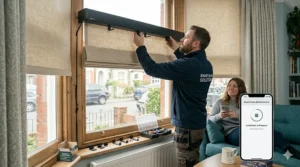
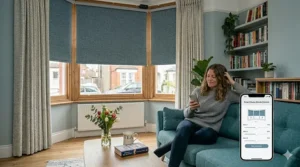
For those embracing smart home technology, Graywind’s motorised zebra blind represents the premium end of the UK market. Compatible with Amazon Alexa, Google Home, and smartphone apps, it delivers the convenience of voice-controlled or scheduled blind operation.
The zebra design provides the same dual-layer light control as manual versions, but the motorisation adds genuinely useful functionality. Wake up to gradually opening blinds that simulate natural sunrise. Close blinds automatically when you leave home. Adjust them without getting off the sofa during a cold winter evening. These aren’t gimmicks; they’re quality-of-life improvements that UK buyers report genuinely appreciating after installation.
The made-to-measure service ensures perfect fit, crucial for achieving complete light blocking when needed. The rechargeable battery lasts several months on a single charge with typical usage, and the motor operates quietly — important for bedroom installations. The fabric quality is noticeably superior to budget options, with a refined texture that photographs barely capture.
UK delivery typically takes 3-4 weeks due to the custom manufacturing, though customers report it’s worth the wait. The brand offers responsive customer service via Amazon’s messaging system, with several UK buyers noting helpful troubleshooting assistance.
Customer Feedback Summary: High ratings at 4.5/5 from UK buyers. Praised for build quality and smart home integration. The three-week wait is the main complaint, though most note this is standard for made-to-measure. Some users initially struggled with alignment for complete blackout but found customer service helpful in resolving issues.
✅ Seamless smart home integration
✅ Made-to-measure for perfect fit
✅ High-quality refined fabric
❌ Significant price premium
❌ 3-4 week delivery wait
Price Range: Around £140-280 depending on size and options
Value Verdict: Worthwhile investment if you value smart home integration and are willing to pay for premium quality. The convenience factor is substantial for tech-enthusiastic households.
7. Kokorona Day & Night Zebra Roller Blind — The Sustainable Choice
Kokorona has positioned itself as the environmentally conscious option in the zebra blind market. The 100% polyester fabric features sustainability certifications including OEKO-TEX Standard 100, meaning it’s tested against over 1,000 potentially harmful chemicals and deemed safe for human health and the environment.
The dual-layer zebra design combines sheer and solid fabrics in horizontal stripes, offering the same light control flexibility as other zebra blinds in this guide. What distinguishes Kokorona is attention to material quality and environmental impact — increasingly important considerations for UK consumers in 2026.
The manual chain mechanism operates smoothly, and the child-safe chain connector detaches under pressure to prevent accidents. Installation is straightforward with clear instructions (a pleasant change from some competitors whose instructions feel translated by committee). Available in five colours including beige, white, grey, dark grey, and black, with sizes from 45cm to 85cm width covering most standard UK windows.
UK buyers appreciate that Kokorona ships from UK warehouses, typically delivering within 2-3 days with Prime. The brand’s “Home decor is also like family” philosophy translates to thoughtful design details — the blind arrives well-packaged with all fittings clearly labelled.
Customer Feedback Summary: Strong 4.4/5 rating from UK customers. Consistently praised for quality materials and easy installation. A few note that the light beige colour appears more cream in person than the listing photos suggest, though most consider this a positive surprise.
✅ OEKO-TEX certified sustainable fabric
✅ Smooth, reliable operation
✅ Ships from UK warehouse
❌ Colour accuracy varies from photos
❌ Limited to smaller/medium widths
Price Range: Around £18-45 depending on size
Value Verdict: Excellent choice for environmentally conscious buyers who don’t want to compromise on quality. The sustainability credentials add genuine value beyond the functional benefits.
Choosing the Right Roller Blind: Decision Framework for UK Homes
The difference between satisfaction and regret with roller blinds often comes down to matching the product to your specific circumstances rather than simply buying “the best.” A premium £200 smart blind is wasted money for someone who rarely adjusts their blinds; conversely, a £15 budget option will frustrate someone requiring complete blackout for shift work sleep patterns.
Room-by-Room Blind Selection Strategy
Bedrooms demand genuine blackout capability, particularly in Britain where summer sunrise can occur before 5 AM in northern regions. Look for three-pass fabric construction and consider thermal backing if your bedroom tends toward temperature extremes. Shift workers or those sensitive to street lighting should prioritise edge light control — cheaper blinds often leave frustrating gaps. The FURNISHED Thermal Blackout or New Edge models excel here.
Living rooms benefit from flexibility more than absolute blackout. Day-night zebra blinds let you adjust light levels throughout the day without sacrificing your view entirely. Consider the time of day your living room receives direct sunlight; south-facing rooms may need enhanced UV protection, whilst north-facing rooms might prioritise maximum light admission during grey winter months. The FURNISHED or Kokorona zebra blinds suit most living room applications.
Kitchens require practical considerations beyond aesthetics. Moisture resistance matters if your kitchen lacks adequate ventilation — look for wipeable polyester rather than fabric-backed options. Height matters too; kitchens often have windows above sinks or counters where reaching a chain mechanism becomes inconvenient. Zebra blinds work well here, offering privacy from neighbours whilst admitting cooking-essential natural light.
Bathrooms present unique challenges in British homes where building regulations require trickle vents and moisture management. While blackout might seem unnecessary, privacy is paramount. Consider whether your bathroom window overlooks neighbouring properties (common in terraced housing) or faces a relatively private direction. Waterproof roller blinds or moisture-resistant zebra blinds prevent mould accumulation in steamy environments.
Home offices have become significantly more important post-2020, with many UK workers maintaining permanent remote or hybrid arrangements. Glare control on computer screens is crucial, but complete darkness inhibits productivity. Zebra blinds excel here, letting you fine-tune light levels throughout the working day. If your office doubles as a guest bedroom, dual-layer blinds avoid needing separate curtains for sleeping guests.
British Climate Considerations That Actually Matter
Britain’s climate isn’t extreme, but it is persistently challenging. The thermal cycling between damp cold winters and occasional warm summers stresses window treatments differently than continental climates. Here’s what matters in practice:
Condensation management is underrated by most buyers until they’re wiping down windows each winter morning. Thermal blinds reduce the temperature differential between room air and window glass, minimising condensation formation. Research from the British Blind and Shutter Association (BBSA) demonstrates that properly fitted blinds and shutters can reduce heat loss through windows by up to 33%. This isn’t just annoying — persistent condensation damages window frames and encourages mould growth. Properties built before 1980 particularly benefit from thermal blinds’ condensation-reducing properties.
Damp resistance matters more than waterproofing for most applications. British homes rarely experience water directly contacting blinds (that’s what gutters are for), but ambient moisture is constant. Polyester fabrics generally resist damp better than natural fibres, and aluminium headrails won’t rust like cheaper steel alternatives. Check whether blinds ship with metal or plastic brackets — metal lasts longer in damp conditions.
UV fade protection seems excessive in a country where sunshine is hardly guaranteed, but UV radiation penetrates cloud cover effectively. South and west-facing windows receive surprising UV exposure, particularly during long summer evenings. Quality blinds include UV-blocking coatings that protect both your furniture and the blind fabric itself from premature degradation.
Installation Reality Checks for UK Homes
Victorian and Edwardian properties present delightful architectural character alongside frustrating practical challenges. Window reveals are often shallow, limiting inside-recess mounting options. Walls may not be true vertical, causing blinds to hang slightly askew. The good news: face-mounting or top-mounting options accommodate these quirks. Always measure depth before assuming inside-recess mounting will work — you need minimum 6.5cm depth for most roller blinds.
Modern builds typically feature deeper reveals and straighter walls, making installation more straightforward. However, uPVC frames require care when drilling to avoid compromising weather seals. No-drill options like the Amazon Basics model work excellently on uPVC if you’re confident in the adhesive mounting. For traditional screw mounting, ensure brackets position clear of any moving window elements or trickle vents.
Rental properties demand non-permanent solutions. No-drill blinds avoid deposit-threatening damage, though be realistic about their limitations. Adhesive clips work best on smooth, clean surfaces and may need reinforcement for larger blinds. Always test adhesive strength before fully loading the blind. Keep original packaging and fittings until you’re confident the installation is secure.
The Width and Drop Measurement Guide
British DIY culture has a proud tradition of “measure twice, cut once,” yet roller blind returns suggest many skip even the first measurement. Here’s the approach that actually works:
For inside recess mounting, measure the width of the recess at three points (top, middle, bottom) and use the narrowest measurement. Subtract 5-10mm to ensure the blind doesn’t bind against the sides. For height, measure from the top of the recess to the windowsill, again at three points, using the longest measurement. Most British homes have recesses that aren’t perfectly uniform — that’s why three measurements matter.
For outside recess mounting, measure the recess width and add 10-15cm on each side to ensure adequate overlap and prevent light gaps. This mounting style works well for shallow recesses or where inside mounting would interfere with window opening. The blind will project approximately 5-8cm from the wall depending on bracket style.
Standard UK sizes have evolved around common window dimensions. You’ll find blinds readily available in 45cm, 60cm, 90cm, 120cm, and 150cm widths with 165cm drops being standard. Larger or custom sizes often require made-to-measure services with corresponding wait times (typically 2-4 weeks) and price premiums (often £50-100 additional).
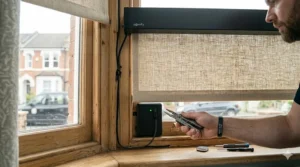
Spring vs Chain Operation: What Most Guides Won’t Tell You
The mechanism debate — spring-loaded versus chain-operated — receives remarkably little honest discussion in most buying guides, presumably because both “work” in the technical sense. Here’s what several years of UK customer feedback reveals:
Chain-operated mechanisms (like those in all products reviewed here) offer precise control and reliable long-term operation. The chain won’t snap back if you release it partway, letting you position the blind exactly where you want. Child safety concerns are manageable with proper safety devices (which all reviewed products include). The main annoyance is the chain itself — it hangs there permanently, which some find aesthetically unappealing. In British homes with limited space, that dangling chain occasionally catches on furniture or creates an obstruction.
Spring-loaded mechanisms (less common in budget roller blinds) eliminate the hanging chain for cleaner aesthetics. However, they’re more temperamental — the spring tension requires periodic adjustment, and they tend to either snap up too fast or refuse to retract fully. In Britain’s humid climate, spring mechanisms can become stiff over time. I typically recommend chain operation for reliability, with the caveat that the chain requires proper installation of safety devices if children or pets are present.
Motorised systems (like the Graywind) eliminate mechanism concerns entirely whilst adding convenience and smart home integration. The motor noise is the main consideration — budget motorised blinds sound like an angry wasp, whilst quality options (including Graywind) operate quietly enough for bedroom use. Battery life varies wildly; solar-powered options exist but work poorly in British winters where sustained sunlight is optimistic at best.
Understanding Roller Blind Fabrics: The Technical Bits That Actually Matter
The fabric determines almost everything about how a roller blind performs, yet it’s where manufacturers are most creative with terminology. Here’s what the terms actually mean in practice for UK buyers:
Blackout Fabrics
Three-pass blackout (like FURNISHED uses) means three layers of coating on the fabric. The first layer bonds to the fabric, the second provides the actual light-blocking properties (usually foam-based), and the third protects the middle layer and provides the visible colour. This construction achieves genuine 100% blackout when properly installed. The thickness means slightly more weight and bulk when rolled up, but the light-blocking performance justifies this minor inconvenience.
Two-pass blackout uses one base layer and one light-blocking layer. It’s cheaper to manufacture and lighter weight, but light blocking is typically 95-98% rather than complete. For most applications this suffices, though shift workers or anyone requiring absolute darkness will notice the difference during bright conditions.
Coated fabrics represent budget blackout attempts — standard fabric with an opaque coating applied. Light blocking ranges from decent to disappointing, with significant variation between manufacturers. The coating can crack over time, particularly if the blind sees heavy use or exposure to temperature cycling (common in British homes without double glazing).
Thermal Properties
“Thermal” means the fabric helps regulate temperature by providing an insulating layer at the window. However, the effectiveness varies enormously. Independent testing at the University of Salford’s Energy House Laboratory confirmed that quality thermal blinds can reduce heat loss through windows by up to 33% on modern double-glazed windows — with even greater savings possible on older single-glazed properties. Basic thermal coating adds perhaps 5-10% improvement over non-thermal fabric — noticeable but not transformative. Enhanced thermal backing (like New Edge uses) can provide 20-30% improvement in heat retention, which is substantial if you’re heating that room regularly.
The thermal benefit works bidirectionally: keeping heat in during winter and keeping heat out during summer. Britain’s temperature range isn’t extreme, but those efficiency gains compound over months of heating seasons. For a bedroom or living room in an older property with poor insulation, thermal blinds genuinely reduce energy bills by several pounds monthly.
Dimout and Light-Filtering
Dimout fabrics reduce light penetration by 70-90% whilst still allowing some glow through. They’re excellent for living rooms where you want privacy without creating a cave-like atmosphere. During British summer evenings when you want to soften the glare without completely blocking your view, dimout strikes a practical balance.
Light-filtering (used in the sheer sections of zebra blinds) diffuses light whilst maintaining some transparency. This creates privacy from outside observers whilst preserving your ability to see general shapes and daylight levels outside. It’s ideal for ground-floor rooms facing public pavements — you get privacy from pedestrians whilst avoiding the “boarded up” appearance of blackout blinds during daytime.
Material Composition
100% polyester dominates the roller blind market for good reasons: it’s durable, resists moisture damage, doesn’t shrink or warp, and holds colour well under UV exposure. British damp climate particularly suits polyester’s moisture resistance. The main drawback is environmental — polyester is petroleum-based, though recycled polyester options (like some Kokorona products) address this concern partially.
Polycotton (used in some FURNISHED blinds) blends cotton and polyester for a more natural feel whilst retaining polyester’s practical benefits. The cotton component makes the fabric slightly softer and reduces static electricity buildup. However, it offers marginally less moisture resistance than pure polyester — rarely an issue unless the blind is installed in an exceptionally damp environment.
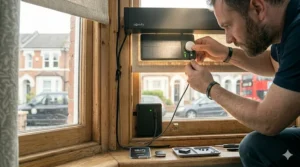
Installation Tips from Thousands of UK Customer Experiences
The following aren’t official instructions (those come with your blind), but rather the practical wisdom gleaned from reading several thousand UK customer reviews:
Before You Start
Measure three times, order once. It bears repeating because it’s where most problems originate. British windows aren’t standardised, and even new-build properties have surprising variation. Use a metal tape measure (fabric measures can stretch) and record all measurements in millimetres to avoid confusion between inches and centimetres.
Check your wall material. Victorian homes might have lath-and-plaster where you can’t drill. 1930s properties often have solid brick where you need a masonry bit. Modern homes use plasterboard over studs, requiring appropriate fixings. A quick tap with your knuckle reveals solid versus hollow areas — plan bracket positions accordingly.
Gather proper tools. You’ll need: cordless drill (if not using no-drill option), appropriate drill bits for your wall type, spirit level (essential — wonky blinds torment you forever), pencil, tape measure, and a hoover for dust containment. Most installation failures stem from inadequate tools rather than user error.
The Installation Process That Actually Works
Mark bracket positions using the blind itself rather than trying to measure distances from the instructions. Hold the blind (still assembled) against the wall where you want it, mark through the bracket holes with pencil, then remove the blind and drill. This approach ensures perfect alignment because you’re using the blind as its own template.
Drill pilot holes slightly smaller than the screws provided. This is particularly crucial in uPVC or wooden frames where oversized holes compromise grip. In soft materials, the screw should require firm (but not excessive) pressure to insert. If it spins freely, the hole is too large and the fixing will fail over time.
Use a spirit level religiously. A blind that’s off-level by even 2-3mm across a 100cm width will be visibly askew and will wear unevenly. The chain will hang at an angle, and the blind may bind on one side. Spend two extra minutes ensuring perfect level — you’ll appreciate it every time you look at the window.
Test operation before final tightening. Install the blind but leave screws slightly loose, then test that it raises and lowers smoothly. If it binds or drags, you can adjust bracket positioning before fully committing. Once you’ve confirmed smooth operation, tighten screws fully.
The British Home Special Cases
Tiled walls (common in bathrooms and kitchens) require patience and the correct drill bit. Mark the spot with tape to prevent the drill bit wandering, start with slow speed to penetrate the glaze, then switch to normal speed once through. Never use hammer action on tiles — you’ll crack them.
Bay windows tempt people toward single large blinds, but three separate blinds (one per window section) usually work better. British bay windows aren’t perfectly uniform, and trying to span the entire bay with one blind creates fitting and operational challenges. The visual separation between three blinds is minimal whilst the practical benefits are substantial.
Windows that open inward need careful consideration. Standard roller blinds project 5-8cm from the wall (depending on brackets), which may interfere with window opening. Either mount the blind high enough to clear the window’s arc of travel, or consider a different fixing method. This is particularly relevant for tilt-and-turn windows popular in newer British properties.
Common Mistakes When Buying Roller Blinds (And How to Avoid Them)
Mistake 1: Prioritising Price Over Fit-for-Purpose
The £15 blackout blind seems brilliant value until you realise your bedroom faces east and summer sunrise at 4:45 AM renders it inadequate. You’ll upgrade within six months, effectively paying twice. Instead, assess your actual requirements first: Do you genuinely need 100% blackout? Is thermal efficiency actually valuable given your heating costs and room insulation? Would zebra blind flexibility better suit your living pattern?
Match the blind to the application rather than gravitating toward the cheapest option that vaguely fits. A £40 thermal blackout blind that reduces your heating costs by £10 monthly is cheaper after four months than the £15 basic option that does nothing for energy efficiency.
Mistake 2: Underestimating Measurement Complexity
Measuring for roller blinds is deceptively simple until you attempt it. Common errors include: measuring between window frames rather than inside the recess itself, forgetting to account for handles or trickle vents that project into the mounting space, assuming your window is square when it’s actually several millimetres off in one corner, and confusing width-by-drop with the reversed height-by-width some suppliers use.
The reliable approach: measure width and height at three points each, photograph your measurements alongside the window, and verify them independently before ordering. If your window is significantly off-square (more than 10mm variation), consider made-to-measure or outside-recess mounting instead.
Mistake 3: Ignoring British Building Quirks
Modern homeowners often underestimate how non-standard British housing is. Properties built before 1950 rarely have true right angles or consistent dimensions. Even if two windows look identical, measuring often reveals 20-30mm differences. Assuming standardisation leads to ordering one size for multiple windows, only to find that only two of the five fit properly.
Always measure each window individually, even if they appear identical. The few extra minutes measuring saves the frustration of returns and replacements. This applies double for Victorian and Edwardian properties where windows were often hand-made and truly unique.
Mistake 4: Overlooking Light Gap Management
Even excellent blackout blinds allow light seepage around edges if improperly installed. The blind fabric itself might block 100% of light, but the 5mm gap between blind edge and window reveal glows like a beacon during sunrise. This is physics, not product failure, yet many buyers don’t consider it until after installation.
For genuine blackout, consider side channels (additional accessories that guide the blind edges), outside-recess mounting with adequate overlap, or combining blinds with light-blocking curtains. Alternatively, accept minor edge glow as inevitable unless you’re willing to invest in complete blackout systems costing considerably more.
Mistake 5: Neglecting Child Safety Compliance
British child safety regulations for window blinds exist because accidents happened frequently enough to necessitate legislation. Roller blinds with cords present genuine strangulation risks to young children. Since February 2014, all blinds sold in the UK must comply with BS EN 13120:2009+A1:2014, which establishes mandatory child safety requirements. Yet many buyers treat the safety device as an optional add-on rather than a mandatory safety feature. Installing the blind without properly securing the chain connector to the wall is negligent, particularly in homes with young children or visiting grandchildren.
Every chain-operated blind sold in the UK must include a chain safety device. Install it properly — typically 1.5m from the floor to keep chain out of children’s reach. This isn’t optional or paranoia; it’s basic child safety. If you’re using no-drill blinds and can’t secure the chain safety device, consider cordless or motorised alternatives instead.
Roller Blind Maintenance for Long-Term Performance
British homes demand more from window treatments than many climates due to our persistent humidity and rapid temperature cycling. Proper maintenance extends blind lifespan from a few years to a decade or more:
Weekly and Monthly Care
Dust accumulation affects roller blinds invisibly until you suddenly notice the fabric looks dull. A quick pass with a vacuum cleaner’s brush attachment monthly prevents buildup. Pay particular attention to the headrail area where dust collects in the mechanism. Don’t use the vacuum’s main suction directly on fabric — the suction can distort lighter materials.
Chain mechanism requires only occasional attention. If the chain becomes stiff or jerky, a tiny amount of silicone spray on the chain mechanism (not the chain itself) restores smooth operation. Don’t use oil-based lubricants, which attract dust and eventually gum up the mechanism.
Seasonal Deep Clean
Fabric cleaning depends on material type. Polyester roller blinds tolerate gentle wiping with a damp cloth and mild detergent. For stubborn marks, a very slightly moistened magic eraser works remarkably well without damaging most fabrics. Always test in an inconspicuous corner first. Never machine wash roller blind fabric — the coating will crack and the fabric will deform.
Blackout blinds show dirt more readily than patterned fabrics. Light colours particularly reveal dust accumulation. However, overly aggressive cleaning damages the blackout coating. The reliable method: vacuum first to remove loose dust, then spot-clean specific marks with barely-damp cloth. Less is more.
Addressing Common Issues
Binding or uneven rolling usually indicates the blind isn’t level or dust has accumulated in the side channels. Check the spirit level positioning first — if the blind has shifted (sometimes happens with adhesive mounts), re-level before assuming mechanical failure. Clean side channels if present, ensuring no debris obstructs fabric travel.
Fabric sagging or loose rolling suggests the tension mechanism needs adjustment. Most roller blinds have a tension adjustment point (usually at one end of the tube). Detailed instructions vary by manufacturer, but the general principle involves adding or reducing spring tension until the blind hangs taut. Don’t over-tighten, which stresses the fabric and mechanism.
Fading or discolouration is normal after several years of UV exposure, particularly on south or west-facing windows. Quality blinds include UV inhibitors that slow this process, but nothing stops it entirely. Darker colours show fading less than lighter shades. If aesthetics matter, budget for blind replacement every 5-7 years for sun-exposed windows.
Frequently Asked Questions
❓ Can roller blinds really reduce heating costs in UK homes?
❓ Which roller blind type works best for rental properties?
❓ How do I stop light gaps around the edges of blackout blinds?
❓ Are motorised roller blinds worth the extra cost in 2026?
❓ What's the realistic lifespan of roller blinds in British homes?
Final Thoughts: Making Your Decision
Choosing roller blinds needn’t be overwhelming once you understand that “best” is meaningless without context. The “best” blind for a shift worker’s bedroom differs entirely from the “best” for a south-facing living room, which differs again from the “best” for a rental property bathroom.
Start with your specific requirements rather than gravitating toward whatever product currently sits atop the best-seller list. Consider your room’s orientation, your privacy needs, your energy efficiency priorities, and your installation circumstances (rental versus owned, competent DIYer versus installation-averse). Match those requirements to the products reviewed here, recognising that spending £40 wisely often delivers better value than spending £80 on features you’ll never use.
For most UK buyers in 2026, I’d recommend the FURNISHED Thermal Blackout for bedrooms needing genuine darkness and energy efficiency, the FURNISHED or Kokorona Zebra blinds for living rooms valuing light control flexibility, and the Amazon Basics No-Drill for renters or temporary installations. Those aren’t prescriptive recommendations but rather starting points based on what thousands of British customers report working well in practice.
Remember that roller blinds are functional tools before they’re aesthetic statements. A blind that saves you £60 annually on heating costs but doesn’t perfectly match your colour scheme is a better investment than a colour-perfect blind that does nothing for insulation. Prioritise performance matching your needs, then optimise for aesthetics within that functional category.
Recommended for You
- 7 Best Blackout Roman Blinds UK 2026
- Best Roman Blinds UK 2026: 7 Top Picks & Buying Guide
- Best Eyelet Curtains 90×90 Drop UK: 7 Expert Picks 2026
Disclaimer: This article contains affiliate links. As an Amazon Associate, I earn from qualifying purchases. If you purchase products through these links, we may earn a small commission at no additional cost to you.
✨ Found this helpful? Share it with your mates! 💬🤗
