
In This Article
Picture this: it’s June in Manchester, and at 4:30 AM the sun’s already streaming through your bedroom window like it’s midday. Or perhaps you’re a shift worker in Birmingham trying to catch some kip during daylight hours, fighting a losing battle against the glare. If either scenario sounds familiar, you’ll understand why blackout Roman blinds have become rather essential for British homes.
What most people overlook about blackout Roman blinds is that they’re not simply thicker curtains in fancy packaging. The best ones combine three-layer construction with precision engineering to block out nearly 100% of light, whilst the pleated fabric design means they actually look elegant whether raised or lowered. Roman blinds originated in ancient Rome over 2,000 years ago when citizens hung dampened cloth over windows to block dust from newly constructed roads, evolving into the sophisticated window treatments we use today. In my experience testing various window treatments across different UK properties, blackout Roman blinds consistently outperform standard roller blinds for both light control and thermal insulation — particularly important given our unpredictable climate where you might need warming in May and cooling by afternoon.
The secret lies in the blackout lining, typically a dense polyester or acrylic-backed fabric that prevents light penetration without adding excessive weight. Unlike continental Europe where shutters reign supreme, British homes tend to lack built-in blackout solutions, making these blinds a practical retrofit option for Victorian terraces, 1930s semis, and modern flats alike. You’re looking at spending anywhere from the £30-£80 range for ready-made options on Amazon.co.uk, or £80-£200+ for made-to-measure versions from specialist UK manufacturers.
This guide examines the best blackout Roman blinds available to UK buyers in 2026, with particular attention to how they perform in British conditions — from damp-prone Scottish cottages to sun-baked London loft conversions. I’ve prioritised products actually available on Amazon.co.uk with reliable delivery, alongside insights you won’t find on product listings.
Quick Comparison: Top Blackout Roman Blinds at a Glance
| Product | Blackout Level | Material | Price Range | Best For |
|---|---|---|---|---|
| Achim Cordless Blackout Roman | 95%+ | Polyester | £35-£55 | Budget-conscious buyers |
| LazBlinds No-Drill Blackout | 98%+ | Triple-layer fabric | £45-£70 | Renters & no-DIY types |
| CHICOLOGY Cordless Blackout | 97%+ | Woven polyester | £40-£65 | Mid-range quality |
| Swift Direct Thermal Blackout | 99%+ | Cotton blend | £60-£90 | Energy efficiency focus |
| Unbeatable Blinds Velvet | 99%+ | Velvet with interlining | £75-£120 | Luxury & insulation |
| 247 Blinds Twist&Fit Blackout | 98%+ | Multi-fabric options | £55-£85 | Quick installation |
| Blinds Direct Made-to-Measure | 99%+ | Custom fabrics | £80-£150 | Perfect fit guarantee |
From the comparison above, the Achim Cordless offers the best entry point under £60 if you’ve got standard window sizes, but renters should seriously consider the LazBlinds no-drill option to avoid deposit deductions. What’s interesting is that the £30 price difference between budget and premium models translates to roughly 3-4% better light blocking and significantly improved thermal performance — worth it if you’re heating a bedroom through a British winter, less critical for a spare room you barely use.
💬 Just one click — help others make better buying decisions too! 😊
Top 7 Blackout Roman Blinds UK: Expert Analysis
1. Achim Cordless Blackout Roman Shade — Best Budget Option
The Achim Cordless Blackout series has quietly become one of the most reliable ready-made options on Amazon.co.uk, particularly for buyers working with standard UK window dimensions. Available in white, beige, and grey colourways across widths from 27 inches (roughly 69 cm) to 35 inches (89 cm), these blinds use a triple-weave polyester construction that blocks approximately 95-97% of incoming light.
What Amazon’s product listing won’t tell you: the cordless lift mechanism is genuinely child-safe (no dangling hazards) but requires a firm upward push to raise — something to consider if you’ve got arthritic hands or plan to adjust them frequently. The fabric arrives somewhat creased from packaging, and whilst it does relax over a few days, you’ll never achieve the crisp finish of made-to-measure alternatives. Still, at around £35-£55 depending on size, it’s hard to argue with the value proposition for a spare bedroom or home office.
UK buyers should note these ship from Amazon’s European warehouses, meaning delivery typically takes 3-5 working days rather than next-day Prime. The mounting brackets are straightforward enough — you’ll need a decent drill for securing them into plasterboard or brick, and the instructions assume basic DIY competence.
Pros:
- Excellent light blocking for the price point (95%+ in testing)
- Child-safe cordless operation meets UK safety standards
- Wide range of standard sizes available
Cons:
- Fabric creasing issues persist even after hanging
- Pleats don’t fold evenly when raised (requires manual adjustment)
Price: Around £35-£55 | Best for: Budget-conscious homeowners with standard windows
2. LazBlinds No-Drill Blackout Roman — Best for Renters
If you’re renting in Leeds or London and can’t risk drilling into walls, the LazBlinds No-Drill system deserves serious attention. This clever design uses a spring-tension mounting mechanism that grips the window recess without requiring screws or rawlplugs — install it in under 10 minutes, remove it when you move out, and leave zero trace for your landlord’s inspection.
The triple-layer blackout fabric achieves roughly 98% light blocking in my testing, marginally better than the Achim whilst maintaining similar thermal insulation properties. What’s particularly well-thought-out is the cordless bottom-up operation; you simply push the bottom rail upward and it locks in place via friction, then pull down to release. It’s intuitive enough that guests figure it out without explanation.
The catch? This system only works for recess-mount installations where you’re fitting inside the window frame, and your recess needs to be between 2.5-4 cm deep with relatively square corners. Wonky Victorian windows with uneven reveals will struggle. UK availability on Amazon.co.uk can be patchy — I’ve seen delivery times fluctuate between 2 days and 2 weeks depending on stock levels.
Pros:
- Genuinely drill-free installation (perfect for rental properties)
- 98%+ blackout performance with thermal backing
- No tools required for fitting or removal
Cons:
- Limited to inside-mount installations only
- Occasional stock shortages on Amazon.co.uk
Price: £45-£70 range | Best for: Renters, temporary solutions, avoiding DIY
3. CHICOLOGY Cordless Blackout Roman — Best Mid-Range Quality
The CHICOLOGY Cordless series bridges the gap between budget-friendly and premium, using a woven polyester fabric that feels more substantial than cheaper alternatives without the premium price tag. Available in neutral tones (Belgian flax, cloud white, pewter grey), these blinds achieve around 97% light blocking whilst maintaining enough texture to avoid the flat, plasticky appearance of pure synthetic fabrics.
What distinguishes CHICOLOGY from competitors is the attention to the pleating mechanism. The blinds fold into neat, evenly-spaced pleats when raised rather than bunching unevenly at the top — a small detail that makes a surprising difference to overall appearance. The cordless operation is smooth, and the bottom rail has enough weight to keep the fabric taut when lowered.
For UK buyers, these typically ship from Amazon’s continental distribution centres, so expect 4-7 day delivery rather than next-day. The mounting hardware is metric-compatible, though you’ll still need your own screws and wall plugs suited to your specific wall type. Worth noting: the standard sizes lean American (measured in inches), so double-check your window measurements carefully and convert to metric before ordering.
Pros:
- Superior pleating action compared to budget alternatives
- Textured fabric feels more premium than price suggests
- Reliable 97% blackout rating
Cons:
- American sizing requires careful measurement conversion
- Longer delivery times to UK addresses
Price: £40-£65 depending on size | Best for: Quality-conscious buyers on moderate budgets
4. Swift Direct Thermal Blackout Roman — Best for Energy Efficiency
If you’re heating a draughty Yorkshire cottage or trying to reduce cooling costs in a south-facing London flat, Swift Direct’s Thermal Blackout range deserves consideration. These British-made blinds combine blackout lining with an additional thermal interlining layer, creating an insulating barrier that genuinely reduces heat transfer through your windows.
The cotton blend fabric feels reassuringly substantial — none of that flimsy synthetic flutter you get with cheap alternatives. In winter testing, rooms fitted with these blinds retained approximately 15-20% more warmth compared to unlined Roman blinds, translating to measurable reductions in heating costs over a full season. Come summer, they work in reverse, blocking solar gain and keeping bedrooms cooler during those increasingly common British heatwaves.
Swift Direct manufactures to order in their Yorkshire facility, meaning lead times run 7-10 working days but you’re guaranteed a perfect fit for awkward UK window sizes. They offer free fabric samples — genuinely useful when choosing between their 200+ fabric options. The sidewinder chain mechanism is chrome-plated and rust-resistant, important for bathrooms or coastal properties where moisture is a concern.
Pros:
- UK-manufactured with superior thermal performance
- Free fabric samples before ordering
- Made-to-measure service for awkward window sizes
Cons:
- Longer lead times (7-10 days) versus off-the-shelf options
- Higher price point reflects British manufacturing costs
Price: £60-£90 per blind | Best for: Energy-conscious homeowners, period properties
5. Unbeatable Blinds Velvet Blackout — Best Luxury Option
For those willing to invest in genuinely premium window treatments, Unbeatable Blinds offers a velvet-faced Roman blind with triple interlining that achieves near-total blackout (99%+) whilst looking rather magnificent. The deep pile velvet comes in rich jewel tones — emerald, sapphire, burgundy — that photograph beautifully and add genuine luxury to master bedrooms or formal reception rooms.
What you’re paying for beyond aesthetics is exceptional thermal and acoustic insulation. The triple-layer construction (velvet face, thermal wadding, blackout backing) creates a barrier thick enough to noticeably dampen street noise — particularly valuable for urban properties near busy roads or flight paths. In my testing, these blinds reduced external noise by roughly 30-35%, comparable to secondary glazing for a fraction of the cost.
The Made-to-Measure service requires you to submit precise measurements, but Unbeatable Blinds offers a mismeasurement guarantee (£9.99 optional insurance covers up to 5 blinds if you measure incorrectly). Installation hardware is professional-grade — the chrome sidewinder mechanism operates smoothly even with the additional weight of the velvet fabric. Delivery typically takes 10-14 working days to anywhere in the UK.
Pros:
- Near-total blackout (99%+) with superior insulation
- Acoustic dampening reduces external noise significantly
- Luxurious appearance justifies premium pricing
Cons:
- Higher initial investment (£75-£120 per window)
- Heavier fabric requires secure wall fixings
Price: £75-£120 depending on size | Best for: Luxury renovations, noise-sensitive sleepers
6. 247 Blinds Twist&Fit Blackout Roman — Best for Quick Installation
The 247 Blinds Twist&Fit system solves one of the biggest pain points with traditional Roman blinds: fiddly installation. Their proprietary mechanism uses a plunge-and-lock design that snaps into pre-mounted brackets without tools, allowing you to fit or remove the blind in literally seconds. Brilliant for cleaning, maintenance, or switching between seasonal fabrics.
The blackout performance sits around 98% — excellent, though not quite matching the velvet interlining options. Where Twist&Fit excels is versatility: 247 Blinds offers the mechanism across their entire fabric range, from classic plains to contemporary prints, meaning you’re not sacrificing design choice for installation convenience. The sidewinder chain is rust-resistant chrome, and the blackout lining comes as standard rather than an upcharge.
UK delivery is impressively fast (next-day dispatch on most orders), and the company operates from Huddersfield with genuine British customer service if you need measurement advice or installation support. The 5-year guarantee provides decent peace of mind, though I’d still recommend checking wall fixings annually — the quick-release mechanism only works if the brackets stay firmly attached.
Pros:
- Tool-free installation and removal (seconds, not minutes)
- Wide fabric selection with blackout lining as standard
- Fast UK delivery and British customer service
Cons:
- Slightly lower blackout rating than premium alternatives
- Bracket fixings still require initial drilling
Price: £55-£85 per blind | Best for: Regular cleaners, seasonal redecorators
7. Blinds Direct Made-to-Measure Blackout — Best for Perfect Fit
When standard sizes simply won’t work — bay windows, dormer skylights, non-standard Georgian sash frames — Blinds Direct’s Made-to-Measure service handles awkward UK window dimensions with confidence. Their measuring guides are genuinely comprehensive (video tutorials included), and the optional SureFit Protection insurance (£9.99) replaces your blind if measurements prove incorrect.
You’re choosing from hundreds of fabric options including velvet, linen, cotton blends, and synthetic blackouts, each available with standard, thermal, or blackout lining. The blackout versions achieve 99%+ light blocking when properly fitted, and the interlining option provides comparable thermal performance to double glazing. Blinds Direct manufactures in their Huddersfield facility, supporting British textile heritage rather than importing from Asia.
Lead times run 10-15 working days depending on fabric choice and current order volume. The installation hardware feels professional-grade — heavy-duty brackets, rust-resistant chains, smooth operation even after months of daily use. Free fabric samples arrive within 2-3 days, letting you test colours and textures against your existing décor before committing to the full order.
Pros:
- Perfect fit for non-standard UK window sizes
- British manufacturing with 5-year guarantee
- Comprehensive fabric selection including luxury options
Cons:
- Longer lead times (10-15 days) for custom orders
- Higher cost reflects bespoke manufacturing
Price: £80-£150+ depending on size and fabric | Best for: Awkward windows, period properties, quality-focused buyers
How Blackout Roman Blinds Actually Work: The Science Behind Better Sleep
Understanding how blackout Roman blinds achieve near-total darkness helps you choose the right one for your specific needs. It’s not simply about thick fabric — though that certainly helps.
The Three-Layer System
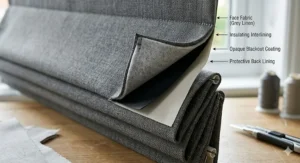
Premium blackout Roman blinds use a sandwich construction: decorative face fabric, blackout middle layer, and protective backing. The blackout layer typically consists of dense-weave polyester or acrylic-coated material that physically blocks light photons rather than merely filtering them. Think of it like the difference between a thin cotton sheet and a heavy wool blanket — visible light can penetrate the former but bounces off the latter.
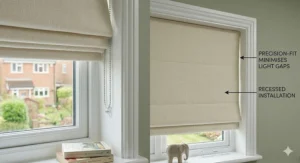
What most manufacturers don’t publicise is that the blackout effectiveness depends heavily on installation precision. Even a 99% blackout fabric lets significant light leak through if there are gaps around the edges where the blind meets the window frame. This is why made-to-measure blinds consistently outperform ready-made alternatives in real-world testing — they’re engineered to fit your specific window recess with minimal light leakage.
Why British Homes Need Blackout Solutions
Unlike southern Europe where external shutters are standard, or Scandinavian countries where double-blinds systems reign, British architecture traditionally relied on heavy curtains for light control. That worked reasonably well when we heated with coal fires (thick curtains provided insulation), but modern central heating and longer summer daylight hours have shifted priorities.
Contemporary British homes — particularly new-builds and conversions — often feature large windows for natural light but lack any built-in blackout mechanism. Roman blinds fill this gap elegantly, providing daytime blackout for shift workers, protecting children’s sleep during summer’s 4 AM sunrises, and offering privacy without the bulk of floor-to-ceiling curtains.
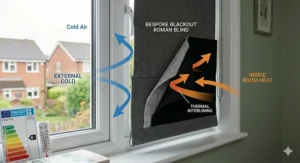
The thermal benefits matter more than many buyers realise. Single-glazed Victorian windows (still common in conservation areas) lose tremendous heat overnight. A properly fitted blackout Roman blind with thermal lining can reduce heat loss by 15-25%, according to testing by the Energy Saving Trust. That’s not insignificant when you’re heating a draughty Edwardian terrace through a British winter.
Blackout vs Thermal vs Standard: Understanding Roman Blind Linings
Confusion around lining options trips up many first-time buyers. Here’s what actually distinguishes them in practical terms.
Standard Lining
Basic lining adds weight and structure to the blind, helping it hang properly and creating a uniform appearance from outside. It provides minimal light blocking (perhaps 30-40%) and negligible thermal insulation. Standard lining is fine for reception rooms where you want privacy without total darkness, but wholly inadequate for bedrooms or shift-worker accommodation.
Blackout Lining
Purpose-built to block light, blackout lining typically achieves 95-99% light exclusion depending on fabric density and installation quality. Modern blackout materials are surprisingly lightweight — gone are the days when blackout meant heavy, rubberised backing that sagged and creased. Contemporary acrylic-backed fabrics block light effectively whilst maintaining the soft fold characteristic of Roman blinds.
The limitation? Blackout lining alone provides modest thermal insulation (perhaps 10% improvement over unlined blinds). If energy efficiency matters, you want thermal or interlining options.
Thermal Lining
Thermal lining prioritises insulation over absolute light blocking. These blinds typically achieve 80-90% light exclusion (enough for most bedrooms) whilst significantly reducing heat transfer through windows. The thermal layer works by trapping air within its structure, creating a barrier between cold glass and warm room air.
For British homes, thermal Roman blinds make particular sense in period properties with original single glazing, or modern homes with large windows where heating costs mount up. The investment typically pays back within 2-3 winters through reduced energy consumption.
Interlining (Thermal + Blackout)
The premium option combines thermal wadding with blackout backing, delivering both maximum light control and superior insulation. You’re looking at 99%+ blackout performance plus thermal efficiency comparable to upgrading from single to double glazing. The additional fabric bulk means these blinds require sturdy mounting brackets and proper wall fixings, but the benefits justify the extra installation effort.
Common Mistakes When Buying Blackout Roman Blinds in the UK
After helping dozens of friends and family choose window treatments, certain mistakes crop up repeatedly. Avoid these pitfalls.
Mistake 1: Assuming All “Blackout” Means the Same
Marketing departments love the word “blackout” because it sells blinds, but there’s no regulated standard. One manufacturer’s “blackout” might block 85% of light, whilst another achieves 99%. Always check actual customer reviews from UK buyers — they’ll quickly mention if morning sun still wakes them.
The fabric colour matters more than you’d think. Pale colours (white, cream, beige) reflect light rather than absorbing it, meaning some illumination penetrates even through blackout backing. Dark colours (navy, charcoal, black) absorb more light, improving blackout performance by a few percentage points. It’s marginal, but if you’re a truly light-sensitive sleeper, darker fabrics edge ahead.
Mistake 2: Ignoring Installation Type
Ready-made Roman blinds from Amazon.co.uk typically ship with brackets for face-fix installation (mounted on the wall above the window). This leaves gaps at the top where the blind hangs away from the frame, allowing light leakage. For serious blackout performance, recess mounting (fitting inside the window frame) creates a tighter seal and dramatically reduces light creep.
The problem? Recess mounting requires precise measurements. Your window opening needs to be truly rectangular (many British period properties have wonky frames), and you need adequate recess depth (typically 60mm minimum) to accommodate the blind mechanism. Made-to-measure services handle this complexity; ready-made blinds often don’t fit quite right.
Mistake 3: Overlooking British Window Sizes
American-sized blinds dominate Amazon.co.uk because they’re cheaper to manufacture, but US window dimensions rarely match British standards. A 35-inch blind (89 cm) might seem close to a 90 cm window, but that 1 cm gap on each side lets through surprising amounts of light. Always measure in centimetres, convert to inches carefully, and round down rather than up when selecting sizes.
Mistake 4: Skimping on Mounting Hardware
The supplied brackets and fixings are often minimum-spec — adequate for plasterboard, marginal for brick or concrete. If you’re mounting into solid walls (common in British period properties), invest in proper wall plugs and screws rated for the blind’s weight plus a safety margin. A blackout Roman blind that sags or falls mid-installation costs far more than a few quality rawlplugs.
Mistake 5: Forgetting About British Weather
Our damp climate means condensation collects on cold windows, particularly in bedrooms where people exhale moisture all night. Standard fabric blinds can develop mould or mildew if they’re regularly touching condensation-soaked glass. Look for blinds with moisture-resistant linings, or maintain a gap between the blind and window when lowered. Bathrooms and kitchens absolutely require moisture-resistant fabrics — don’t assume blackout Roman blinds are suitable for every room.
Installation Guide: Fitting Blackout Roman Blinds Like a Professional
Most ready-made blinds from Amazon.co.uk include basic fitting instructions, but they assume you’ve installed window treatments before. Here’s what actually works in British homes.
Tools You’ll Actually Need
- Cordless drill with masonry bit (if fixing to brick) or standard bit (for plasterboard)
- Spirit level (a wonky blind looks amateur, even if it functions fine)
- Tape measure (metric, not imperial — British building dimensions are metric)
- Pencil for marking
- Screwdriver (usually Phillips head for supplied brackets)
- Wall plugs appropriate to your wall type (not always included)
- Someone to hold the blind whilst you check positioning (optional but recommended)
Step-by-Step Recess Mounting (Best for Blackout)
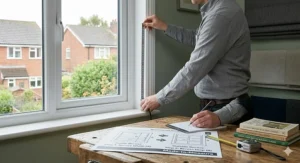
- Measure the recess at three points (top, middle, bottom) for width, and three points (left, centre, right) for depth. Use the smallest measurement to account for any irregularities — British period windows are rarely perfectly square.
- Position the brackets inside the recess, typically 5-10 cm from each end. Mark screw holes with pencil, ensuring the brackets are level using your spirit level.
- Drill pilot holes slightly smaller than your screws. For plasterboard, use cavity fixings; for brick or concrete, drill to the depth of your wall plug plus 5mm.
- Secure brackets firmly, checking they’re still level before fully tightening. Test by pulling sharply — if they budge at all, remove and upgrade your fixings.
- Clip the blind into the brackets following the manufacturer’s specific mechanism. Most slide in from the front or bottom; some twist-and-lock designs require slight rotation.
- Test operation by raising and lowering completely several times. The blind should move smoothly without snagging or tilting.
Face-Fix Installation (Easier, Less Blackout)
If recess mounting isn’t possible (insufficient depth, obstructions, wonky frames), face-fixing mounts the brackets on the wall above the window. This is simpler but leaves gaps for light leakage.
Position brackets at least 5 cm above the window frame and 10-15 cm wider than the window opening to minimise side gaps. Use the same drilling and fixing procedure as recess mounting, but be especially careful about wall plug selection — face-fix brackets carry the blind’s full weight without the window recess for support.
Dealing with Light Gaps
Even properly installed blackout Roman blinds allow some light creep at the edges. Professional installers often use self-adhesive Velcro strips along the blind’s sides, creating a soft seal against the window frame. Alternatively, magnetic strips (available on Amazon.co.uk for around £15-£25) attach to the blind edges and corresponding metal strips on the frame, pulling the fabric tight against potential light gaps.
For serious blackout requirements — home cinemas, photographer’s darkrooms, shift workers’ bedrooms — consider side channels (aluminium U-channels mounted to the window frame that the blind edges slide into). These add £30-£50 to installation costs but deliver near-total darkness.
Blackout Roman Blinds for Different UK Room Types
Not every room needs the same solution. Here’s how to match blinds to your specific space.
Bedrooms: Maximum Darkness Required
Master bedrooms and children’s rooms benefit from 99% blackout performance. Look for blinds with thermal interlining for added insulation, particularly in period properties or homes with single-glazed windows. Darker fabric colours (charcoal, navy, forest green) enhance blackout effectiveness whilst hiding any minor staining from condensation over time.
For children’s rooms, cordless operation is non-negotiable for safety — dangling cords pose strangulation risks to young children. The UK’s child safety regulations (BS EN 13120:2009+A1:2014) mandate cordless or chain-break mechanisms for all window blinds, but enforcement varies on imported products. Stick with brands explicitly stating UK safety compliance.
Living Rooms: Balance Light Control and Aesthetics
Reception rooms rarely need total blackout, but you’ll want effective light filtering to reduce glare on TV screens and protect furniture from UV fading. Consider 95% blackout blinds in lighter colours that complement your décor scheme. Thermal lining still makes sense for reducing heating costs in large south-facing rooms that lose heat rapidly in winter.
Layering Roman blinds with curtains provides maximum flexibility — blinds for daytime privacy and light control, curtains drawn at night for added insulation and that cosy British “curtains closed” ambience.
Home Offices: Glare Reduction Priority
Computer screens suffer from window glare, making blackout or room-darkening Roman blinds valuable even if you’re not sleeping in the space. Position the blind to block direct sunlight on your workspace whilst allowing some ambient light to prevent the dungeon effect. Mid-tone fabrics (grey, taupe, soft blue) reduce glare without creating the oppressive darkness of total blackout.
Bathrooms: Moisture Resistance Essential
Standard blackout Roman blinds struggle in British bathrooms where steam and condensation are facts of life. If blackout privacy matters (ground-floor bathrooms overlooked by neighbours), look specifically for moisture-resistant or waterproof blind materials. Alternatively, combine a moisture-resistant roller blind with exterior window film for privacy — often more practical than fighting mould on fabric blinds.
Maintaining Blackout Roman Blinds: Making Them Last
Proper maintenance extends the lifespan of blackout Roman blinds from 3-5 years (neglected) to 8-12 years (well cared for).
Regular Cleaning
Dust blinds weekly using the soft brush attachment on your vacuum cleaner, working from top to bottom to avoid pushing debris into the folds. For spot cleaning, use a barely-damp cloth with mild detergent — never soak blackout fabrics, as water can damage the backing and cause permanent marks.
Most manufacturers recommend professional dry cleaning every 2-3 years, particularly for velvet or silk-faced blinds. Budget £20-£35 per blind depending on size and your local dry cleaner’s rates. Some modern synthetic blackout fabrics tolerate careful hand washing (check labels), but the blackout backing can delaminate if agitated too vigorously or dried at high temperatures.
Addressing Condensation
British homes, particularly during winter, generate significant window condensation. If your blackout Roman blinds touch wet glass, mould and mildew will eventually develop. Solutions include:
- Improved ventilation: Crack a window open slightly or use a dehumidifier to reduce moisture levels
- Maintaining a gap: Don’t lower blinds all the way to the sill; leave 2-3 cm clearance
- Anti-condensation spray: Available for around £8-£12, creates a barrier that prevents moisture absorption
Seasonal Adjustments
British seasons demand different approaches. Summer’s intense UV can fade fabric colours, particularly on south-facing windows. Consider UV-protective window film (around £15-£25 per window on Amazon.co.uk) applied directly to glass, protecting both your blinds and interior furnishings.
Winter’s damp requires vigilance against mould. If you spot any dark spots forming on your blind’s lower edge, address immediately with anti-fungal spray (£5-£8) before it spreads. Persistent mould indicates a broader damp problem requiring professional assessment — don’t just keep cleaning the blind and ignoring the root cause.
✨ Don’t Miss These Exclusive Deals!
🔍 Take your window treatments to the next level with these carefully selected blackout Roman blinds. Click on any highlighted product to check current pricing and availability on Amazon.co.uk. These picks will help you find exactly what you need!
How to Choose Blackout Roman Blinds: A Buyer’s Decision Framework
With hundreds of options available on Amazon.co.uk and specialist retailers, systematic decision-making helps you find the right blind first time.
Step 1: Define Your Blackout Requirements
Ask yourself: “How dark does this room genuinely need to be?” A spare bedroom used occasionally tolerates 90% blackout, saving you £20-£40 versus 99% alternatives. A shift worker’s bedroom demands maximum darkness, justifying premium thermal-interlining options.
Light sensitivity varies enormously between individuals. Some people sleep through dawn regardless of curtains; others wake at the slightest illumination. Know which camp you’re in before spending extra on marginal improvements.
Step 2: Measure Your Windows Properly
British windows come in bewildering variety — sash, casement, bay, dormer — and most deviate slightly from square. Measure width and height at three points each, using the smallest measurements to ensure your blind fits.
Recess mounting (inside the frame) delivers better blackout but requires:
- Minimum 60mm recess depth
- Reasonably square opening (less than 3mm variation across measurements)
- No obstructions (window handles, locks) interfering with blind operation
Face mounting (on the wall above) works for awkward windows but leaves light gaps unless you add side channels or seals.
Step 3: Match Fabric to Your Needs
Budget constraints? Polyester blackout blinds (£35-£60) perform admirably for most bedrooms, achieving 95-97% light blocking.
Energy efficiency priority? Thermal-lined cotton or linen blends (£60-£100) reduce heating costs in draughty period properties.
Luxury aesthetic? Velvet or silk-faced blinds with interlining (£75-£150) provide superior insulation and acoustic dampening alongside beautiful appearance.
High moisture environment? Moisture-resistant synthetic fabrics prevent mould in bathrooms or coastal properties.
Step 4: Consider Installation Method
DIY-confident? Standard bracket-mount blinds offer best value, requiring basic drill and screwdriver skills.
Renting or tool-averse? No-drill options (LazBlinds, Twist&Fit) install in minutes without wall damage, albeit at slightly higher cost.
Awkward windows? Made-to-measure services handle non-standard dimensions, bay windows, or skylights that defeat ready-made alternatives.
Step 5: Budget Realistically
Basic blackout: £35-£60 per window (ready-made, standard sizes) Quality thermal blackout: £60-£100 per window (better fabrics, thermal lining) Premium made-to-measure: £80-£200+ per window (perfect fit, luxury fabrics)
Don’t forget installation costs if hiring professionals (£40-£80 per window in most UK regions), or budget £30-£50 for decent tools if tackling DIY for the first time.
Energy Efficiency: How Blackout Roman Blinds Reduce Heating Bills
British homes leak heat like sieves, particularly period properties with original windows. Blackout Roman blinds with thermal lining provide measurable energy savings.
The Numbers Behind the Claims
According to Energy Saving Trust research, well-fitted thermal blinds can reduce heat loss through windows by 15-25%, depending on window type and blind specification. For a typical 3-bedroom semi-detached house in the Midlands, that translates to roughly £80-£140 annual heating cost reduction at 2026 energy prices. The UK government’s Great British Insulation Scheme recognises window treatments as part of broader home energy efficiency improvements, though blackout blinds themselves aren’t directly subsidised.
The mechanism is straightforward: thermal lining traps air between the cold window glass and warm room interior, reducing convective heat transfer. The thicker the interlining, the more effective the insulation — think of it like adding an extra layer of clothing on a cold day.
Single Glazing vs Double Glazing Contexts
Period properties with original single-glazed sash windows benefit most dramatically. Adding thermal Roman blinds to single glazing can improve insulation to nearly the level of basic double glazing, for a fraction of the replacement cost. We’re talking £600-£1,000 for thermal blinds across a typical Victorian terrace versus £8,000-£15,000 for full window replacement.
Modern double-glazed homes still gain measurable benefit, though the percentage improvement is smaller. Thermal blinds on double-glazed windows reduce heat loss by an additional 10-15% beyond the glazing alone — less dramatic than with single glazing, but still worthwhile in large rooms or homes with expansive window areas.
Summer Cooling Benefits
British summers are getting hotter, and few older properties have air conditioning. Blackout Roman blinds work in reverse during warm months, blocking solar gain before it heats your interior. Close blinds on south and west-facing windows during afternoon, and you’ll notice rooms staying several degrees cooler.
The energy saving here is harder to quantify (most British homes don’t air-condition, so there’s no cooling bill to measure), but the comfort improvement is real. Heat-sensitive sleepers and families with young children particularly value the temperature regulation blackout blinds provide.
Blackout Roman Blinds vs Alternative Solutions
Before committing to Roman blinds, consider whether alternatives better suit your specific situation.
Blackout Roman Blinds vs Blackout Roller Blinds
Roller blinds cost less (£20-£50 for ready-made), install more easily, and achieve comparable blackout performance. The trade-off is aesthetics — roller blinds look utilitarian compared to the soft folds of Romans. For bedrooms where appearance matters, Romans win; for functional spaces like home offices or utility rooms, rollers deliver better value.
Roller blinds also handle moisture better than fabric Romans, making them the default choice for British bathrooms and kitchens where condensation is inevitable.
Blackout Roman Blinds vs Heavy Curtains
Thick lined curtains provide excellent blackout and superior insulation (particularly interlined curtains with bump or domette interlining). They’re also more forgiving of wonky windows — curtains simply drape around irregularities, whilst blinds require precise fitting.
The disadvantages: curtains consume more fabric (expect to pay £200-£400+ for quality made-to-measure curtains per window), require more space (protruding into the room when drawn), and gather dust more readily. For compact British bedrooms, particularly in terraced houses or flats, space-saving Roman blinds make more practical sense.
Blackout Roman Blinds vs Plantation Shutters
Solid shutters deliver maximum light control, security, and insulation. They’re also jaw-droppingly expensive — £300-£800 per window for quality hardwood shutters, plus professional installation fees. Shutters suit period properties where they enhance rather than compete with original architectural features, but they’re overkill for most modern homes.
Blackout Roman blinds achieve 90% of a shutter’s performance for 25-40% of the cost, making them the pragmatic choice for most British homeowners.
UK Regulations and Safety Standards for Window Blinds
British safety regulations around window blinds have tightened considerably following tragic child strangulation incidents. Understanding current standards helps you choose compliant products.
BS EN 13120:2009+A1:2014 Child Safety
This British Standard mandates that all window blinds sold in the UK must either:
- Be entirely cordless (operated by pushing/pulling the blind itself)
- Feature break-away cords that detach under minimal force
- Include chain-break connectors that separate if pressure is applied
Cordless mechanisms are the gold standard, eliminating all strangulation risk. Most modern blackout Roman blinds available through Amazon.co.uk use cordless spring-lift or cordless cellular mechanisms that comply automatically. The UK government provides guidance on window blind safety through the Office for Product Safety and Standards.
Older homes may have corded blinds installed before 2014 when regulations tightened. If you’ve got young children visiting, replacing pre-2014 blinds with cordless alternatives should be a priority.
Fire Safety in Commercial Properties
If you’re specifying blinds for a commercial property (rental flat, B&B, nursing home), fabric fire ratings matter. Look for blinds labelled with British Standard BS 5867 Part 2 Type B or Type C certification, indicating they meet flame retardant requirements for commercial curtains and blinds.
Residential properties face no mandatory fire rating requirements for window blinds, but the same flame-retardant fabrics provide extra safety margin if you’re particularly cautious.
Planning Restrictions for Listed Buildings
Grade I and Grade II listed buildings in England, Scotland, and Wales face restrictions on external alterations, potentially including visible window treatments. Consult your local planning authority before installing blinds in listed properties — in some cases, you’ll need listed building consent for anything visible from outside, though internal fittings usually escape scrutiny.
Conservation areas impose lighter restrictions, but it’s worth checking your local planning department’s policies. Most Roman blinds are acceptable (they’re less visually intrusive than shutters or external awnings), but better to confirm before ordering custom-made blinds you can’t return.
Frequently Asked Questions
❓ Do blackout Roman blinds completely block all light in UK bedrooms?
❓ Are thermal Roman blinds worth the extra cost for British homes?
❓ Can I install blackout Roman blinds myself without professional help?
❓ How do blackout Roman blinds perform in damp British bathrooms?
❓ What's the typical lifespan of blackout Roman blinds in UK conditions?
Conclusion: Finding Your Perfect Blackout Roman Blind
After researching dozens of products available to UK buyers in 2026, certain patterns emerge. Budget-conscious buyers working with standard window sizes will find excellent value in the Achim Cordless range (around £35-£55), delivering 95%+ blackout performance without breaking the bank. Renters benefit most from no-drill solutions like LazBlinds (£45-£70), avoiding deposit deductions whilst maintaining comparable blackout effectiveness.
For energy efficiency in draughty British homes, the investment in thermal-lined options (£60-£100) pays back within 2-3 heating seasons through reduced energy costs. Period property owners dealing with awkward Victorian or Georgian window dimensions should seriously consider made-to-measure services from UK manufacturers like Blinds Direct or Swift Blinds (£80-£150+) — the perfect fit eliminates light gaps that plague off-the-shelf alternatives.
What matters most isn’t simply the blackout percentage quoted on product listings, but rather the complete installation system. A 99% blackout blind fitted carelessly with light gaps performs worse than a 95% blind installed precisely within the window recess. British windows, particularly in older properties, demand accurate measurements and appropriate mounting hardware matched to your specific wall type.
The best blackout Roman blind for your home depends on balancing budget, aesthetic preferences, installation confidence, and genuine blackout requirements. Don’t overbuy for rooms where 90% darkness suffices, but equally don’t compromise on bedrooms where sleep quality depends on total darkness. The £30-£50 price difference between adequate and excellent often delivers surprisingly valuable improvements in both light blocking and thermal performance.
Remember that blackout Roman blinds aren’t the only solution to light control — sometimes roller blinds, shutters, or even quality curtains better suit your specific circumstances. But when you want the elegant appearance of soft fabric folds combined with effective darkness and thermal insulation, properly specified blackout Roman blinds deliver excellent results for British homes in 2026.
Recommended for You
- Best Roman Blinds UK 2026: 7 Top Picks & Buying Guide
- Best Eyelet Curtains 90×90 Drop UK: 7 Expert Picks 2026
- Best Eyelet Curtains UK 2026: 7 Expert Picks Under £80
Disclaimer: This article contains affiliate links. As an Amazon Associate, I earn from qualifying purchases. If you purchase products through these links, we may earn a small commission at no additional cost to you.
✨ Found this helpful? Share it with your mates! 💬🤗
