
In This Article
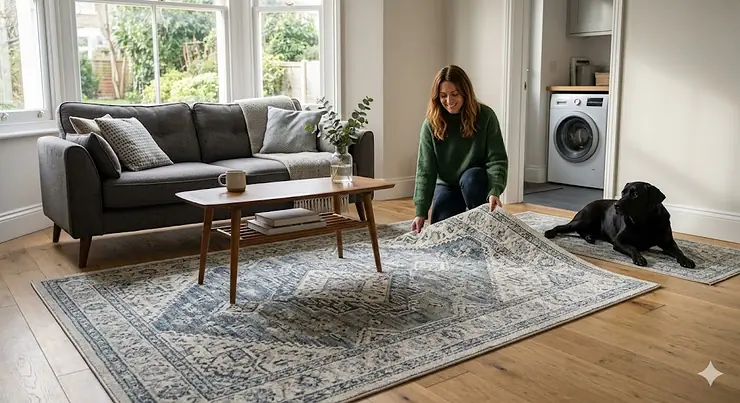
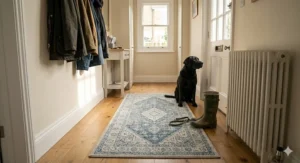
Spilled your morning tea on the living room rug? Again? If you’ve ever faced the grim prospect of scrubbing muddy paw prints out of a cream-coloured hall runner on a drizzly Tuesday evening, you’ll understand why machine washable rugs have become rather popular in UK households.
The British climate—with its perpetual drizzle and muddy boots season lasting roughly nine months—makes traditional rugs a genuine liability. According to the Met Office, the UK experiences rainfall on average 156 days per year, with some regions seeing considerably more. Add a couple of energetic children, a Labrador who thinks puddles are swimming pools, and perhaps a cat with questionable aim, and you’ve got yourself a recipe for flooring-related despair. Machine washable rugs solve this peculiarly British problem with surprising elegance.
Unlike their traditional counterparts that require professional cleaning (typically costing £80-£150 for a medium-sized rug), these innovative floor coverings can be chucked straight into your washing machine at 30°C. What most UK buyers overlook about this technology is that it’s not merely about convenience—it’s about maintaining a presentable home without the constant anxiety that comes with light-coloured fabrics in a family environment. The market has evolved considerably since Ruggable pioneered the two-piece system in 2016, and British shoppers now have access to dozens of styles, materials, and price points on Amazon.co.uk, many with Prime next-day delivery.
This guide examines seven real products available on Amazon.co.uk right now, with detailed commentary on how they perform in actual British homes—not American suburbs with their different climate and living arrangements. We’ll cover everything from budget options under £50 to premium alternatives that rival traditional rugs in appearance whilst maintaining that crucial washability factor.
Quick Comparison: Top Machine Washable Rugs at a Glance
| Product | Material | Price Range | Best For | OEKO-TEX Certified |
|---|---|---|---|---|
| THE RUGS Striped Cotton Mix | 55% Polyester, 45% Cotton | £40-£80 | Budget-conscious families | Yes |
| DEXI Non-Slip Kitchen Runner | 100% Polyester | £35-£65 | High-traffic kitchens | Yes |
| HOMESCAPES Chenille Collection | Cotton Chenille | £60-£120 | Living room comfort | No |
| Livabliss Modern Geometric | Low-pile Polyester | £70-£150 | Contemporary aesthetics | Yes |
| PHP Shaggy Soft Touch | Microfibre Polyester | £50-£95 | Bedroom luxury | No |
| THE RUGS Moroccan Trellis | Polypropylene Blend | £55-£110 | Statement pieces | Yes |
| GENIMO Vintage Persian Style | Heat-set Polypropylene | £45-£90 | Traditional décor | Yes |
💬 Just one click — help others make better buying decisions too! 😊
Top 7 Machine Washable Rugs: Expert Analysis
1. THE RUGS Striped Cotton Blend Collection
THE RUGS has quietly become one of Amazon.co.uk’s most reliable brands for washable floor coverings, and their striped cotton blend series demonstrates why. The 55% polyester and 45% cotton composition strikes a proper balance—enough synthetic content to survive repeated washing without disintegrating, yet sufficient natural fibre to avoid that plasticky feel some cheaper alternatives suffer from.
The non-slip latex backing works remarkably well on British flooring types (laminate, engineered wood, tiles), though it does require the occasional wipe-down as dust accumulates underneath. Available in sizes from 80×150 cm up to 200×290 cm, these rugs suit everything from narrow Victorian hallways to more generous modern living rooms. What the spec sheet won’t tell you is that the grey stripe option hides dirt considerably better than the lighter variants—rather important when you’re dealing with the Great British Mudbath that occurs between October and March.
Customer feedback from UK buyers consistently praises the colour retention after multiple washes, though several reviewers note the rug emerges from the machine slightly wrinkled and requires laying flat to settle. The cotton content means these do shrink marginally (roughly 2-3%) after the first wash, so factor that into your sizing calculations.
Pros:
✅ OEKO-TEX Standard 100 certified—safe for nurseries and playrooms
✅ Natural cotton blend feels pleasant underfoot
✅ Holds colour well through 15+ washes based on UK customer reviews
Cons:
❌ Requires flat drying—no tumble dryer
❌ Initial shrinkage of 2-3% after first wash
Price range: Around £40-£80 depending on size. The 120×170 cm sits in the mid-£50s, which represents solid value for a rug you can confidently throw in the wash every fortnight without worrying about degradation. Best suited for families with young children who haven’t yet mastered the art of not spilling everything.
2. DEXI Non-Slip Kitchen Runner
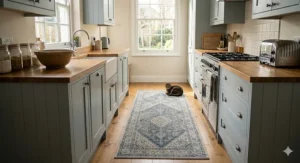
If you’re after a straightforward, no-nonsense kitchen runner that can handle the realities of British cooking (splattered Bolognese, dropped beetroot, the inevitable red wine incident), DEXI delivers exactly that. The 100% polyester construction won’t win awards for eco-credentials, but it does mean this runner can survive weekly washing without complaint.
The non-slip backing uses a rubberised material rather than the foam-backed alternatives some competitors employ. In practice, this makes a genuine difference on tile floors—the rug stays put even when you’re shuffling about making your third cup of tea before 9 AM. Available in 60×180 cm and 60×240 cm runner formats, these fit nicely in galley kitchens or along kitchen islands.
What most buyers overlook about this model is its deliberately low pile height (approximately 6mm). This isn’t a plush, sink-your-toes-in affair—it’s designed for practicality in a working kitchen where you’ll be standing for extended periods. The thin profile also means it fits comfortably under most kitchen cabinet doors, which thicker rugs struggle with. UK reviewers note it dries quickly (important in British homes where indoor drying is the norm nine months a year) and emerges from the 30°C wash cycle without the colour bleeding that plagues cheaper alternatives.
Pros:
✅ Excellent grip on tiles and laminate
✅ Dries within 4-6 hours on a clothes horse
✅ OEKO-TEX certified—no nasty chemicals near your food prep area
Cons:
❌ Very thin pile—comfort sacrificed for practicality
❌ Limited colour options (mostly greys and beiges)
Price range: £35-£65 depending on length. The 60×180 cm typically sits around £40, which is entirely reasonable for something you’ll be washing every week or two. This one’s designed for utility rather than aesthetics—if you want a kitchen rug that looks spectacular, keep looking. If you want one that handles the chaos of actual cooking, this does the job.
3. HOMESCAPES Chenille Collection
The HOMESCAPES range represents what happens when a brand prioritises comfort and appearance over purely utilitarian concerns. Their chenille collection uses 100% cotton chenille yarns, which creates that gloriously soft, almost velvety texture underfoot. This is proper luxury for a machine washable rug, though you do pay for the privilege—expect to spend £60-£120 depending on size.
The thickness (approximately 12mm pile height) makes these genuinely comfortable for living rooms where you might sit on the floor, practice yoga, or let children play. Unlike the thinner, more plasticky alternatives, these actually look like traditional rugs from a distance. Available in sizes from 60×90 cm bath mats up to 120×170 cm area rugs, the range covers most typical UK room dimensions without venturing into the massive American-style sizing that won’t fit through your front door.
The trade-off for this luxury is washing logistics. Anything above 100×150 cm becomes rather heavy when wet, and you’ll need a larger-capacity washing machine (8kg minimum, ideally 10kg) to handle it properly. Several UK reviewers mention using a launderette’s commercial machines for the larger sizes, which adds £8-£12 per wash to the running costs. In the damp British climate, expect 24-48 hours drying time if you’re laying it flat indoors. The rug does tend to shed initially—perfectly normal for cotton chenille, but worth knowing if you’ve got dark hardwood floors where the fluff shows up.
Pros:
✅ Genuinely luxurious feel—comparable to traditional high-end rugs
✅ Cotton chenille provides excellent warmth for cold British floors
✅ Sophisticated colour options beyond the usual beige-grey spectrum
Cons:
❌ Larger sizes require commercial washing machines
❌ Long drying time in typical British conditions
Price range: Around £60-£120. The 90×150 cm living room size typically sits in the £75-£85 range. This one’s for buyers who want their washable rug to look and feel like it cost considerably more—ideal for sitting rooms where appearance matters, less suitable for muddy hallways.
4. Livabliss Modern Geometric Collection
Livabliss has carved out a niche for contemporary design in the machine washable market, and their geometric collection demonstrates rather sophisticated pattern work for rugs in this price category. The low-pile polyester construction (pile height around 7-8mm) uses heat-set polypropylene in some variants, which holds patterns more crisply than the cheaper printed alternatives.
What distinguishes this range is the attention to current interior design trends. Rather than the generic patterns that dominated washable rugs five years ago, these feature proper geometric designs—chevrons, hexagons, and abstract linear patterns that wouldn’t look out of place in a design magazine. The colour palettes lean toward muted greys, navy blues, and terracotta tones that work well in modern British homes with Farrow & Ball-type colour schemes.
The OEKO-TEX Standard 100 certification means these meet stringent safety standards, though the synthetic material does generate some static electricity in dry conditions (less of an issue in perpetually damp Britain than in centrally heated American homes, admittedly). Available in 80×150 cm, 120×170 cm, and 160×230 cm, the sizing works well for UK living rooms and bedrooms. UK customers note these ship from European warehouses, typically arriving within 3-5 days with Prime.
The rubber backing provides adequate grip on most surfaces, though a few reviewers mention adding rubber corner grips on very smooth laminate flooring. Machine washing at 30°C works perfectly—the geometric patterns don’t blur or fade even after 20+ cycles. The thin profile means it dries relatively quickly (12-18 hours on a clothes horse), and you can tumble dry on low heat if necessary, though this does accelerate wear.
Pros:
✅ Contemporary patterns that actually look modern
✅ OEKO-TEX certification for peace of mind
✅ Relatively quick drying for British indoor conditions
Cons:
❌ Synthetic material can feel slightly plasticky in warm weather
❌ May require additional grip aids on very smooth floors
Price range: £70-£150 depending on size. The popular 120×170 cm sits around £95. This suits urban flats and modern homes where design matters—you’re paying a premium for style over pure functionality, but if you want a washable rug that doesn’t scream “I’m machine washable,” this delivers.
5. PHP Shaggy Soft Touch
For those who associate “rug” with “something plush you sink into,” PHP’s Shaggy collection scratches that particular itch. The microfibre polyester construction creates a deep pile (approximately 30-35mm) that feels genuinely luxurious underfoot—rather like walking on a dense cloud, assuming clouds were made of synthetic fibres and came in tasteful shades of grey.
This high pile creates specific challenges in British homes. The rug acts as a remarkably effective dirt trap, which cuts both ways—it prevents tracked-in mud from spreading across your floors, but it also requires vigorous shaking before washing to dislodge embedded debris. Several UK reviewers develop a routine: shake outside, vacuum thoroughly, then wash. Skipping the preliminary steps overloads the washing machine with detritus.
Available in 80×150 cm, 120×170 cm, and 140×200 cm sizes, these suit bedrooms beautifully—stepping onto deep, soft pile on a cold November morning is considerably more pleasant than hitting cold laminate. The shaggy texture also provides decent sound dampening in flats where noise transmission is a concern. What the marketing won’t mention is that the high pile makes these unsuitable for rooms with wheeled furniture (office chairs, coffee tables on castors)—the pile compresses and doesn’t fully recover.
The microfibre sheds considerably for the first month, then settles down. Washing works well at 30°C, though wringing out a wet shaggy rug is rather like wrestling a soggy sheep. Drying takes 36-48 hours in typical British conditions—plan accordingly. The lack of OEKO-TEX certification might concern families with very young children, though PHP assures compliance with general UK safety standards.
Pros:
✅ Genuine luxury feel—no compromises on comfort
✅ Excellent for cold floors in British winters
✅ Good sound dampening properties for flats
Cons:
❌ Extensive drying time in British climate
❌ Not suitable for rooms with wheeled furniture
Price range: Around £50-£95. The bedroom-friendly 120×170 cm typically costs £65-£75. This one’s specifically for spaces where comfort trumps practicality—bedrooms, reading nooks, or anywhere you want something genuinely soft underfoot. Not recommended for hallways, kitchens, or anywhere subjected to heavy foot traffic and frequent spills.
6. THE RUGS Moroccan Trellis
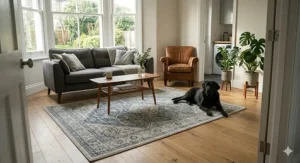
Returning to THE RUGS for their Moroccan-inspired range, this collection demonstrates that machine washable rugs needn’t look utilitarian. The polypropylene blend construction uses a medium pile height (approximately 10-12mm) that balances comfort with practicality, whilst the trellis pattern provides visual interest without overwhelming smaller British rooms.
The pattern work here deserves specific mention. Rather than the blurry, printed-on designs that characterise cheaper washable rugs, this uses a proper woven technique that creates texture and depth. From across a room, you’d struggle to identify this as a washable rug—it looks like a mid-range traditional piece. Available in pink, green, and grey colourways, the palette works well with both contemporary and more traditional British interiors.
The non-slip backing uses the same latex formulation as THE RUGS’ other ranges, which performs consistently well on UK flooring types. Sizes span 80×150 cm up to 200×290 cm, though the larger sizes do push washing machine capacity—8kg machines handle up to 160×230 cm comfortably, whilst the 200×290 cm requires 10kg capacity or a trip to the launderette.
UK customer feedback highlights this rug’s colour retention through multiple washes, though the pink variant does fade slightly faster than the grey or green options. The polypropylene resists staining remarkably well—red wine, coffee, and mud all lift out with standard washing without requiring pre-treatment. The rug sheds minimally after the first wash, unlike some cheaper alternatives that produce clouds of fluff for weeks.
Pros:
✅ Attractive Moroccan-inspired design suitable for various décor styles
✅ OEKO-TEX certified—safe for family homes
✅ Excellent stain resistance for British living conditions
Cons:
❌ Larger sizes require substantial washing machine capacity
❌ Pink colourway fades marginally faster than other options
Price range: Around £55-£110 depending on size. The versatile 120×170 cm sits in the £70-£80 bracket. This suits living rooms and dining areas where you want a proper decorative element that happens to be washable, rather than an obviously practical choice. The Moroccan pattern provides enough visual interest to anchor a room without overwhelming it.
7. GENIMO Vintage Persian Style
GENIMO’s vintage Persian collection rather cleverly bridges the gap between traditional aesthetics and modern practicality. The heat-set polypropylene construction mimics the look of hand-knotted Persian rugs—complete with intricate borders, central medallions, and deliberately faded “vintage” colouring—whilst maintaining the crucial washability factor.
The manufacturing process uses digital printing on a low-pile base (approximately 6-7mm), then heat-sets the design to prevent colour bleeding. This technology has improved considerably over the past few years, and these rugs genuinely look like traditional pieces from a distance. The “distressed” finish helps hide the occasional stain or wear mark, making these particularly suitable for high-traffic areas in British homes.
Available in sizes from 80×150 cm to 160×230 cm, the range covers typical UK room proportions without venturing into the oversized territory that won’t fit most British living rooms. The thin pile makes these ideal for placing under dining tables or in doorways where thicker rugs create tripping hazards. Several UK reviewers specifically praise these for use in rental properties where security deposits depend on not damaging the landlord’s carpets.
The OEKO-TEX certification provides peace of mind for families, whilst the synthetic material proves remarkably durable—some UK customers report 50+ washes without significant degradation. The thin profile means these dry quickly (10-16 hours on a clothes horse), and they emerge from the machine without the wrinkling that plagues some cotton-blend alternatives. The colours run slightly warm-toned, which works well with British homes’ typically yellow-toned lighting.
Pros:
✅ Traditional Persian aesthetic at a fraction of the cost
✅ Quick drying time suits British indoor drying conditions
✅ OEKO-TEX certified with excellent durability
Cons:
❌ Thin pile offers limited cushioning
❌ Printed design rather than woven—close inspection reveals this
Price range: Around £45-£90. The popular 120×170 cm typically costs £60-£70. This one’s specifically for buyers who want traditional aesthetics in spaces where practicality matters—dining rooms under tables, hallways near exterior doors, or rental properties where washability prevents security deposit disputes. The vintage styling means minor marks and fading actually enhance rather than detract from the appearance.
Real-World Application: Matching Rugs to British Households
Let’s translate these product specifications into actual British living scenarios, because “low-pile polyester” means rather different things depending on whether you’re in a Victorian terrace in Manchester or a modern flat in Brighton.
The Urban Family (Two Adults, Two Children Under 8, One Medium Dog)
Location: Semi-detached in Birmingham Challenge: Muddy paws October through March, frequent spills, limited storage
For this scenario, THE RUGS Striped Cotton Blend in the darker grey colourway makes most sense as a living room centrepiece (120×170 cm, around £60). The cotton-poly blend handles weekly washing without complaint, the dark stripes hide minor marks between washes, and the price point means replacing it in three years doesn’t sting. Pair this with DEXI Kitchen Runners (around £40 for the 60×180 cm) to protect the highest-traffic route from back door to kitchen sink.
Budget: £100 total. Washing frequency: Living room rug fortnightly, kitchen runner weekly. This combination survives the chaos of primary school-age children and a Labrador who thinks “wipe your paws” is merely a suggestion. The key insight here is that dark colours in high-traffic areas buy you an extra week between washes—valuable when you’re juggling work, school runs, and everything else.
The Professional Couple in a Modern Flat
Location: Two-bedroom flat in central London Challenge: Design matters, limited washing machine capacity (7kg), wants contemporary aesthetic
The Livabliss Modern Geometric range suits this scenario perfectly. A 120×170 cm for the living area (around £95) provides that contemporary design element without looking obviously practical. The low pile fits the flat’s underfloor heating without creating dead spots, and the thin profile means the 7kg machine handles it comfortably.
For the bedroom, the PHP Shaggy in a smaller 80×150 cm (around £50) adds luxury without overwhelming the machine’s capacity. Total budget: £145. Washing frequency: Living room monthly (more for aesthetics than necessity), bedroom every 6-8 weeks. This combination prioritises appearance and comfort whilst maintaining the crucial washability—useful when you’re hosting dinner parties in a compact space where spills happen.
The Retired Couple in a Rural Cottage
Location: Semi-rural village in the Cotswolds Challenge: Dealing with muddy country walks, flagstone floors, period property aesthetics
The GENIMO Vintage Persian style (160×230 cm, around £90) works beautifully in a cottage sitting room—the traditional design complements period features whilst the washability handles muddy dogs after countryside rambles. The thin pile works well over the uneven flagstones that characterise older properties.
Add a HOMESCAPES Chenille runner (90×150 cm, around £75) in the bedroom for warmth on cold mornings—the cotton content feels pleasant on elderly feet, and the higher pile provides cushioning on hard floors. Total budget: £165. Washing frequency: Persian rug monthly (or after particularly muddy walks), chenille runner every 6-8 weeks.
The crucial consideration here is washing logistics. At 78 and 82 respectively, this couple uses the village launderette’s commercial machines (£8 per wash) for the larger Persian rug, washing the smaller bedroom piece at home. The annual washing cost (roughly £100 for the Persian, £40 for the chenille) still undercuts professional rug cleaning (£150-£200 annually for two rugs).
How to Choose Machine Washable Rugs: The UK Buyer’s Framework
Choosing the right machine washable rug for British conditions requires considering factors beyond mere aesthetics. Here’s the proper decision-making framework:
1. Assess Your Washing Machine Capacity First
This isn’t glamorous, but it’s essential. A standard UK washing machine holds 7-8kg. A dry 120×170 cm rug weighs approximately 2-3kg; wet, it can reach 8-10kg. If your machine struggles with a double duvet, it won’t handle larger washable rugs. Measure your drum capacity honestly before falling in love with that 200×290 cm statement piece. For flats with 6kg machines common in compact kitchens, stick to rugs under 100×150 cm or accept using launderettes.
2. Match Pile Height to Room Function and Flooring Type
Low pile (under 10mm): Kitchens, dining rooms, hallways, anywhere with heavy foot traffic or furniture on castors. Works over underfloor heating without creating dead spots.
Medium pile (10-20mm): Living rooms, bedrooms, spaces where comfort matters but practicality still features. Balances aesthetics with washing logistics.
High pile (20mm+): Bedrooms only, unless you enjoy wrestling soggy carpets. Provides luxury but demands patience during drying in British conditions.
British homes with flagstone, tiles, or engineered wood benefit from low-pile options that don’t shift underfoot. Carpeted rooms can accommodate higher piles as the underlying carpet provides the non-slip foundation.
3. Calculate True Cost of Ownership in British Context
Purchase price tells only part of the story. Factor in:
- Washing frequency realistic for your household (weekly? monthly? quarterly?)
- Energy costs (30°C washes cost approximately 35-45p per cycle currently)
- Launderette fees if applicable (£6-£12 per large wash)
- Expected lifespan (quality rugs: 4-6 years; budget options: 18-24 months)
- Replacement costs
A £150 rug washed monthly at home costs roughly £55 annually in energy (£150 + £55 × 5 years = £425 total). A £45 rug requiring launderette washing monthly costs £144 annually in washing fees alone (£45 + £144 × 2 years = £333 total). Sometimes the premium option proves cheaper over time.
4. Prioritise OEKO-TEX Standard 100 Certification for Family Homes
This certification guarantees the rug contains no harmful chemicals—crucial for homes with crawling babies, toddlers who put everything in their mouths, or pets who spend considerable time on floors. OEKO-TEX Standard 100 tests for over 1,000 harmful substances, including heavy metals, formaldehyde, and pesticide residues. Worth the marginal price premium for peace of mind, particularly given British homes’ relatively poor ventilation compared to newer builds with mechanical systems.
5. Consider British Climate Impact on Material Choice
Cotton blends: Absorb moisture readily—problematic in damp British homes but feel more natural. Require longer drying times (24-48 hours).
Polyester/polypropylene: Resist moisture effectively—dry faster (10-18 hours), perform better in British humidity. Can feel slightly synthetic.
Microfibre: Soft and luxurious but trap moisture—extended drying time (36-60 hours) makes these challenging in flats without outdoor space.
British homes rely primarily on indoor drying nine months yearly. Fast-drying synthetic materials prove more practical than romantic cotton options unless you’ve got outdoor space or a utility room with a dehumidifier.
6. Account for British Flooring Types
Victorian/Edwardian terraces: Often uneven floors—thinner rugs conform better, reducing trip hazards.
Modern flats: Usually very smooth laminate—need excellent non-slip backing or additional corner grips.
Period cottages with flagstone: Require thicker pile for comfort over hard, cold surfaces.
Carpeted homes: Any pile height works as the underlying carpet provides grip and cushioning.
7. Factor in Storage and Handling Realities
Can you actually lift a wet 160×230 cm rug out of your washing machine? Many buyers overlook this practical consideration. Wet rugs weigh considerably more than dry ones—a large wet rug can reach 12-15kg, challenging for individuals with mobility issues. British terraced houses with narrow stairs create additional challenges for moving large rugs between floors.
Common Mistakes When Buying Machine Washable Rugs
British buyers repeatedly make predictable errors when selecting washable rugs. Learning from others’ expensive mistakes seems rather more sensible than making them yourself.
Mistake 1: Ignoring UK Washing Machine Load Capacity
The most frequent error involves purchasing rugs too large for domestic machines. American websites often assume 10-12kg machines as standard; British homes typically have 7-8kg capacity. The result: a lovely rug that won’t actually fit in your machine, necessitating £8-£12 launderette visits that quickly negate any savings over professional cleaning. Always check your machine’s drum capacity (usually marked inside the door) before ordering.
Mistake 2: Underestimating Drying Time in British Climate
Reviewers from California mention 6-8 hour drying times; British buyers find 24-48 hours more realistic. Our perpetually damp climate makes indoor drying the norm from September through May, and synthetic rugs don’t release moisture quickly in cold, humid conditions. Buyers without adequate drying space (clothes horse, spare bedroom, or utility room) struggle with wet rugs occupying living areas for days. This proves particularly problematic for families who need the rug back in action quickly.
Mistake 3: Choosing Light Colours for High-Traffic Areas
That gorgeous cream rug looks spectacular in the Amazon photos—until you place it in a British hallway during autumn. Light colours show every muddy footprint, requiring washing frequencies that dramatically shorten lifespan. UK customers consistently report regretting cream, beige, or white rugs in hallways, kitchens, and near exterior doors. Dark greys, navy blues, and patterned designs hide marks far more effectively in British conditions.
Mistake 4: Overlooking UKCA/OEKO-TEX Certification
Some buyers focus purely on aesthetics and price, ignoring safety certifications. This matters particularly for children’s rooms and nurseries, where babies spend hours on floors. Non-certified rugs may contain formaldehyde, heavy metals, or pesticide residues—legal in some countries but undesirable in spaces where toddlers crawl and explore with their mouths. OEKO-TEX Standard 100 certification ensures rigorous testing for harmful substances, providing peace of mind worth the minor price premium. British buyers are protected by the Consumer Rights Act 2015, which requires products to be safe and as described, but independent certification provides additional assurance.
Mistake 5: Not Measuring Furniture Clearances
British homes often feature lower-set furniture than American equivalents—kitchen cabinets, bedroom drawers, and sofa skirts sit closer to floors. Thick-pile rugs (20mm+) won’t slide under furniture properly, creating unsightly edges and trip hazards. Buyers should measure clearances before ordering high-pile rugs, particularly for kitchens where cabinet kickboards leave minimal space.
Mistake 6: Assuming “Machine Washable” Means “Tumble Dryer Safe”
These are distinct properties. Many machine washable rugs explicitly prohibit tumble drying, as the heat damages backing materials and can cause shrinkage or warping. British buyers accustomed to tumble drying everything find this frustrating, particularly in winter when indoor drying space is scarce. Always check care labels—rugs requiring air drying need alternative drying arrangements.
Mistake 7: Buying Solely Based on Amazon Reviews from Other Climates
American reviewers operate in vastly different conditions—lower humidity, more sunshine, larger washing machines, and different flooring types. A rug praised by Californian buyers for quick drying may perform differently in a damp Manchester flat. Prioritise reviews from UK customers, particularly those mentioning British-specific issues like drying time, mould resistance, and performance on British flooring types. Independent UK consumer testing from organizations like Which? can also provide valuable insights based on British household conditions.
Machine Washable Rug Technology: What Actually Makes Them Work
Understanding the engineering behind washable rugs helps explain their capabilities and limitations—particularly important when marketing claims sound rather optimistic.
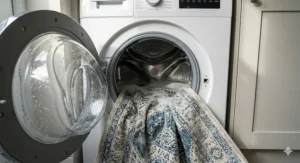
Traditional rugs fail in washing machines because their construction never anticipated such treatment. Hand-knotted wool rugs use techniques developed centuries before washing machines existed; the fibres, dyes, and backing materials disintegrate when subjected to mechanical agitation and submersion. Machine washable rugs use fundamentally different construction:
The Backing Revolution
The critical innovation involves the backing material. Traditional rugs use jute, hessian, or similar natural fibres that rot when repeatedly soaked. Machine washable alternatives employ synthetic latex, rubber, or specialised polymer blends that tolerate water exposure without degradation. These backings allow washing at 30°C without hesitation, ending worries about dirt on your favourite design rug.
THE RUGS and similar brands use latex-based non-slip backings that serve dual purposes: providing grip on smooth floors whilst surviving dozens of wash cycles. The backing accounts for roughly 30-40% of the rug’s weight and significantly impacts washability—cheaper alternatives using foam backing deteriorate after 10-15 washes, whilst quality latex formulations withstand 50+ cycles.
Spillproof Coating Technology
Premium washable rugs use a water-based coating solution commonly used in medical and outdoor clothing, which separates oils, stains, and liquids from the fabric, causing them to bead up rather than absorb into the rug. This coating explains why red wine or coffee spills on quality washable rugs can be blotted up rather than requiring immediate washing—the liquid sits on the surface rather than penetrating fibres.
This technology requires specific material choices. Natural fibres like cotton absorb moisture readily, making spillproof coatings less effective. Synthetic polyester and polypropylene provide the non-porous foundation necessary for coating adhesion. The trade-off involves that slightly synthetic feel compared to natural wool—acceptable for high-traffic areas, less appealing for bedrooms where tactile comfort matters.
Heat-Set Printing and Colourfast Dyes
Cheap washable rugs print patterns directly onto fabric using standard textile inks—these fade rapidly with washing. Quality alternatives use heat-set processes that bond dyes molecularly to synthetic fibres, creating colourfast designs that survive 30-40 washes before showing significant fading. This explains price variations between seemingly similar rugs—the manufacturing process differs substantially.
GENIMO’s heat-set polypropylene construction demonstrates this technology effectively. The intricate Persian-style patterns maintain detail and colour intensity through dozens of washes because the dyes are heat-bonded rather than surface-applied. British buyers benefit from this technology particularly, given our tendency to wash rugs more frequently than necessary (partly from anxiety about dirt, partly from having the washing machine capacity spare).
The Two-Piece System (Ruggable-Style)
Ruggable popularised the two-piece approach: a permanent rug pad with Velcro-like texture, plus a removable cover featuring the actual design. This system allows washing just the cover rather than the entire rug, reducing washing machine load and drying time. The covers use thin, printed polyester (approximately 2-3mm thick) that washes and dries rapidly—crucial for British indoor drying.
The drawback involves the initial investment—both pad and cover must be purchased—and the covers can shift slightly on the pad with heavy foot traffic. British users report needing to realign covers weekly in hallways, less frequently in low-traffic rooms. The system works brilliantly for families who need to wash rugs weekly, less compellingly for those washing monthly where integrated designs prove more practical.
Limitations of Current Technology
Despite marketing claims, machine washable rug technology has inherent constraints. The synthetic materials required for washability feel different from natural wool—less warm, slightly plasticky, and lacking wool’s natural sound dampening. The low-pile construction necessary to fit standard washing machines means less cushioning than traditional high-pile rugs. British buyers should understand these represent fundamental trade-offs rather than manufacturing defects.
The lifespan of machine washable rugs tops out around 4-6 years with regular washing—traditional quality rugs last decades. The agitation that cleans clothing proves harder on rug fibres than everyday foot traffic, with repeated cycles matting fibres, stripping protective treatments, and accelerating visible wear. Factor this into value calculations: a £150 washable rug lasting five years costs £30 annually, whilst a £600 traditional rug lasting twenty years costs £30 annually plus periodic professional cleaning (£80-£150 yearly). The economics favour washable rugs primarily for households with young children or pets where frequent deep cleaning is essential.
Machine Washable Rugs vs Traditional Alternatives: The British Perspective
British buyers face a genuine choice between machine washable rugs and traditional alternatives. Each approach suits different circumstances, and understanding the trade-offs helps make informed decisions.
Upfront Cost Comparison (120×170 cm Rug, GBP)
| Type | Initial Cost | Annual Maintenance | 5-Year Total |
|---|---|---|---|
| Budget Machine Washable | £50 | £30 (washing) | £200 (inc. replacement) |
| Quality Machine Washable | £120 | £35 (washing) | £295 |
| Mid-Range Traditional | £300 | £120 (professional cleaning) | £900 |
| High-End Traditional | £800 | £150 (professional cleaning) | £1,550 |
From this comparison, machine washable rugs deliver clear savings for households requiring frequent cleaning—families with young children, multiple pets, or messy hobbies. The break-even point occurs around three professional cleanings annually. Below that frequency, traditional rugs prove more cost-effective when their superior longevity is factored. British buyers dealing with muddy seasons October through March typically exceed three deep cleans annually, tilting economics toward washable alternatives.
Aesthetic and Comfort Considerations
Traditional wool rugs feel warmer and more substantial underfoot—wool’s natural properties include excellent insulation and sound dampening. In British homes with hard flooring (increasingly common as carpets fall from favour), this makes a genuine difference to comfort. High-quality traditional rugs also age beautifully, developing patina that synthetic alternatives cannot match.
Machine washable rugs sacrifice some of this comfort for practicality. The thin pile and synthetic materials feel less luxurious, though modern manufacturing has narrowed this gap considerably. HOMESCAPES’ chenille collection demonstrates that machine washable doesn’t necessarily mean compromised comfort—their cotton chenille rivals traditional rugs whilst maintaining washability. The gap remains most obvious in budget ranges, where thin polyester feels distinctly synthetic.
Environmental Impact in British Context
The environmental calculation proves more complex than it initially appears. Traditional wool rugs use natural, renewable materials and last decades—minimal resource consumption when amortised over their lifespan. However, their cleaning requires chemical treatments and professional facilities that consume significant water and energy.
Machine washable rugs use synthetic materials (petroleum-derived polyester and polypropylene) but allow home washing with standard detergents at 30°C. A typical 30°C wash cycle consumes approximately 0.5-0.6 kWh of electricity—roughly 10-12p at current British energy prices. Over five years with monthly washing, that’s £6-£7.20 in electricity. Professional cleaning uses industrial washing equipment consuming 15-20 kWh per rug, plus transport emissions.
The synthetic materials in washable rugs eventually require disposal (British councils accept textiles for recycling, though synthetic rugs often end in general waste). Traditional wool rugs biodegrade but rarely reach disposal—they’re repaired, repurposed, or resold. British buyers prioritising environmental impact should consider usage patterns: high-wash-frequency households generate less environmental impact with washable rugs, whilst low-wash-frequency households favour traditional options.
Storage and Seasonal Considerations
British homes notoriously lack storage space. Machine washable rugs provide flexibility here—they can be washed, dried, and folded into compact spaces during summer when rugs feel excessive. Traditional rugs require professional storage or occupy significant cupboard space. For flats and smaller British homes, this storage advantage matters considerably.
Seasonal rug rotation—heavy rugs for winter warmth, lighter ones for summer—works more practically with washable alternatives that store compactly and emerge fresh from storage without professional cleaning. British buyers in rental properties particularly benefit, as they can rotate rugs without worrying about security deposit deductions for cleaning.
The Hybrid Approach for British Homes
Many British households adopt a practical hybrid strategy: machine washable rugs in high-mess areas (kitchens, hallways, children’s rooms, near exterior doors) combined with traditional rugs in low-traffic, low-mess spaces (formal sitting rooms, adult bedrooms, dining rooms where meals are taken carefully).
This approach maximises both economy and aesthetics—washable rugs handle the British climate’s mud and damp in practical areas, whilst traditional rugs provide luxury and longevity where their superior qualities can be appreciated without frequent cleaning. Total investment might reach £400-£600 for a three-bedroom British home, but spreads over a decade with proper care.
Maintenance and Care: Optimising Lifespan in British Conditions
Machine washable rugs tolerate washing, certainly, but optimising their lifespan requires understanding specific maintenance approaches suited to British conditions.
Pre-Wash Preparation Matters More Than You’d Think
Shaking rugs vigorously outside before washing removes 40-50% of debris—dust, hair, crumbs, and grit that would otherwise clog your washing machine’s filter. British buyers often skip this step due to limited outdoor access (flats with no balcony, terraced houses with no garden), but it genuinely matters. Even shaking over a bathtub or holding out a window reduces the debris load significantly.
Vacuum both sides before washing—grit embedded in pile acts like sandpaper during the wash cycle, accelerating fibre wear. The flip side (backing) accumulates dust and hair surprisingly quickly, particularly in British homes where static electricity from synthetic flooring attracts debris. A quick vacuum on both sides before each wash extends lifespan by an estimated 30-40%.
Temperature and Detergent Selection for British Water
Most machine washable rugs specify 30°C maximum washing temperature. British buyers tempted to use warmer water for deeper cleaning should resist—heat damages backing materials and causes shrinkage in cotton-blend rugs. The 30°C specification reflects manufacturing limitations, not timidity.
British water hardness varies considerably by region—very hard in London and Southeast England, soft in Scotland and Northwest England. Hard water benefits from extra detergent (roughly 10-15% more than packet instructions), whilst soft water requires less. Overdoing detergent in soft water creates excessive suds that don’t rinse completely, leaving residue that attracts dirt more quickly. Use liquid detergents rather than powders—powders don’t dissolve fully at 30°C and leave gritty residues in rug pile.
Avoid fabric softener entirely. It coats synthetic fibres with waxy residues that reduce spillproof properties and make rugs feel slippery underfoot. British buyers accustomed to adding fabric softener to everything should make an exception for washable rugs.
The Great British Drying Challenge
Indoor drying in British climate requires patience and strategy. Lay rugs flat on clothes horses or over bannisters rather than hanging from one edge—hanging concentrates wet weight unevenly, distorting the shape. Position near (but not directly touching) radiators or in well-ventilated rooms to accelerate drying without heat damage.
Expect 18-36 hours drying time for medium-thickness rugs (10-15mm pile) in typical British conditions—cold, humid, and with limited airflow. Opening windows seems counterintuitive when it’s raining, but actually helps moisture evaporation by increasing air circulation. Dehumidifiers dramatically reduce drying time (12-18 hours) if you’ve got one available.
Never place wet rugs directly back on floors, even if you’re desperate for floor coverage. The trapped moisture creates mould growth underneath—problematic on wooden floors (which stain), catastrophic on carpets (which develop mildew). Wait until rugs are genuinely dry, not merely damp.
Frequency Guidelines for British Households
Washing frequency depends heavily on usage and tolerance for visible dirt:
Weekly washing: Kitchens with heavy cooking, hallways near exterior doors during muddy season (October-March), homes with multiple large dogs Fortnightly washing: Living rooms with young children, kitchens with moderate use, homes with cats or small dogs Monthly washing: Bedrooms, low-traffic living areas, homes without pets or children Quarterly washing: Guest bedrooms, formal dining rooms, adult-only spaces
British buyers tend to over-wash through anxiety about dirt—understandable given our muddy climate—but this accelerates wear unnecessarily. Spot-cleaning spills immediately and vacuuming thoroughly twice weekly extends time between full washes considerably.
Spot-Cleaning Techniques for Common British Spills
Tea and coffee: Blot immediately with cold water and white vinegar solution (1:1 ratio). Don’t rub—blotting lifts liquid without spreading it. Rinse with cold water, blot dry.
Red wine: Blot excess, cover with salt to absorb remaining liquid, vacuum salt after 30 minutes. If stain remains, use diluted washing-up liquid (one drop in 200ml water), blot gently.
Mud (the perpetual British challenge): Let dry completely—attempting to clean wet mud spreads it. Vacuum dried mud, then spot-clean residue with diluted detergent if necessary. Most modern washable rugs release dried mud readily with vacuuming.
Pet accidents: Blot excess, use enzymatic cleaner designed for pet stains (standard detergents don’t break down biological compounds), rinse thoroughly. For rugs with spillproof coating, biological stains sit on surface and lift relatively easily.
Storage Between Seasonal Use
British homes increasingly use lighter summer rugs and warmer winter options. When storing rugs between seasons, wash thoroughly first—storing dirty rugs invites moths and carpet beetles. Roll rather than fold (folding creates creases that become permanent), wrap in breathable cotton sheets (not plastic—trapped moisture causes mildew), and store in dry locations. British cupboards and lofts are notoriously damp; consider adding silica gel packets to storage to absorb moisture.
Long-Term Cost & Value Analysis: The British Economic Case
The economics of machine washable rugs become clearer when examining total cost of ownership across typical British household scenarios, factoring in washing costs, replacement frequency, and alternative options.
Single Professional in One-Bedroom London Flat (7kg Washing Machine, £0.22/kWh Energy)
Initial purchase: Livabliss Modern Geometric 120×170 cm (£95) Washing frequency: Monthly Annual washing cost: 12 washes × £0.40 per wash = £4.80 Expected lifespan: 5 years Total 5-year cost: £95 + (£4.80 × 5) = £119 Annual amortised cost: £23.80
Alternative: Professional cleaning traditional rug Purchase: £400 for equivalent quality traditional rug Professional cleaning: 3 times yearly × £65 = £195 annually 5-year total: £400 + (£195 × 5) = £1,375 Annual amortised cost: £275
Savings with washable rug: £251 annually, £1,256 over five years
For this demographic, machine washable rugs deliver overwhelming economic advantage. Limited mess generation (no children, no pets) means the rug maintains appearance with monthly washing, whilst the small flat’s 7kg machine handles the 120×170 cm size comfortably. The contemporary aesthetic suits young professional décor preferences.
Family with Two Children Under 10, Large Dog (10kg Washing Machine, £0.24/kWh Energy)
Initial purchase: Two THE RUGS Striped Cotton 120×170 cm (£120 total) + one DEXI kitchen runner (£40) Washing frequency: Fortnightly for living rugs, weekly for kitchen Annual washing cost: Living rugs (26 washes × 2 = 52), kitchen (52 washes) × £0.45 = £46.80 Expected lifespan: Living rugs 4 years, kitchen 2 years 4-year total: £120 + £40 + (£46.80 × 4) + £40 (kitchen replacement at 2 years) = £387.20 Annual amortised cost: £96.80
Alternative: Traditional rugs with professional cleaning Purchase: £800 for three traditional rugs equivalent quality Professional cleaning: 6 times yearly (heavy soiling) × £65 × 3 rugs = £1,170 annually 4-year total: £800 + (£1,170 × 4) = £5,480 Annual amortised cost: £1,370
Savings with washable rugs: £1,273 annually, £5,093 over four years
For families managing British mud season and enthusiastic pets, washable rugs prove transformative economically. The high washing frequency (necessary to maintain liveable conditions) makes traditional rug cleaning prohibitively expensive. The savings could fund a family holiday or contribute meaningfully to children’s activities.
Retired Couple in Rural Three-Bedroom House (8kg Machine, Quarterly Launderette Visits)
Initial purchase: GENIMO Vintage Persian 160×230 cm (£90) + HOMESCAPES Chenille 90×150 cm (£75) Washing frequency: Persian monthly (launderette at £9), Chenille every 6 weeks (home at £0.45) Annual washing cost: Persian (12 × £9 = £108) + Chenille (9 × £0.45 = £4.05) = £112.05 Expected lifespan: 5 years 5-year total: £165 + (£112.05 × 5) = £725.25 Annual amortised cost: £145.05
Alternative: Traditional rugs with professional cleaning Purchase: £1,200 for two traditional rugs Professional cleaning: Twice yearly × £85 × 2 rugs = £340 annually 5-year total: £1,200 + (£340 × 5) = £2,900 Annual amortised cost: £580
Savings with washable rugs: £435 annually, £2,175 over five years
This scenario demonstrates washable rugs’ value even when launderette costs are factored. The Persian rug exceeds the home machine’s capacity, necessitating commercial washing, yet still delivers substantial savings versus professional cleaning. The couple’s fixed income makes the £435 annual saving meaningful.
The Hidden Costs Traditional Analysis Misses
Beyond direct washing expenses, machine washable rugs provide less quantifiable economic benefits:
Time savings: Professional rug cleaning requires transport to/from facilities, typically consuming 1-2 hours total. For British buyers without cars (common in urban areas), this escalates to public transport journeys with awkward rug-shaped parcels. Home washing requires approximately 10 minutes active time (loading, unloading, positioning for drying).
Flexibility value: Emergency situations—the dog with an upset stomach, the child’s birthday party gone wrong—can be addressed immediately with washable rugs rather than waiting for professional cleaning appointments (typically 5-7 days from booking to completion). This flexibility has value, particularly for households managing unpredictable situations.
Avoided replacement costs: Traditional rugs suffering catastrophic stains (red wine, pet accidents) often require replacement rather than cleaning. Machine washable rugs tolerate these incidents, avoiding £300-£800 replacement costs that strike unexpectedly.
FAQ: Your Machine Washable Rug Questions Answered
❓ Can I tumble dry machine washable rugs after washing?
❓ Do machine washable rugs work with underfloor heating common in British new builds?
❓ Are machine washable rugs suitable for British rental properties where security deposits are at risk?
❓ How do OEKO-TEX certified rugs differ from standard machine washable options, and does certification matter for British buyers?
❓ What's the realistic lifespan of machine washable rugs with weekly washing in a busy British household?
Conclusion: Making the Right Choice for Your British Home
Machine washable rugs have evolved from being novelty items to genuine alternatives for British households. The technology has matured sufficiently that you needn’t sacrifice aesthetics for practicality—GENIMO’s Persian designs, Livabliss’s contemporary patterns, and HOMESCAPES’ chenille luxury demonstrate that washable needn’t mean compromised.
The economic case proves compelling for most British households, particularly those managing the unique challenges our climate presents. Muddy paws from October rambles, spilled tea from afternoon meetings, and the general dampness that characterises British life all favour rugs you can wash without anxiety or excessive expense.
The decision framework comes down to honest assessment of your circumstances. Do you wash rugs primarily for hygiene (children, pets, allergies) or appearance (occasional entertaining, minimal mess)? High-wash-frequency households benefit enormously from washable options, whilst low-wash situations might prefer traditional rugs’ superior longevity and comfort.
For most British buyers reading this, the answer involves some combination: washable rugs in practical areas (kitchens, hallways, children’s rooms), traditional pieces in formal spaces (sitting rooms, adult bedrooms). This hybrid approach maximises both economy and quality of life—you’re not constantly anxious about spills ruining expensive rugs, yet you maintain aesthetic standards where they matter.
The products examined here represent what’s genuinely available on Amazon.co.uk with Prime delivery—no theoretical options that arrive from distant warehouses six weeks hence. THE RUGS Striped Cotton delivers excellent value for families, DEXI kitchen runners handle practical spaces admirably, HOMESCAPES Chenille provides luxury without abandoning washability, Livabliss geometrics suit contemporary aesthetics, PHP Shaggy offers bedroom comfort, THE RUGS Moroccan creates statement pieces, and GENIMO Persian bridges traditional and practical.
British homes deserve flooring solutions that acknowledge our specific challenges—mud, damp, compact spaces, limited drying options—rather than importing American assumptions about climate and lifestyle. Machine washable rugs, selected thoughtfully and maintained properly, deliver that solution with remarkable effectiveness. Your cream rug needn’t be a source of constant anxiety anymore, and that alone makes the technology rather worthwhile.
Recommended for You
- 7 Best Affordable Oriental Rugs Under £150 UK | Expert Picks 2026
- Best Persian Rugs UK: 7 Stunning Picks for 2026
- 7 Best Affordable Wool Rugs Under £200 | 2026 UK
Disclaimer: This article contains affiliate links. As an Amazon Associate, I earn from qualifying purchases. If you purchase products through these links, we may earn a small commission at no additional cost to you.
✨ Found this helpful? Share it with your mates! 💬🤗
