
In This Article
Spent your Sunday morning repositioning that hallway runner for the third time before you’ve even had breakfast? You’re not alone. In the UK, loose mats and rugs contribute to a significant portion of household slips and trips. According to the Health and Safety Executive, slips, trips and falls account for 30% of all non-fatal workplace injuries in Great Britain — and the home environment presents similar risks, particularly in high-traffic areas where rugs sit on laminate, wood, or tiled floors. The Royal Society for the Prevention of Accidents (RoSPA) emphasises that securing loose-fitting rugs is a critical step in preventing home accidents, which account for approximately 6,000 deaths annually in the UK.
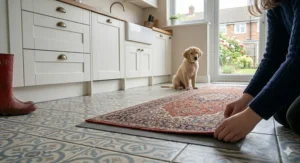
The British climate doesn’t help matters. Between October and March — our wettest months — wet footwear meeting slippery rugs creates the perfect recipe for an embarrassing (or worse, injurious) slide across the kitchen floor. Research shows that around 1,500 people over 65 die every year in the UK as a result of falls in their homes, with loose rugs identified as a major contributory factor. Throw in a couple of energetic pets or young children hurtling around, and that decorative hallway runner becomes less charming accent piece, more health hazard.
What most people overlook about rug grippers is how dramatically home layout affects which solution works best. A runner in a narrow Victorian terrace hallway faces different challenges than a large area rug in an open-plan new build. The floor type matters — wooden floorboards respond differently to adhesives than porcelain tiles — and so does the rug’s backing material. Rubber-backed rugs, for instance, often need entirely different gripper approaches than traditional woven or tufted varieties.
This guide examines seven rug gripper solutions currently available on Amazon.co.uk, focusing on practical performance in British homes rather than marketing claims. We’ll explore which products excel on specific floor types, how British weather affects long-term grip performance, and the real-world trade-offs between convenience, cost, and reliability.
Quick Comparison: Top Rug Grippers at a Glance
| Product | Type | Best For | Price Range | Floor Types |
|---|---|---|---|---|
| DIY Doctor XXL Rug Gripper | Full underlay mat | Large rugs, heavy traffic | £15-£25 | Hard floors, tiles, laminate |
| Gadget Planet Rug Gripper | Corner stickers (4-pack) | Quick fix, rental properties | £5-£10 | Carpets, wood, laminate |
| AYSKTN 12-Pack Anti-Slip | Corner grippers | Multiple small rugs | £8-£12 | Hard floors, wooden, tile |
| DIY Doctor Double Sided Tape | Adhesive tape (20m) | Permanent fixing, stairs | £10-£15 | All hard surfaces |
| Rugs & Stuff Dual Fleece | Dual-surface underlay | Carpets and hard floors | £20-£35 | All surfaces |
| FuKuEn Vacuum Tech Grippers | Reusable pads (8-piece) | Eco-conscious buyers | £6-£10 | Hard floors |
| TEUVO Hook & Loop Tape | Industrial-strength velcro | Heavy rugs, fireplaces | £8-£14 | Carpets primarily |
From the comparison above, budget-conscious buyers will find the most value in corner gripper packs (£5-£12 range), which offer decent performance for light-to-moderate rug movement. However, if you’re dealing with persistent slipping on polished wooden floors or high-traffic areas like hallways and kitchen doorways, the full underlay mats (£15-£35) justify their higher price through superior grip and longer-lasting performance. The tape solutions sit in the middle — excellent for permanent installations on stairs or runners, but less forgiving if you like to rearrange your layout seasonally.
💬 Just one click — help others make better buying decisions too!😊
Top 7 Rug Grippers: Expert Analysis
1. DIY Doctor XXL Rug Gripper — The Workhorse for Large Spaces
The DIY Doctor XXL Rug Gripper arrives as a substantial 200cm x 200cm roll of PVC anti-slip matting with a distinctive open-grid construction. It’s designed for hard floors — laminate, wood, tile, and vinyl — and the XXL designation isn’t marketing fluff; this genuinely covers large area rugs without needing multiple pieces spliced together.
In practical terms, the grid structure matters more than you’d expect. Unlike solid rubber underlays, the perforations allow your rug to breathe and make vacuuming considerably easier — the suction pulls through rather than creating that annoying sealed-vacuum effect that lifts the entire rug. For British homes with underfloor heating, this breathability prevents moisture build-up during our damp autumn and winter months.
The material itself feels substantial — thicker than budget alternatives — and maintains grip even on highly polished wooden floors where cheaper mats tend to slide about defeating their own purpose. UK buyers particularly appreciate that it doesn’t require adhesive; the PVC grips both the floor and rug backing through friction alone, making it ideal for rental properties where permanent solutions aren’t permitted.
Customer feedback from UK Amazon reviews consistently mentions effectiveness on “polished wooden floors” and working well with “two energetic dogs” — the latter being a rather more demanding test than manufacturer specifications typically account for. Several reviewers note it works brilliantly as a mattress topper gripper, which speaks to its versatility beyond rug applications.
Pros:
✅ Covers large rugs (up to 2m x 2m) without seams
✅ Allows vacuum suction through grid construction
✅ No adhesive required — rental-friendly
Cons:
❌ Bulky to store if you need to remove it seasonally
❌ Can be visible if rug edges don’t fully cover it
Around £15-£20 makes this excellent value for large rugs, particularly given that one piece handles what would require multiple smaller mats. For a 3m x 2m lounge rug, you’d need to purchase two and trim to size, but the breathability and no-adhesive convenience justify the investment.
2. Gadget Planet Rug Gripper — Budget Corner Solution
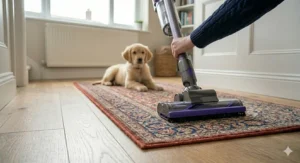
Gadget Planet Rug Gripper comes in a 4-pack of corner grippers designed for carpeted floors, though they function reasonably well on hard surfaces too. Each gripper features gentle plastic spikes on one side that lock into carpet pile, whilst the other side has adhesive to stick to the rug’s underside.
What makes these particularly useful for UK buyers is the “splittable” feature — each gripper can be separated to effectively double your quantity. Rather clever for a budget product, and it means a £6-£8 pack genuinely covers two small rugs or all four corners of a medium runner plus a bathroom mat.
The spikes are described as “gentle yet strong” in the product description, which initially sounds like marketing contradiction but proves accurate in practice. They grip carpet pile without damaging it — important for rental properties or homes with expensive fitted carpets. The adhesive on the rug side holds firmly enough to survive regular foot traffic but can be removed and repositioned if needed.
However, effectiveness varies considerably by carpet type. UK buyers with deep-pile carpets report excellent results, whilst those with low-pile or loop carpets find the grip less impressive. The adhesive also tends to accumulate dust and pet hair over time, reducing stickiness. For British homes, this means more frequent cleaning than you’d expect — perhaps every 4-6 weeks in high-traffic areas.
One UK reviewer mentioned using these in a bathroom, which highlights a common mistake: these aren’t suitable for damp environments. The adhesive loses grip when exposed to moisture, and bathroom humidity will degrade performance within weeks.
Pros:
✅ Splittable design doubles the number of grippers
✅ Budget-friendly for renters
✅ Won’t damage carpet pile
Cons:
❌ Adhesive collects dust and loses grip over time
❌ Less effective on low-pile or loop carpets
At £5-£10, these represent solid value for light-duty applications — bathroom mats, bedside rugs, or low-traffic areas where you want a quick, non-permanent solution. Not ideal for heavy-traffic hallways or if you have pets that constantly rearrange soft furnishings.
3. AYSKTN 12 Anti-Slip Rug Grippers — The Versatile Middle Ground
The AYSKTN 12-Pack Anti-Slip Rug Grippers offers washable, reusable corner pads specifically engineered for hard floors — laminate, wooden, tile, and marble. The 12-piece count gives you enough coverage for multiple rugs throughout a typical British home: perhaps two large area rugs plus a couple of runners or bathroom mats.
These grippers use a dual-texture design: one side grips the floor, the other adheres to the rug backing. Unlike traditional adhesive grippers, these employ a “washable” sticky technology that can be rinsed under water to restore grip — particularly useful in British homes where muddy shoes and wet weather constantly challenge floor cleanliness.
UK reviewers particularly value the washability during winter months. When your hallway runner accumulates road salt, grit, and general British pavement debris, being able to wash the grippers rather than replace them offers genuine long-term savings. One Amazon.co.uk reviewer noted they’d washed theirs “at least a dozen times over eighteen months” with no performance degradation.
The grippers work best on smooth, sealed hard floors. Textured tiles or rough-sawn wooden boards reduce effectiveness — the grip relies on maximum surface contact. British homes with Victorian-era flagstone floors or rustic reclaimed wood may find these less reliable than on modern laminate or engineered wood.
Interestingly, several UK buyers mention using these to secure rugs on stairs and in doorways — high-risk slip zones where rug movement poses genuine injury hazards. NHS Inform Scotland specifically recommends securing carpets and removing loose mats, as uneven surfaces can cause trip hazards, particularly on stairs. The fact that these grippers hold firm in these demanding locations speaks to their effectiveness, though you’d want to use one gripper per stair tread corner rather than relying on just the edges.
Pros:
✅ Washable and reusable — environmentally sound
✅ 12-pack covers multiple rugs throughout the home
✅ Effective on stairs and doorways (high-risk areas)
Cons:
❌ Less reliable on textured or unsealed floors
❌ Requires repositioning after washing as they lose exact placement
Around £8-£12 for 12 pieces offers reasonable value, particularly given the washability factor. If you’re the type who prefers products that last years rather than months, these justify their slightly higher price over disposable corner stickers.
4. DIY Doctor Double Sided Carpet Tape — Permanent Hold Solution
DIY Doctor Double Sided Carpet Tape comes in a 20-metre roll (21mm width) designed for permanent or semi-permanent rug fixing. This is reinforced double-sided tape with “immediate bond strength” — marketing language that, for once, undersells the product. UK buyers consistently report this tape grips so firmly that removing rugs becomes a two-person job.
The tape works on virtually any hard surface: wooden floors, tiles, laminate, ceramic, and even brick or concrete. One UK reviewer used it to secure stair treads, noting it held “firmly in place” through constant daily foot traffic over a year. For British staircases — often narrow, steep, and poorly lit — secure stair runners prevent serious falls.
What distinguishes this from cheaper carpet tapes is the “no residue left” claim, which UK buyers verify is accurate on sealed floors. On wooden floors, provided the varnish or sealant is intact, the tape removes cleanly. However, on older, porous, or damaged wooden floors, some adhesive transfer can occur. Worth testing on an inconspicuous corner before committing to a full rug perimeter.
The immediate bond strength cuts both ways. Whilst excellent for permanent installations, it offers no forgiveness for positioning errors. Once pressed down, repositioning becomes nearly impossible without damaging the tape. For perfectionists or those who like seasonal room rearrangements, this inflexibility proves frustrating.
British buyers using this for outdoor applications (covered porches, conservatories) report mixed results. The adhesive holds in dry conditions but moisture exposure — even just British humidity — eventually compromises the bond. Indoor-only use is recommended.
Pros:
✅ Extremely strong, immediate bond
✅ 20-metre roll covers substantial rug perimeters
✅ No residue on sealed floors
Cons:
❌ Too strong for temporary installations
❌ Difficult to reposition once applied
At £10-£15 for 20 metres, this represents excellent value for permanent installations — stair runners, hallway rugs in rental properties (where underlay mats might violate lease terms), or anywhere rug movement poses genuine safety concerns. Not suitable if you like flexibility.
5. Rugs & Stuff Dual Fleece Underlay — The Premium All-Rounder
The Rugs & Stuff Dual Fleece Underlay uses 130g per square metre polyester fleece impregnated with acrylic resin to create a dual-sided grip surface. One side (black) grips carpets; the other (grey) adheres to hard floors. This versatility makes it particularly valuable for British homes with mixed flooring — perhaps carpeted bedrooms but tiled hallways and wooden lounge floors.
The dual-surface functionality isn’t just marketing gimmickry. If you move house (Britons relocate every 23 years on average, though younger generations move more frequently), this underlay travels with you regardless of the new property’s flooring type. Simply flip it to suit the new surface. Given the £20-£35 price range for larger sizes, this longevity offers genuine value.
UK buyers particularly value the machine washability at 40°C — though the instructions specify water only, no detergent. During British winter, when shoes track in mud, road salt, and general grime, being able to wash the underlay maintains both hygiene and grip performance. Several Amazon.co.uk reviewers mention washing theirs “every few months” to restore tackiness.
The 2.2mm thickness adds a subtle cushioning effect that’s particularly welcome on hard, cold British floors. It’s not marketed as insulation, but that slight padding makes bare-foot morning trips across wooden floors marginally less shocking during January cold snaps. One reviewer described it as “barely noticeable underfoot but definitely takes the edge off cold tiles.”
However, this underlay is explicitly not effective with rubber-backed rugs — the manufacturer states this clearly. Many cheaper rugs sold on UK high streets use rubber backing, so check your rug’s construction before purchasing. Natural fibre rugs (jute, sisal, wool) work brilliantly; synthetic rubber-backed bathroom mats do not.
Pros:
✅ Dual-sided design works on all floor types
✅ Machine washable to restore grip
✅ Adds subtle cushioning on hard floors
Cons:
❌ Premium pricing (£20-£35 range)
❌ Ineffective with rubber-backed rugs
For the £20-£35 price bracket, this offers excellent long-term value if you have multiple floor types or anticipate moving house. The washability and surface versatility justify the higher cost over cheaper, single-surface alternatives. However, budget buyers with consistent flooring throughout their home might find better value in surface-specific options.
6. FuKuEn Vacuum Tech Grippers — Reusable Technology
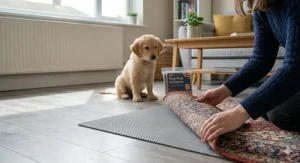
FuKuEn Vacuum Tech Grippers employ what the manufacturer describes as “vacuum technology” — a slightly misleading term for strong suction-cup-style adhesion that doesn’t actually require vacuum equipment. The 8-piece set comprises reusable corner pads (10cm x 10cm each) designed for hard floors.
The “vacuum tech” moniker refers to how these pads create micro-suction between surfaces. Unlike adhesive grippers that lose stickiness as they collect dust, these maintain grip through thousands of contact/lift cycles. UK buyers report washing them weekly during muddy British winter months without performance loss.
What makes these particularly relevant for British buyers is their compatibility with underfloor heating — increasingly common in UK new builds and renovations. Traditional adhesive grippers can degrade under sustained heat, whilst these reusable pads remain unaffected. One UK reviewer specifically mentioned using them “over underfloor heating in the bathroom” with no issues after six months.
The 10cm x 10cm size might seem generous for corner grippers, but UK buyers note this larger footprint distributes force better than smaller pads. When a pet launches across a rug or a child uses it as a skating rink, the larger surface area prevents that corner-peeling-up effect that smaller grippers allow.
However, effectiveness drops markedly on textured or unsealed floors. Victorian terracotta tiles, slate, or rough wooden boards don’t provide the smooth surface these grippers require for maximum suction. They’re engineered for modern, sealed hard floors — think laminate, ceramic, or varnished wood.
Pros:
✅ Reusable and washable — environmentally conscious
✅ Compatible with underfloor heating
✅ Larger 10cm size distributes force better
Cons:
❌ Requires smooth, sealed floors for optimal performance
❌ More expensive per gripper than disposable alternatives
At £6-£10 for 8 pieces, these offer reasonable value for eco-conscious buyers prioritising reusability. If you’re the type who’d rather wash and reuse than constantly replace disposable products, the convenience justifies the marginally higher per-unit cost.
7. TEUVO Hook & Loop Tape — Industrial Strength for Carpets
The TEUVO Hook & Loop Tape takes a fundamentally different approach: heavy-duty velcro strips that adhere to both rug backing and carpet pile. UK buyers on Mumsnet forums consistently cite this as “the only thing that worked” for rugs on top of fitted carpets — a notoriously difficult surface for traditional grippers.
The system uses industrial-strength adhesive on both velcro sides: one strip sticks to the rug’s underside, the other to the carpet. When pressed together, the hook-and-loop mechanism creates a bond that UK reviewers describe as borderline permanent. One Mumsnet user reported it held firm “even with DH sprawling all over it” (for non-British readers: DH = Dear Husband in UK parenting forum parlance).
This aggressive grip makes it ideal for high-stress applications: rugs in front of fireplaces (where constant foot traffic combined with heat challenges most grippers), sofa cushions that perpetually migrate (several UK buyers repurpose it for this), or rugs in homes with large, energetic pets.
However, the “industrial strength” descriptor carries warnings. Removal can damage both the rug backing and carpet pile, particularly on older or delicate carpets. One UK reviewer mentioned it “almost put my back out trying to chisel it off” when relocating, and noted some wooden floor sealant came away with it. This isn’t a solution for rental properties or if you like seasonal room rearrangements.
The tape also requires smooth surfaces. Tufted or deep-pile carpets reduce contact area, weakening the velcro bond. It’s engineered for low-to-medium pile fitted carpets — the standard in most British homes — rather than shag or frieze styles.
Pros:
✅ Industrial-strength hold — genuinely permanent
✅ Effective on the challenging rug-on-carpet scenario
✅ Multi-purpose (sofa cushions, car boot liners)
Cons:
❌ Removal can damage floors and rug backing
❌ Too aggressive for temporary or seasonal use
Around £8-£14 makes this competitively priced for what amounts to a permanent fixing solution. If you’ve tried everything else and your hallway rug still creeps daily towards the front door, this nuclear option delivers results. Just commit to its permanence before application.
Real-World Scenario Guide: Which Gripper for Your Situation
The Victorian Terrace Hallway
Narrow, high-traffic, often tiled or wooden floors, with limited natural light. You need a runner that won’t bunch up when the post arrives or create a trip hazard in dim morning light.
Recommended: DIY Doctor Double Sided Carpet Tape for permanent installation, or DIY Doctor XXL Rug Gripper if your landlord prohibits adhesives. The tape offers maximum security in this high-risk slip zone, whilst the XXL gripper provides strong hold without floor commitment.
Why not corner grippers? The constant, directional foot traffic in hallways causes progressive creep that corner grippers can’t fully prevent. You need continuous perimeter fixing.
The Open-Plan Kitchen Diner
Large area rug defining the dining space, sitting on laminate or tiled flooring. Chairs constantly sliding on/off the rug, plus regular foot traffic from kitchen to dining table. Possible underfloor heating.
Recommended: Rugs & Stuff Dual Fleece Underlay for its cushioning, grip, and underfloor heating compatibility. The washability matters here too — kitchen areas accumulate spills and crumbs that compromise cheaper grippers within weeks.
Why not adhesive solutions? Dining chairs grinding adhesive tape into laminate creates sticky residue that attracts dirt. Full underlay mats distribute this stress across the entire rug surface.
The Rented Flat Bathroom
Small bathroom mat on ceramic tiles, high moisture environment, landlord prohibits anything that might damage surfaces. The mat needs to stay put when stepping out of the shower, but you’ll want to remove it for deep cleaning.
Recommended: FuKuEn Vacuum Tech Grippers for their reusability, easy removal, and moisture resistance. Alternatively, AYSKTN grippers if budget is tight — their washability matters in the damp bathroom environment.
Why not tape? Adhesive grippers degrade rapidly in humid environments. Plus, you’ll want to lift the mat regularly for cleaning underneath — something permanent tape solutions don’t accommodate.
The Family Lounge with Pets
Large rug in front of the fireplace and sofa, constant pet traffic (two dogs mentioned in our research), possible children using it as a play surface. Either carpeted or wooden floors.
Hard floor version: DIY Doctor XXL Rug Gripper for its substantial grip and breathability (important when pets lie on it for hours).
Carpet version: TEUVO Hook & Loop Tape if you’re committed to permanent installation and pet-induced rug migration is driving you mad. This is the “nuclear option” that UK Mumsnet forums swear by for persistent problems.
Why not budget corner grippers? Pets and children create multi-directional stress that peels corners up. You need either full-surface grip or industrial-strength corner fixing.
Common Mistakes When Buying Rug Grippers (And How to Avoid Them)
Mistake 1: Ignoring Floor Surface Texture
Many UK buyers purchase based on floor type (wood, tile, carpet) without considering surface texture. A “wooden floor gripper” works brilliantly on smooth, varnished engineered wood but fails miserably on rough-sawn reclaimed boards.
The fix: Before buying, run your hand across your floor. If it feels rough, textured, or unsealed, standard adhesive or vacuum-tech grippers won’t maintain contact. Look for mechanical solutions like hook-and-loop systems or full rubber mats that mould to irregularities.
Mistake 2: Underestimating British Weather Impact
British homes experience dramatic seasonal humidity shifts: damp, cold winters followed by (occasionally) warm, dry summers. Adhesive grippers that work perfectly in July often fail by October when moisture undermines their bond. Public Health England research on preventing unintentional injuries in homes highlights environmental factors that contribute to accidents, including moisture and temperature variations affecting home safety equipment.
The fix: Prioritise reusable, washable grippers if you live in particularly damp regions (Scotland, Wales, Northern England, coastal areas). These can be cleaned and re-applied as seasons change, rather than requiring replacement when adhesive degrades.
Mistake 3: Buying Corner Grippers for Directional Traffic
Hallway runners experience constant, directional foot traffic — always pushing the rug in the same direction. Corner grippers prevent lifting but don’t stop progressive creep. Within weeks, your runner has migrated 30cm towards the front door. NI Direct’s home safety guidance specifically warns that falls are by far the most common home accidents, and securing loose-fitting rugs is essential to avoid trips and falls.
The fix: High-traffic, directional areas (hallways, stairs) require perimeter fixing — either full underlay mats or tape around all edges. Corner grippers work for multi-directional traffic (lounge areas, bedrooms) but not linear pathways.
Mistake 4: Forgetting About Rug Backing Material
Rubber-backed rugs won’t grip dual-fleece underlays — the two rubber surfaces slide against each other. Conversely, delicate antique rugs with loose weaves can be damaged by aggressive adhesive grippers.
The fix: Check your rug’s backing before purchasing grippers. Natural fibre rugs (wool, jute, sisal) work with virtually any gripper type. Rubber-backed rugs need mechanical solutions (tape, hook-and-loop) rather than friction-based underlays.
Mistake 5: Overlooking Rental Agreement Restrictions
Permanent adhesive tape violates most UK rental agreements, particularly on wooden floors. Yet it’s the most effective solution for many applications, tempting renters to use it anyway.
The fix: If renting, default to non-adhesive solutions: full rubber underlays, reusable vacuum-tech grippers, or removable corner pads. Document their removable nature if your landlord queries them during inspections.
How to Choose the Right Rug Gripper for British Homes
Step 1: Identify Your Floor Type and Condition
Not just “wood” or “tile,” but specifically: Is it sealed or porous? Smooth or textured? New or aged? Victorian flagstone behaves nothing like modern ceramic. Reclaimed scaffolding boards differ from engineered oak.
Test by pressing your thumb firmly against the floor. If it leaves a visible moisture print that evaporates within seconds, the surface is sealed and suitable for most grippers. If no print appears or it persists, the floor is either super-smooth (requiring maximum-grip solutions) or porous (needing mechanical rather than adhesive fixing).
Step 2: Assess Traffic Patterns and Stress Points
Walk your usual routes through the room, noting where feet consistently contact the rug. Hallways receive linear, directional traffic. Lounges get multi-directional use. Bathroom mats face perpendicular stress as you step on/off.
High-stress areas need industrial-strength solutions. Low-traffic zones can use budget-friendly corner grippers. Moderate areas benefit from full underlays that distribute stress evenly.
Step 3: Consider Your Commitment Level
Are you in a forever home or a two-year rental? Do you rearrange furniture seasonally or is this rug’s position fixed?
Permanent situations justify aggressive solutions like double-sided tape or hook-and-loop systems. Temporary scenarios need reversible options: reusable grippers, non-adhesive mats, or removable corner pads.
Step 4: Factor in British Climate and Indoor Conditions
Do you have underfloor heating? Is this a bathroom or kitchen with high moisture? Is the room north-facing and damp, or south-facing and dry?
Moisture-prone areas need washable, reusable grippers that won’t degrade in humidity. Heated floors require heat-resistant materials. Damp rooms benefit from breathable grid-construction mats that prevent mould accumulation.
Step 5: Budget Realistically Over Time
A £6 pack of corner grippers seems cheaper than a £25 underlay mat, but if you replace them every six months versus the mat lasting five years, the economics shift dramatically.
Calculate cost-per-year rather than upfront price. Reusable, washable solutions often offer better long-term value despite higher initial cost. However, if you’re renting short-term, upfront cost might legitimately matter more than longevity.
Rug Gripper Maintenance for UK Weather Conditions
British weather tests rug grippers year-round. Summer humidity, autumn dampness, winter wet footwear, and spring allergies (bringing increased vacuuming) all impact gripper performance.
Autumn/Winter Care (October–March)
This is peak challenge season. Wet shoes track in moisture, road salt, and grit. Central heating creates temperature differentials between floors and rugs, potentially weakening adhesive bonds.
Monthly maintenance: Lift rugs and clean both the floor and gripper surfaces. For reusable grippers, wash in lukewarm water and air-dry completely before reapplying. For adhesive types, wipe accumulated grit from edges to maintain stickiness.
Wet entry areas: Consider rotating to a waterproof mat during peak wet months (November–February), preserving your decorative rug for drier seasons. Alternatively, use heavy-duty rubber-backed mats that don’t require grippers over main entrance areas during winter.
Spring Cleaning (April–May)
Post-winter deep clean is when you’ll discover which grippers survived and which need replacement.
Full reset: Remove all rugs, vacuum thoroughly (including under grippers), wash reusable grippers, assess whether adhesive types need replacing. This is also when you’d rotate rugs to distribute wear patterns.
UV exposure: If your grippers are visible at rug edges, spring sunshine can degrade certain plastics and adhesives. Ensure rugs fully cover gripper edges or choose UV-resistant materials.
Summer Maintenance (June–September)
Relatively easy season for grippers. Dry conditions mean less moisture challenges, though increased foot traffic (children home from school, summer visitors) can accelerate wear.
Dust control: Summer pollen and dust infiltrate British homes despite closed windows. Vacuum more frequently to prevent gripper surfaces accumulating particles that reduce friction.
Long-Term Cost Analysis: Budget vs Premium Grippers
Budget Option: Gadget Planet Corner Grippers (£6 for 4-pack)
Year 1: £6 initial purchase
Year 2: £6 replacement (adhesive degrades)
Year 3: £6 replacement
Year 4: £6 replacement
Year 5: £6 replacement
Five-year total: £30
Pros: Low upfront cost, easy to replace
Cons: Ongoing purchases, accumulating waste, inconsistent performance
Mid-Range Option: AYSKTN 12-Pack (£10)
Year 1: £10 initial purchase
Year 2: £0 (washable, still functional)
Year 3: £10 replacement (eventually wear out)
Year 4: £0
Year 5: £10 replacement
Five-year total: £30
Pros: Washable extends lifespan, 12-pack covers multiple rugs
Cons: Requires maintenance (washing), performance varies by floor type
Premium Option: DIY Doctor XXL Underlay (£20)
Year 1: £20 initial purchase
Year 2-5: £0 (mat lasts years with proper care)
Five-year total: £20
Pros: Lowest long-term cost, consistent performance, no replacements
Cons: Higher upfront cost, bulky storage if removed seasonally
The mathematics favour premium options for permanent installations, but budget grippers make sense for short-term rentals or experimental rug placements where you’re not committed to position or style.
UK-Specific Regulations and Safety Standards
The British safety landscape treats rug safety seriously, particularly in commercial and care environments, though these standards inform best practice for domestic settings.
Workplace (Health, Safety and Welfare) Regulations 1992
Whilst primarily governing commercial premises, these regulations establish that floors must be “suitable, in good condition and properly maintained so people can move around safely.” Loose rugs creating slip hazards violate this standard.
For home offices or domestic businesses operating from residential properties, these regulations technically apply. Securing rugs with appropriate grippers isn’t optional — it’s a legal requirement.
Building Regulations Part M (Access to and Use of Buildings)
Although not explicitly mentioning rug grippers, Part M addresses trip hazards and accessibility. In domestic settings, this primarily impacts adaptations for disabled residents, but the principle — eliminating avoidable trip hazards — applies universally.
If you’re claiming disability benefits or have adapted your home for accessibility, unsecured rugs potentially violate the safety standards underlying those adaptations.
British Standard BS 5181 (Carpet Care)
This standard addresses carpet maintenance, including securing methods for rugs and mats. It recommends underlays or fixing systems for any rug in high-traffic areas or where vulnerable users (children, elderly, disabled) navigate.
Insurance Implications
UK home insurance policies increasingly scrutinise slip and trip claims. If someone injures themselves on an unsecured rug in your home, insurers may reduce or deny claims if they determine you failed to take “reasonable precautions.”
“Reasonable precautions” isn’t legally defined, but industry practice suggests basic rug grippers would be considered minimal due diligence. This applies particularly if you regularly host guests or operate a home business.
Frequently Asked Questions
❓ Do rug grippers work on all floor types in the UK?
❓ How long do rug grippers typically last in British homes?
❓ Can I use rug grippers on carpets or only hard floors?
❓ Are rug grippers safe to use with underfloor heating?
❓ Will rug grippers damage my wooden floors or leave residue?
Final Verdict: Which Rug Gripper Suits British Homes Best?
After examining seven solutions across varying floor types, traffic patterns, and British environmental conditions, the standout recommendation depends entirely on your specific situation.
For most British homeowners seeking versatile, long-term value, the DIY Doctor XXL Rug Gripper offers the best balance of performance, cost, and convenience. Its no-adhesive design respects rental agreements, the breathable grid construction suits British humidity, and the XXL sizing eliminates the need for multiple pieces. At £15-£20, it’s not the cheapest option, but the five-year-plus lifespan makes it the most economical choice for permanent rug placements.
Budget-conscious renters or those testing rug positions should look at Gadget Planet Corner Grippers (£5-£10) or AYSKTN 12-Pack (£8-£12). The splittable design of the former doubles your gripper count, whilst the washability of the latter extends lifespan beyond typical disposable corner pads.
Homes with mixed flooring benefit from Rugs & Stuff Dual Fleece Underlay (£20-£35). Yes, it’s premium pricing, but the dual-sided design, machine washability, and underfloor heating compatibility justify the investment for anyone with both carpeted and hard-floored rooms.
The persistent rug-on-carpet problem — notoriously difficult to solve — finds its match in TEUVO Hook & Loop Tape (£8-£14). UK forum discussions consistently cite this as “the only thing that worked,” though be prepared for its aggressive, near-permanent bond.
What’s striking across all UK buyer feedback is how often “I wish I’d bought this sooner” appears in reviews. The annual cost of replacing cheap grippers, the daily frustration of repositioning rugs, and the genuine injury risk in high-traffic areas all outweigh the modest investment in proper rug securing.
British homes face unique challenges: compact layouts increasing collision risk, year-round damp undermining adhesives, and frequent rental restrictions limiting fixing options. The grippers reviewed here specifically address these British realities, making them considerably more relevant than generic US-market products that assume different flooring, climate, and housing conditions.
Recommended for You
- 7 Best Affordable Area Rugs 240×340 That Transform UK Homes (2026)
- Large Rugs UK 200×300: 7 Best Extra Large Living Room Rugs 2026
- 7 Best Affordable Washable Rugs Under £100 UK 2026 Reviews
Disclaimer: This article contains affiliate links. As an Amazon Associate, I earn from qualifying purchases. If you purchase products through these links, we may earn a small commission at no additional cost to you.
✨ Found this helpful? Share it with your mates! 💬🤗
